Whistory
As obscure as whistle collecting is, information about the actual whistle makers is even more so. In this context we are referring to manufacturers that made production whistles as a business or at the least specialized in them, as part of their overall business. Alfred De Courcy is well known as a whistle maker and yet in general, we still know little about the extent of his early whistle making, before he officially started up the Police Whistle Works, circa 1904 (one other ad has Thunderer Whistle Works. – 1908)
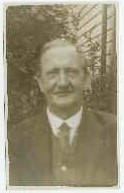
What year would be the breakpoint for De Courcy?
His patents/designs were mainly from 1905 forward from Frankfort Street, — whereas he went on his own about 17 years earlier. After leaving Hudson’s as a foreman at the age of 23, he formed his own company and made whistles from 1888 to 1927. He had trained for 5 years there. Much like Joseph Hudson who trained at Bent and Parker, he left and started from scratch, and little is known about these years before 1904. He was in close association with his brother Edgar during this time and through at least 1906.
What was the early Dowler connection to De Courcy?
With further research in Collecting Police Whistles, page 60, 61 & 62, it becomes clear that Alfred left Hudson to start his own whistle business, the same year as William Dowler passed away, we can surmise that Dowler’s company would back him,?maybe even depend on him. Gilchrist goes on to state that ‘it is probable that Alfred had come to an agreement with them allowing him to manufacture whistles using their equipment’ (italics added). Perhaps they approached him for making their whistles? No wonder Hudson panicked.
MG calls it circumstantial evidence and refers to pointing toward an arrangement between Dowler & Co. and Alfred De Courcy. The timing is more than coincidental, MG then postulates him leasing whistle making equipment, or even employed, —- possibly as a foreman.
Coinciding with this, Alfred started his own company and within 2 years of leaving in 1888 he is listed in a trade directory (1890). He also registered for a round whistle design that same year (1890).
Perhaps he was double-dipping while he built up his own equipment and business? Or was the agreement including leaving to go on his own, taking the whistle equipment?
Thereafter Alfred moves to Frankfort St the same year as Dowler & Co.?’ceases production’ of whistles (1904).
It certainly would have?made sense if Alfred had been?working here, or even running whistle production, it would be even necessary for Dowler & Co. to make an adjustment in 1904.
A question for further research is when did De Courcy make the tubular whistles with cast small mouthpieces. Dowler wide mouthpieces were much larger by comparison.
Many years later in 1905, two years after Henry Arthur Ward had passed away, Alfred was brought to court over the name Thunderer, by Hudson. The claim was that De Courcy had infringed by using the name Thunderer on escargots of ‘substantially of the original’ (1884). Henry’s son testified on Alfred’s behalf. One can read more in Collecting Police Whistles, by Martyn Gilchrist.
The Focus of Our De Courcy Spotlight
In this SPOTLIGHT and a later one, we are endeavoring to look in some detail at the scope of a whistle designer who lasted from 1888 to 1927 and passing on some earned credit. To do so, we are to note two periods to Alfred’s whistle making…
1) 1888 to 1903 – early years
2) 1904 to 1927 – later years
Why do we say so? Although Alfred De Courcy left Hudson’s to start his own business in 1888, he didn’t start stamping his name on his whistles till 1905-6. That left a period of 17 years of many unidentified whistles.
What difficulties would there be in differentiating De Courcy whistles?
Making things even more difficult is that there would be a natural overlap of construction techniques, Gilchrist on page 62 of Collecting Police Whistles states that there was infringement. After all he was a FOREMAN for Hudson’ s whistles. So expectedly there would be difficulties differentiating some of his whistles from their whistles. Perhaps there are some infringements in both ways.
Whistle Classification
| Type | duplex heavy combination flat combo rounds conical tapered escargot tubular angled mouth duplex spherical? |
| Maker | De Courcy, Alfred |
| Category | civil police railway fire brigade military scout sports prisons |
| Material | nickel plated brass steel and brass brass nickel silver |
| Features | Porteous tops |
Whistle Archeology
Edgar De Courcy
An advertisement (1908) states he was established in 1888 and making whistles after leaving Hudson’s, apparently working with his brother Edgar. Edgar De Courcy is listed as a brass founder in 1901. Eventually he had two patents taken out in his name, 3725/1906 for a tube shaped and 9499/1905 for a penknife.
This corrects information stating that Alfred patented these whistles. Surely Edgar’s brass skills helped in their manufacturing. His patents were circa 1905-6 and he had a daughter in 1911. They also lived close by each other. How much they worked together is unknown.
Previously, and worthy of extra consideration is that Alfred registered a remarkable RIBBED designed round whistle in 1890, shortly after leaving Hudson’s, of which two models can be seen on page 39 of More Whistles as well as the larger model pictured below.
His earliest tubular whistles and POLICE whistles were with cast mouthpieces. This did not change until the retooling at Frankfurt Street circa 1904.
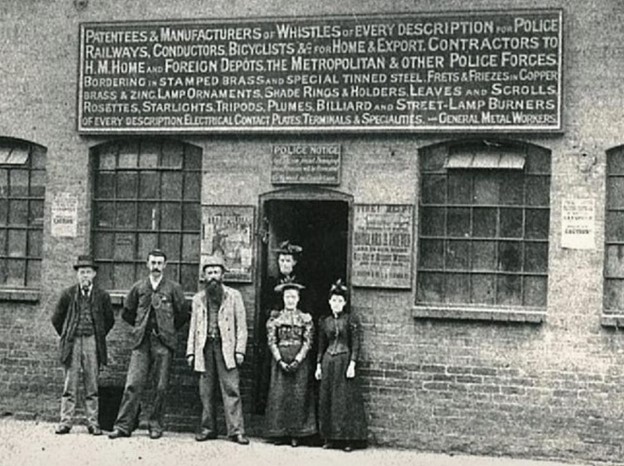
Police Whistle Works (later De Courcy & Co.)
His move from 28 1/2 Mary Street to Frankfort was for growth and a named business. The Police Whistle His move from 28 1/2 Mary Street to Frankfort was for growth and a named business. The Police Whistle Works. (later De Courcy & Co.) 1904. Gilchrist touches on the timing of Dowler stopping production of whistles at this time coinciding with Alfred’s opening his business at this location. Both Hudson and De Courcy made whistles for Dowler at this time, but only Alfred using Dowler’s equipment.
Thus known, along with pictures of his whistles held in current collections indicates this to be true — that he was regularly making whistles during this early period. Please note the two pictured knife whistles (different ring caps) on page 69 of CPWs (Collecting Police Whistles) by Martyn Gilchrist –dated to the 1905 patent. However, accurately dating any of his whistles earlier than 1905 becomes precarious, so we will date them c.1888-1904. Whistles by Alfred are still surfacing and adding to the overall picture.
Wikipedia states “prior to this year (he) supplied many orders to railway, Police, Army, Navy, Asylums, Fire Brigades, sporting goods companies, arm distributors and hardware stores as well as for other makers as W Dowler & Sons and B Lily & Sons.” –—- in substantiated
We know of no written records or many examples to substantiate this generalization. Whistles from these lost years remain rather rare. No Asylum whistles are known, his boatswain pipes were patented 10 years later, nor whistles for B Lilly. No dated military whistles are known.
Catalogs do exist but are rare and are not posted yet. Some whistles are readily available from 1904 onward like whistles made for Dowler, military, and police, while others are rare or not even known to exist yet prior to 1904. Police/fire, fire brigade suppliers exist, but no named fire brigades’ whistles. However quite a few others have been gathered into collections with various stamps and are substantiating railway, sporting goods, police, and military.
Since all the records from Alfred’s whistle business were burned years ago (1969 – Gilchrist), it is a matter of documentation from old trade catalogs, advertisements (yet unpublished), finding pictures of his whistles in collections and museums and city records, advertisements and the like. It is a reconstruction work.
Family tree notes (not always accurate):
- Father – John Williams De Courcy.
- Mother – Susanna Ridding.
- 4 sisters and two brothers.
- 1867 year of birth
- 1883 goes to work at 17 for Hudson’s (coincidental with Hudson’s first large order)
- 1888 leaves Hudson starts his own business at 28 ½ Mary Street
- 1890 marries Mary Ann Condren
- 1891 living at No9 Court House 1, Villa Street, has 3 girls and 1 boy.
- 1901 Edgar working as brass founder, living 4 Carlyle Road, in Lozells, Aston Manor
- 1904 moves business to 20 Frankfort St
- 1924 moves to Orphanage Rd.
- 1927 sells to Hudson whistle part of company
- 1931 dies of peritonitis, Birmingham General Hospital
This SPOTLIGHT falls on Alfred’s early ‘lost’ years, and more succinctly, the variety and workmanship of a very talented whistle manufacturer from 1888 to 1904, which continued into his later years.
Interestingly Alfred did not utilize tines for his partitions.
| Patent # | Year | Title |
|---|---|---|
| 9499 | 1905 | Call combined with a penknife |
| 20619 | 1905 | 4 Piece + top fitting London style escargot-type |
| 3725 | 1906 | Diaphragm & Partition |
Whistology
First up let’s look at More Whistles on page 73 top right. It shows a spherical whistle with spokes as being by A. De Courcy. (this follows up a picture in Whistles page 19 where there is a question mark, now removed) It is an early looking design, but not dated. We have not seen it ‘in hand’, so we will for now follow Martyn’s lead and go with his judgment from years of examining whistles there in the UK. Logically it would be a cycling whistle and would place it circa 1900. You will need the book to see it as we cannot violate copyrights and show it to you. Ball shaped with a small tube protruding at the top edge. Plastic construction.
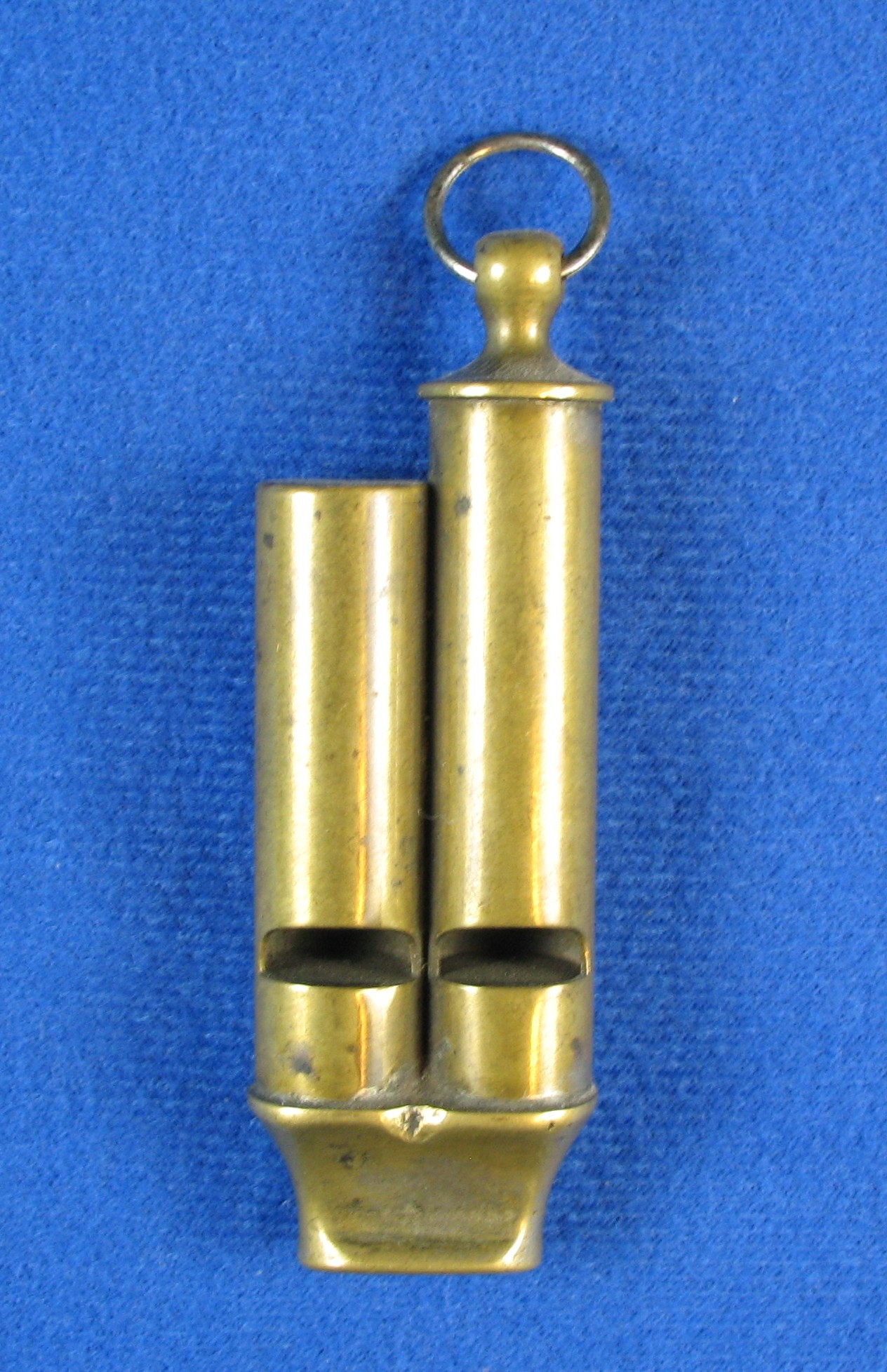
Next up we peer at a dual tube (in-line) heavy wall whistle of plated brass. It has one knop on the longest tube. These typically were also made prior to 1900 by Ward, Barrall but only 3 by Hudson.
We note the wider ‘arched’ openings to the windows (left) — typical of De Courcy (as did Hudson and Ward). Indeed, Alfred took his whistle skills with him from Hudson’s. Perhaps due to his training at Hudson’s his whistles and theirs are hard to differentiate in this respect.
That is also true of the combination whistle here (right) that would seem to be Hudson. However, due to the round whistle design, the diaphragm, etc., we are assigning it to Alfred. Perhaps all that training as a young man contributed to Alfred’s appetite for variety and of course what he saw at Hudson’s factory being possible to make.
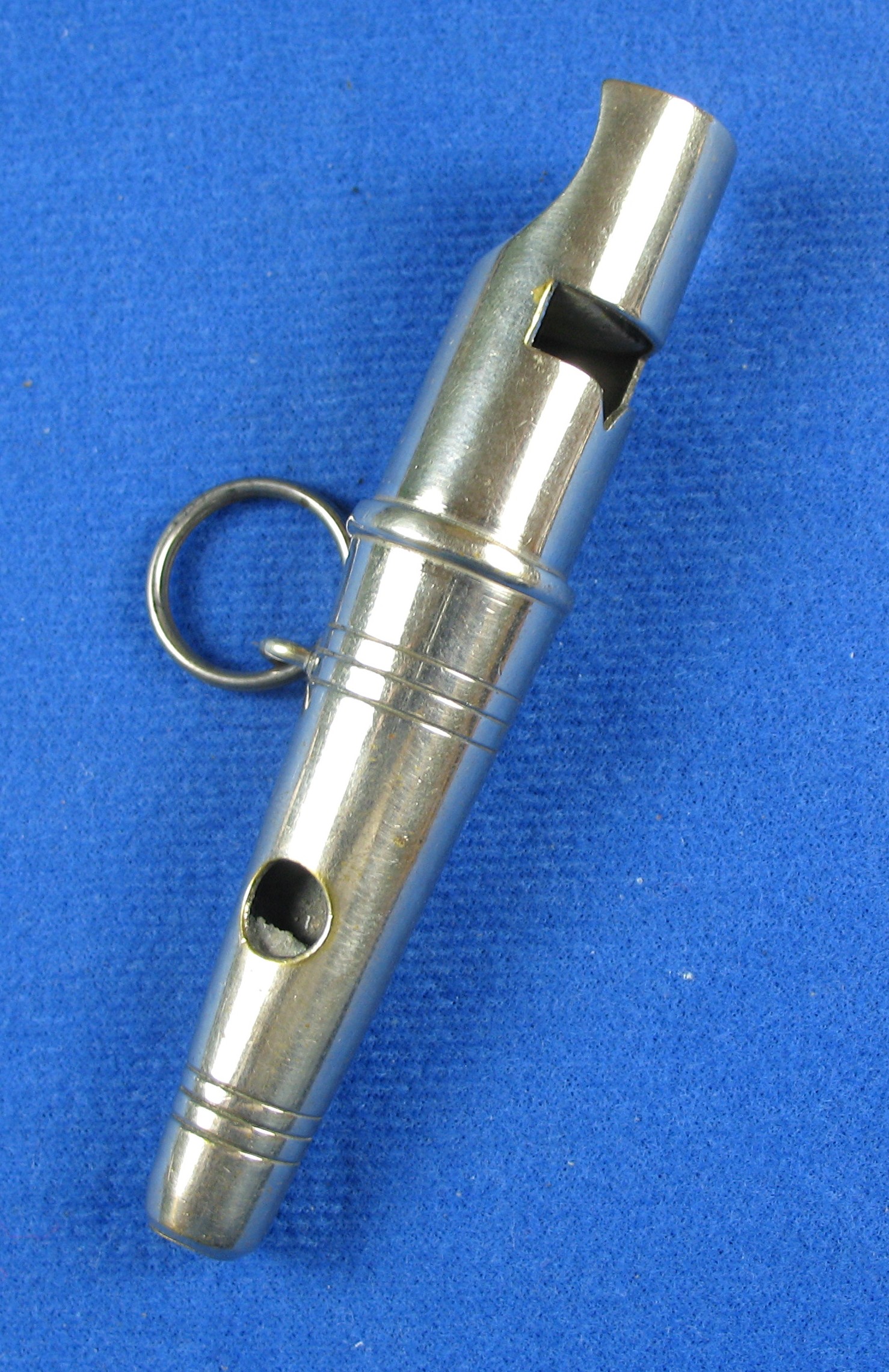
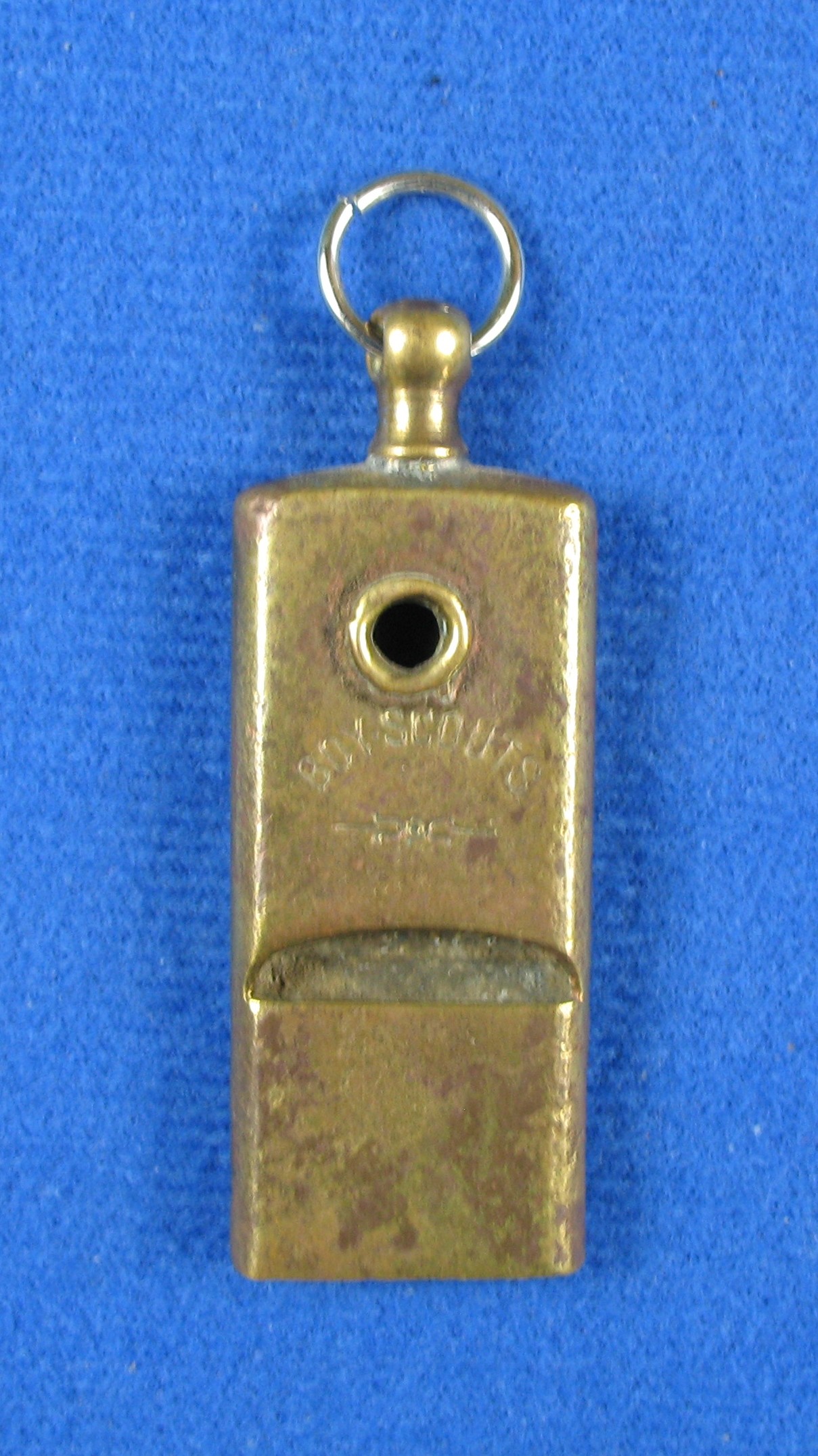
Let’s look away again to the second whistle in More Whistles that was pictured with the cycling whistle and that is a flat scout whistle. Martyn questionably dates his there to the late 1890s to early 1900s. The scout movement was under way about the unofficial start date of 1907 under Baden Powell, 1909 in the states.
Sometimes referred to as vest or pocket whistles too, they come with scout stamps most often.
On the right is another radical turn to a unique ‘outside the box’ idea — a De Courcy designed pen knife combination patented 1905 by Edgar De Courcy. Combination (‘gadget’ – Gilchrist) whistles had been seen for decades prior by other makers.
Consequently, there were vestas, extractors, corkscrews, even knives and more. However, he did made a knife with a whistle (Hudson). He reversed this and made a whistle with a knife inside it, and innovative, so much so that Hudson patented another model 2 years later and eventually bought the rights to his later.
This was innovative and at the beginning of his second phase from Frankfort St.
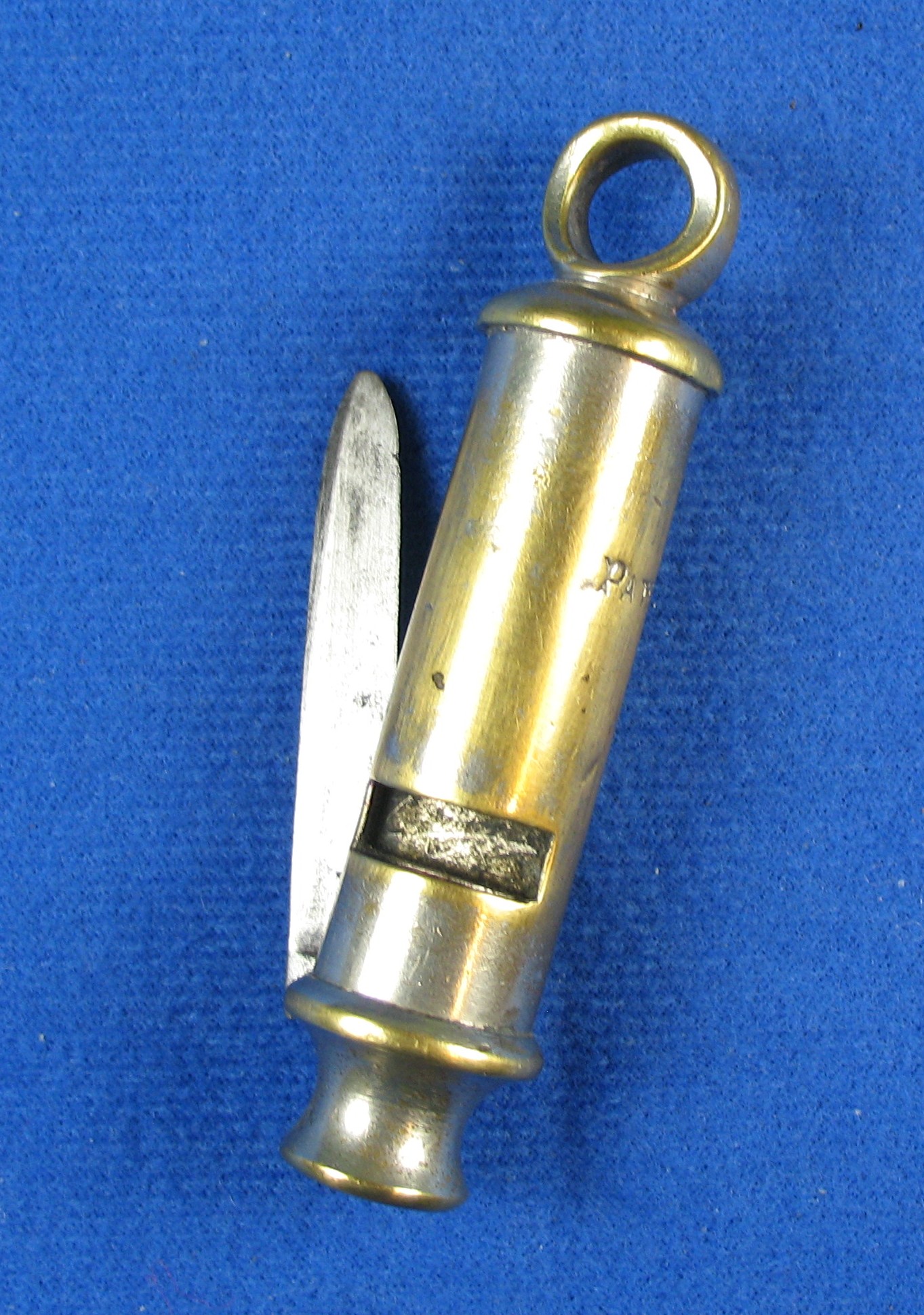
Continuing down, we come to a more difficult area than even the overlap of construction lines between Hudson and De Courcy.
Prior to the early years of Alfred’s whistle making was Henry Arthur Ward. One of the more obscure, but accomplished manufacturers of circa 1880 whistles also from Birmingham. A later court case reveals that Ward was ordering from De Courcy Thunderer escargots during these early years.
Formerly we had thought that the primary use of the window on rounds with wider arching windows was restricted to Hudson and De Courcy. H.A.W., also utilized them, along with square and lower arching windows at least on his round whistles. This makes it more slightly difficult assigning whistles to the right maker.
After leaving Hudson Co in 1888 two years later, Alfred registered this round design model 97 ½ and a smaller model (158176)
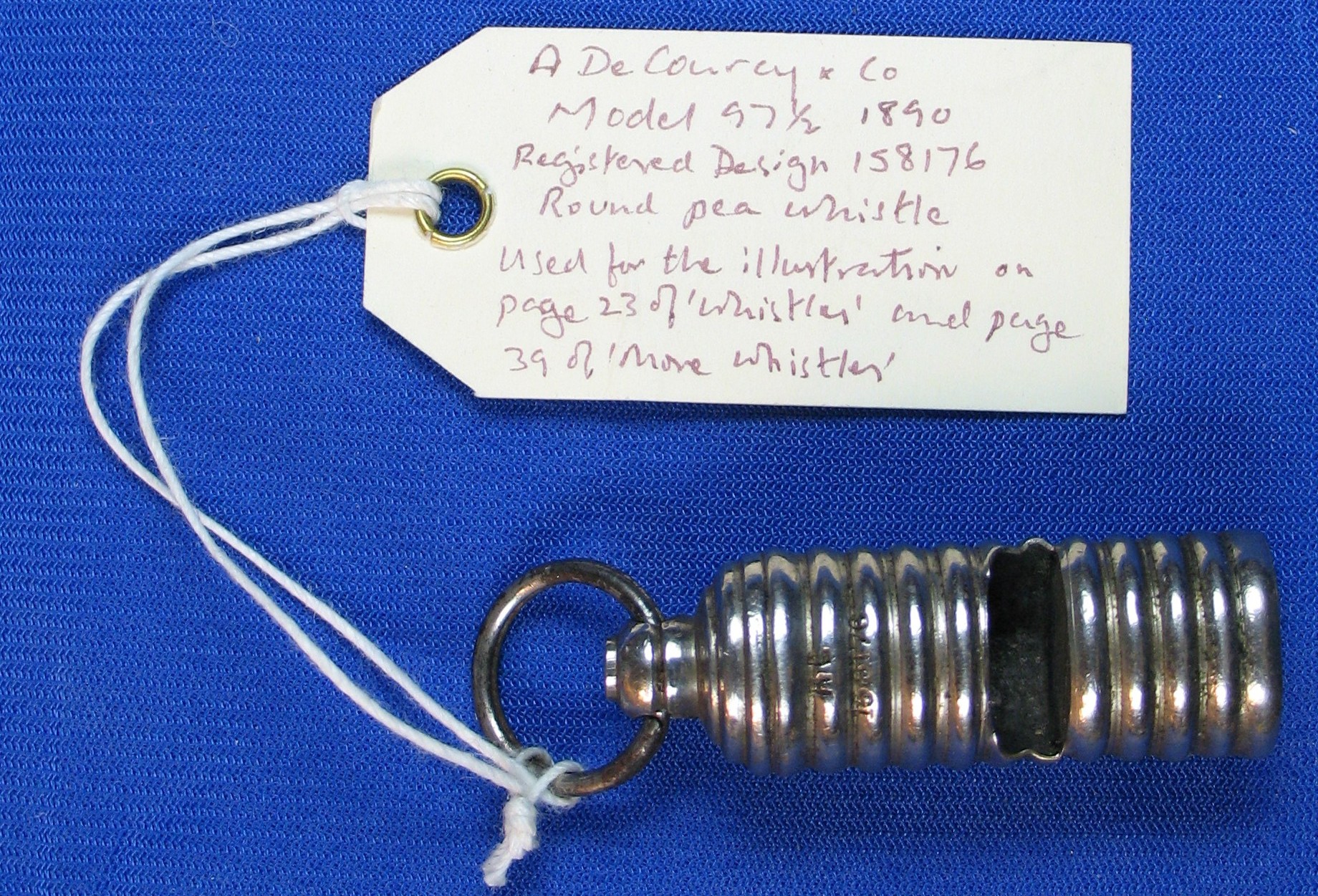
To see the smaller model see page 39 of More Whistles, the bottom right picture.
1890 De Courcy appears in a trade directory.
Gilchrist reports that he was listed in a trade directory that year as a whistle manufacturer and that it would take a year or two to get published in the trade directory, meaning that he was already making whistles right from the start.
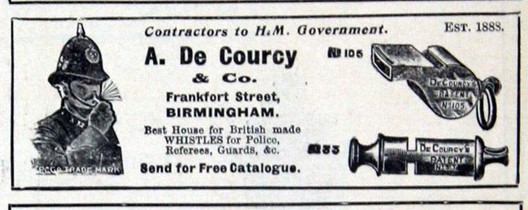
His 1908 advertisement claims establishment 1888.
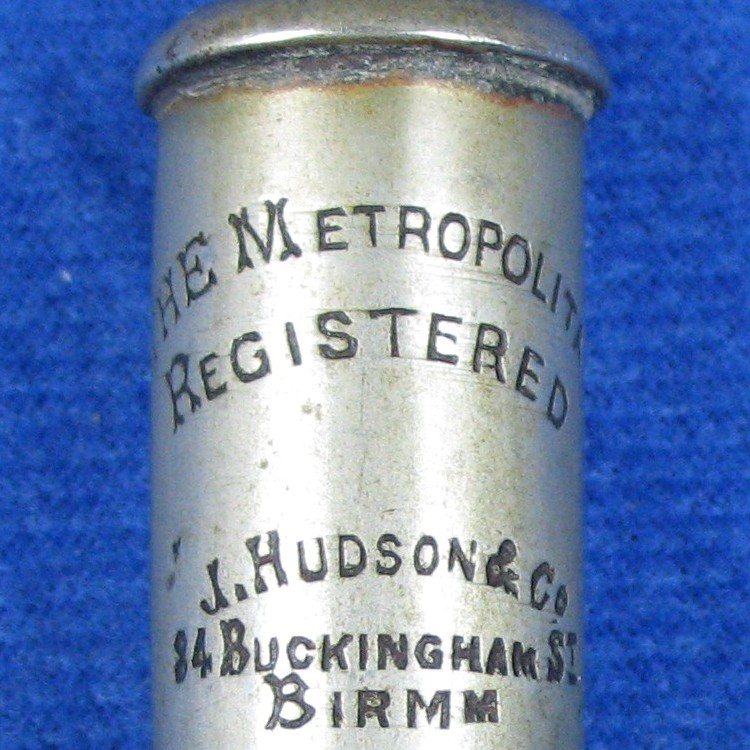
The N.W.R. railway round (originally designed by Hudson circa 1880 prior to moving to 84 Buckingham Street in Birmingham.) also reflects early work, However De Courcy’s whistles known for this model date 1905 to 1915.
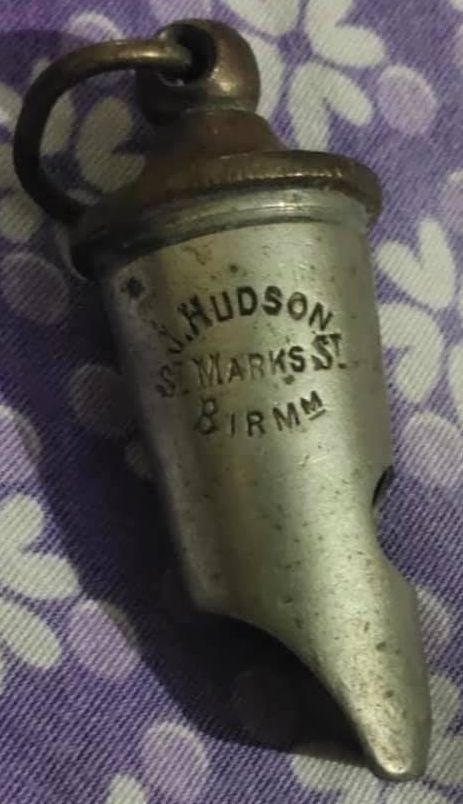
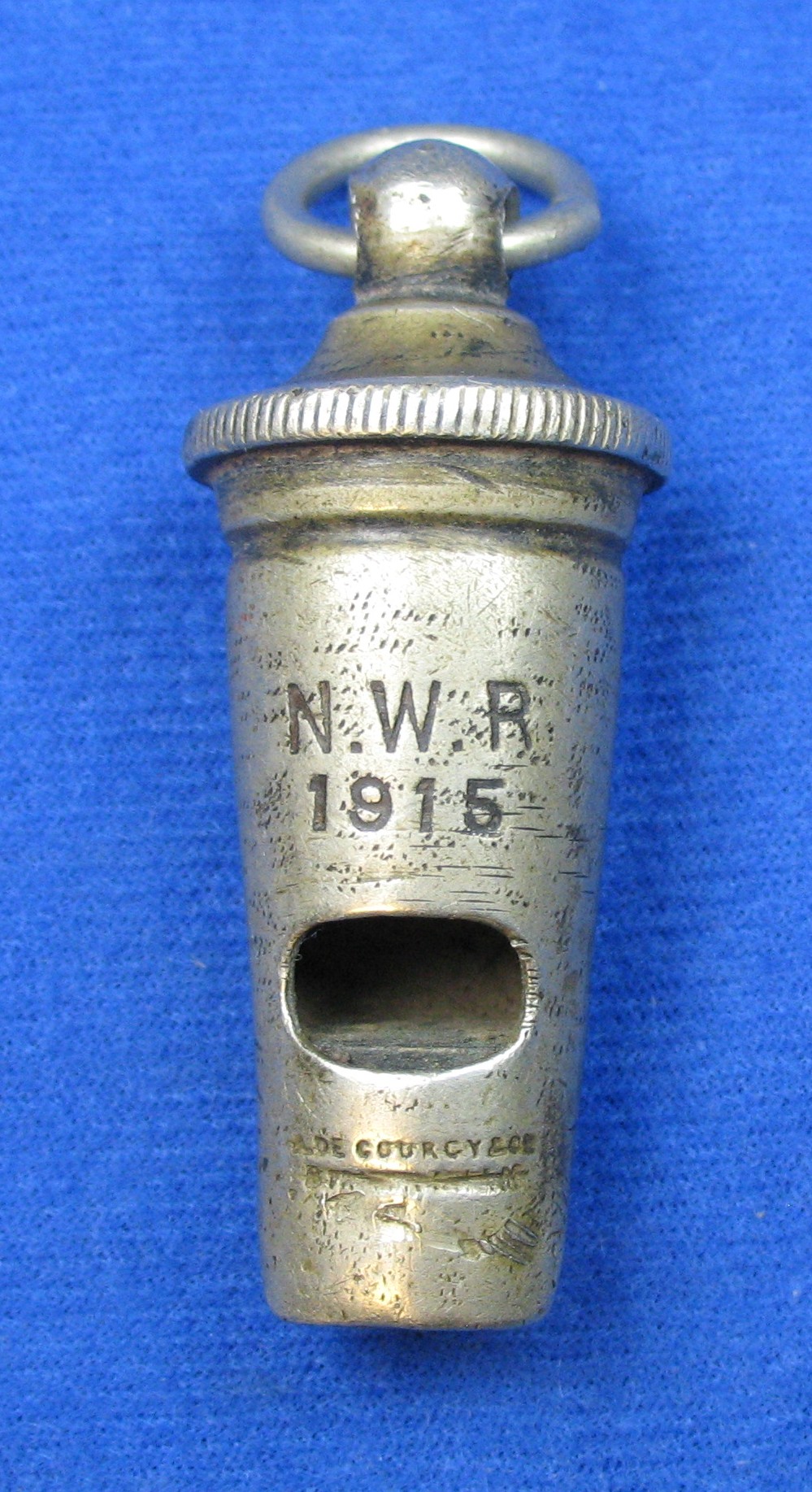
Here one can see the wider arched windows and a Dixon like (left) cut, although straight top corner edges. The middle and right windows are very similar to Hudson’s.
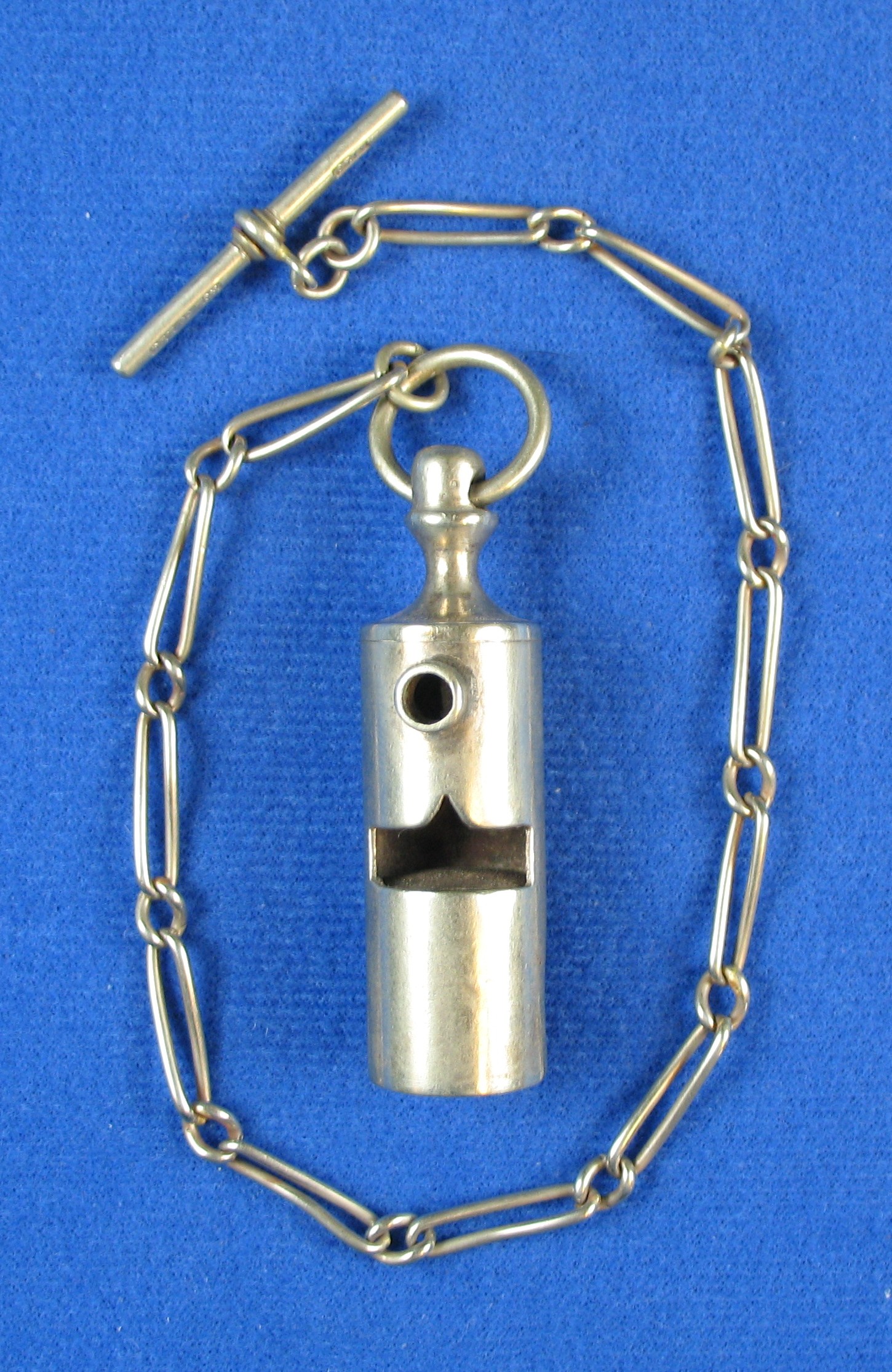
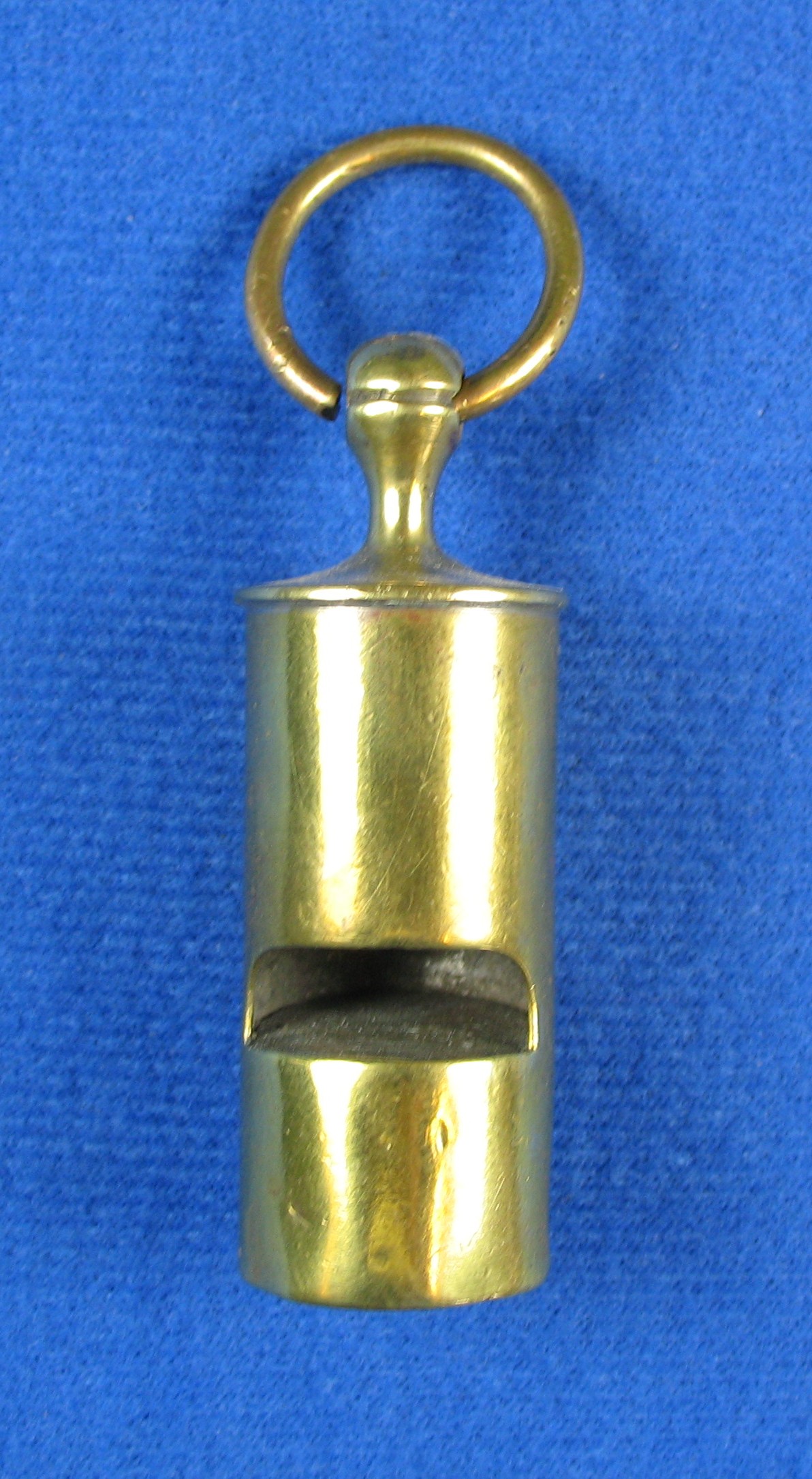
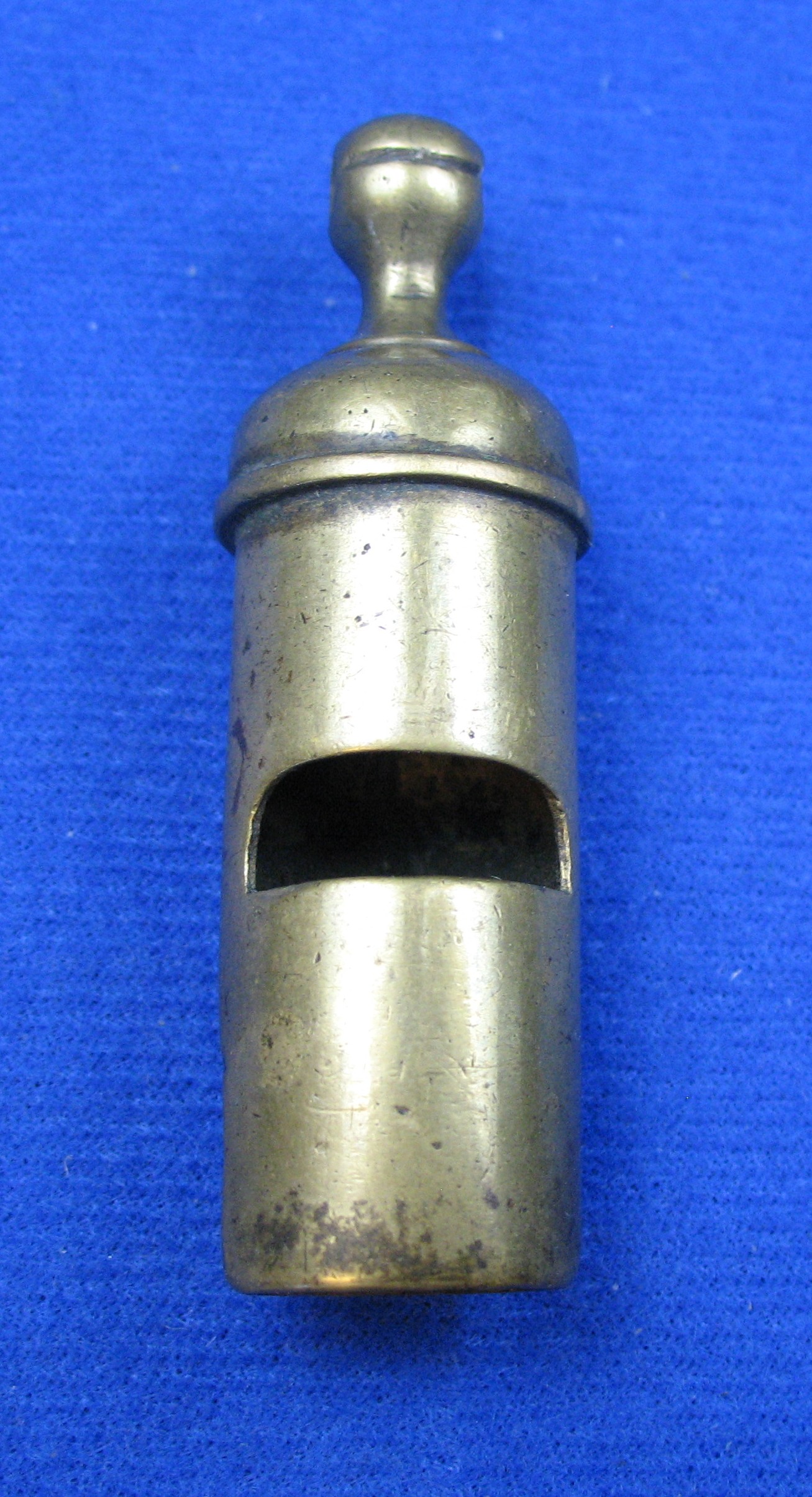
As said in More Whistles conicals continue to be hard to date because manufacturers used the same wedge diaphragm for decades. It is also hard to assign the maker at times, but there are some details to look for.
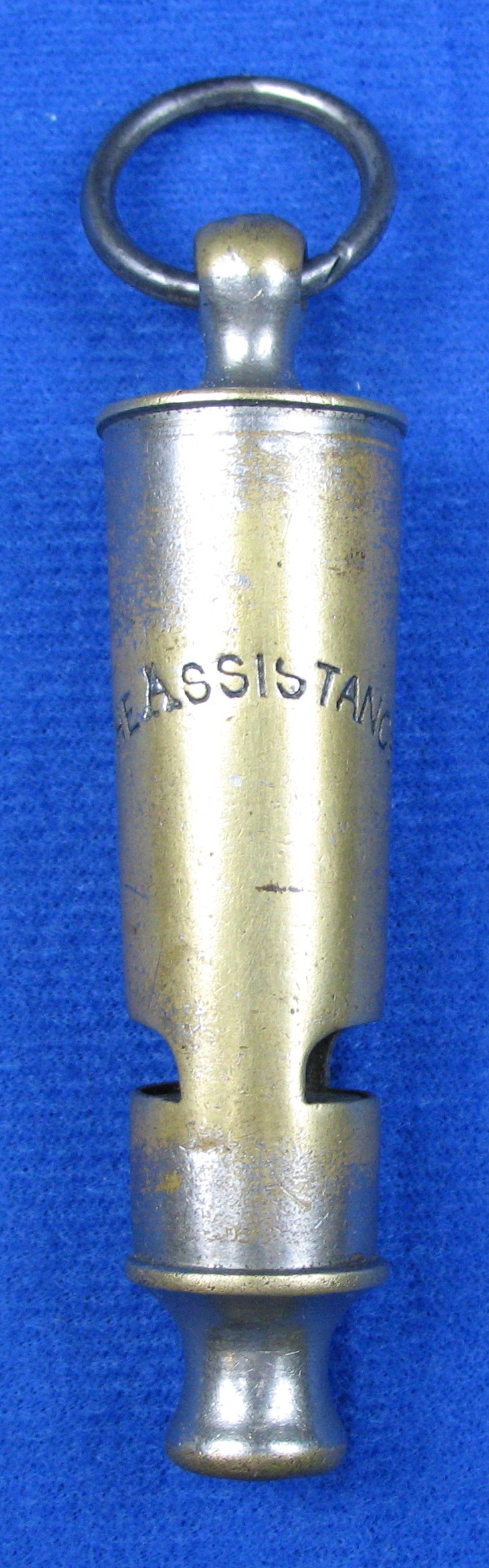
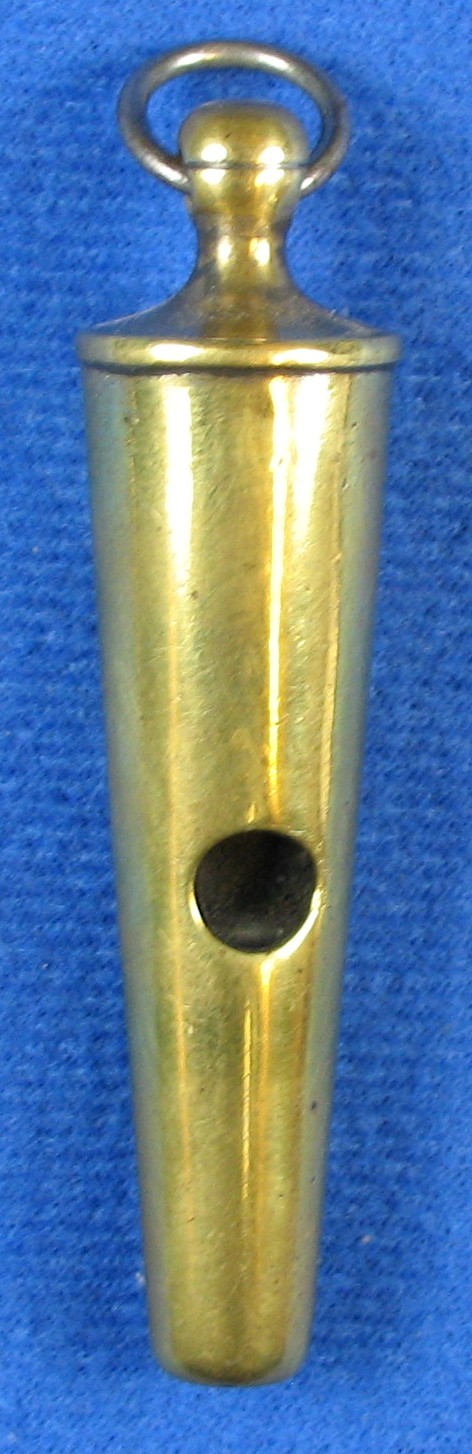
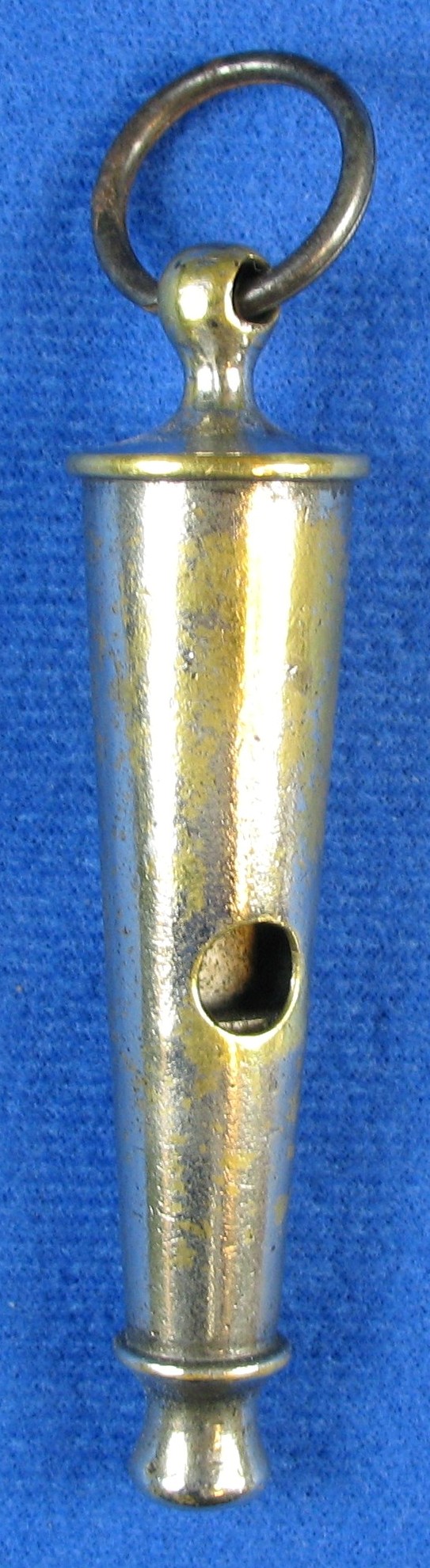
Of course, that would depend, if they weren’t ordered from someone else and another’s stamp used. Here are a several early beauforts for examination.
Please note the unusual conical style of the ASSISTANCE (77mm), a trade name used by Alfred De Courcy. It has attributes from three types of whistles. It is shaped like a conical but has two windows shaped like his round whistles AND a diaphragm like a tubular whistle. It has a cast mouthpiece and top. In his later years he would use a rolled mouthpiece on this whistle model.
The larger conical (84mm) on the right also has a cast top and mouthpiece, but with a wedge diaphragm. The middle whistle is a generally standardized size (74mm) with a wedge diaphragm.
There are whistles of a tubular construction made by Alfred from this early period.
Only one early year period whistle – London Police, has been found of police issues. All others known presently (10) come after 1905. However, his early civil whistles with other stamps appear to be somewhat later after the Frankfort move. They no longer used cast mouthpieces, perhaps retooling for rolled mouthpieces in 1904-5.
Whatever the timing, at some point circa 1900 he started using ‘rolled’ mouthpieces before the 1906 patented diaphragms were used. The top caps are cast of course, but the mouthpieces date them only generally. Creating a loose benchmark, if cast then pre-1904, if rolled post 1904.
Please let us know if you find corrections or other notes to post and we will post them here. Pictured are three examples of his early work and stamps… all with cast mouthpieces. Note that they are very similar to Walton who made whistles for 6 years on his own after he also left being a foreman who left Hudson’s – 1898.
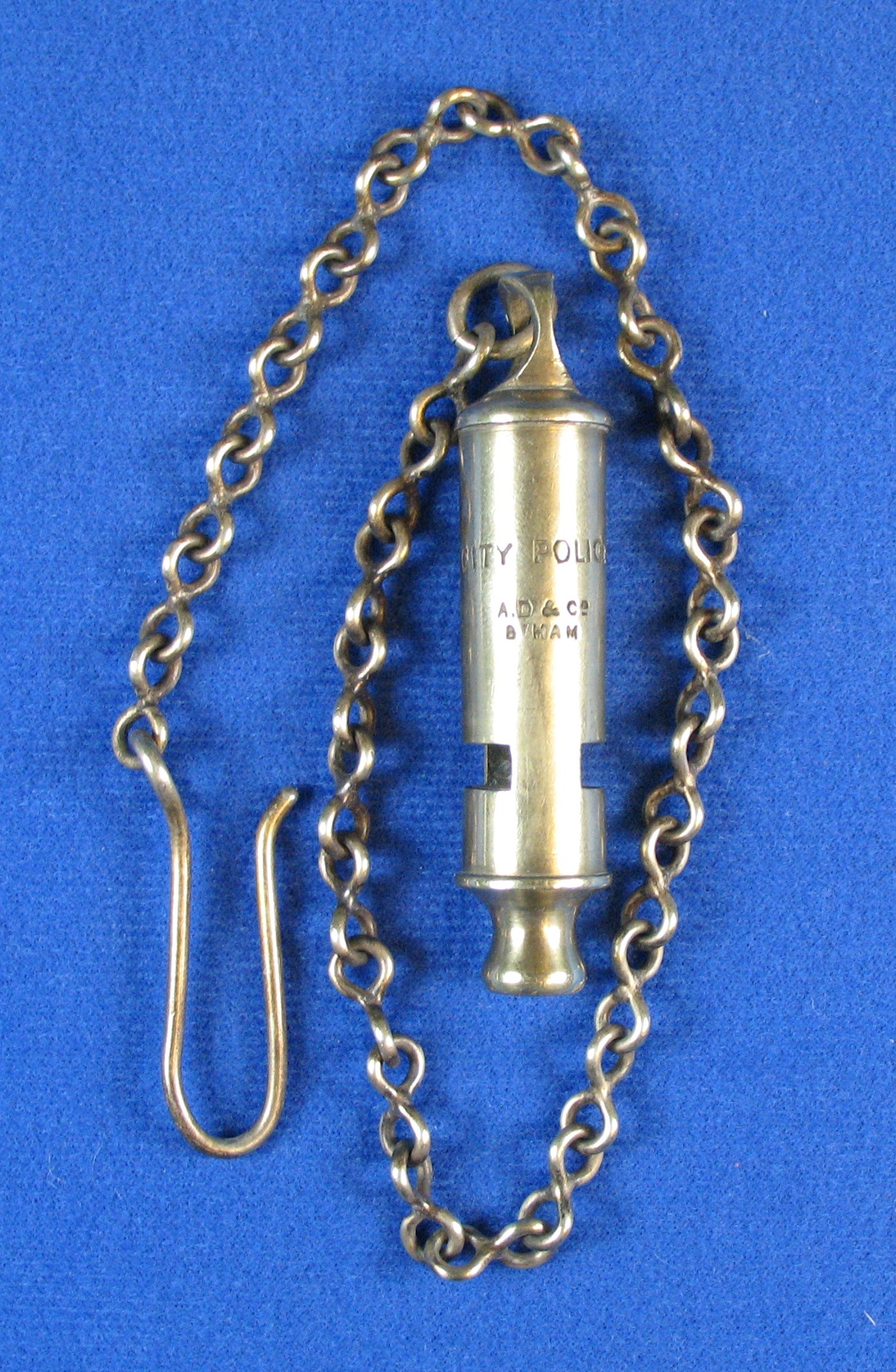
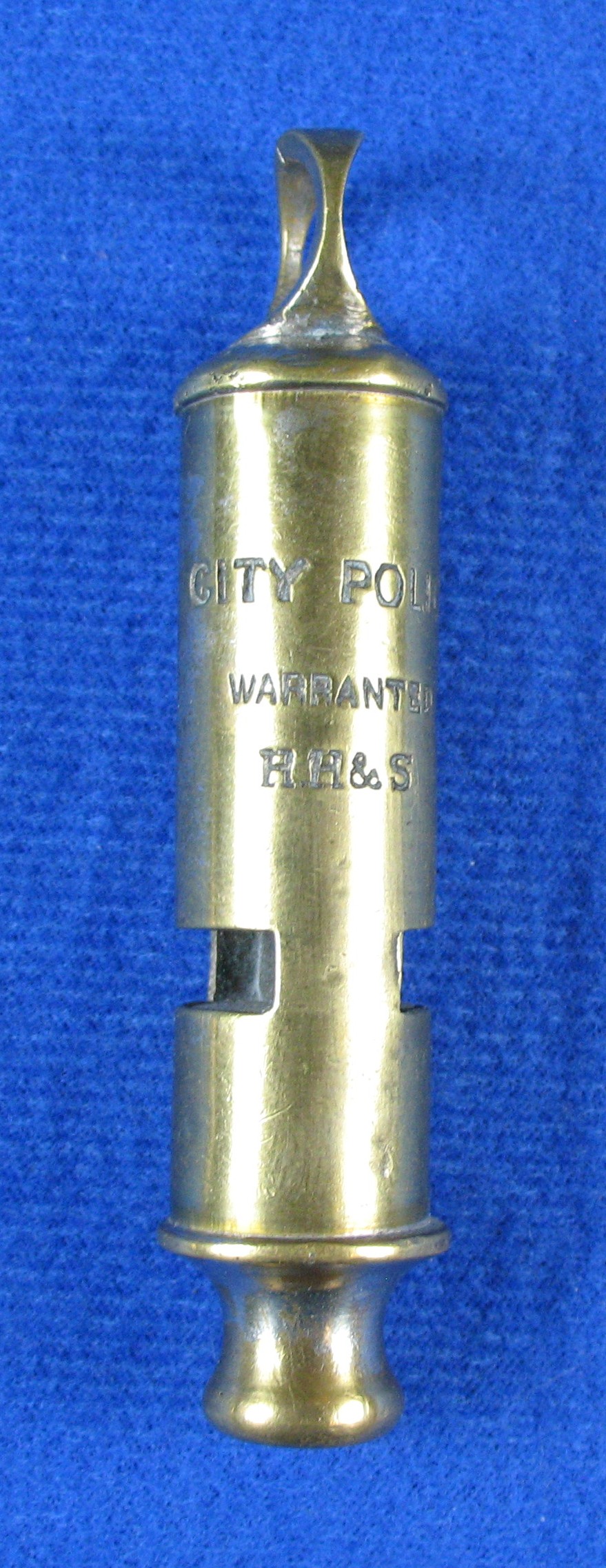
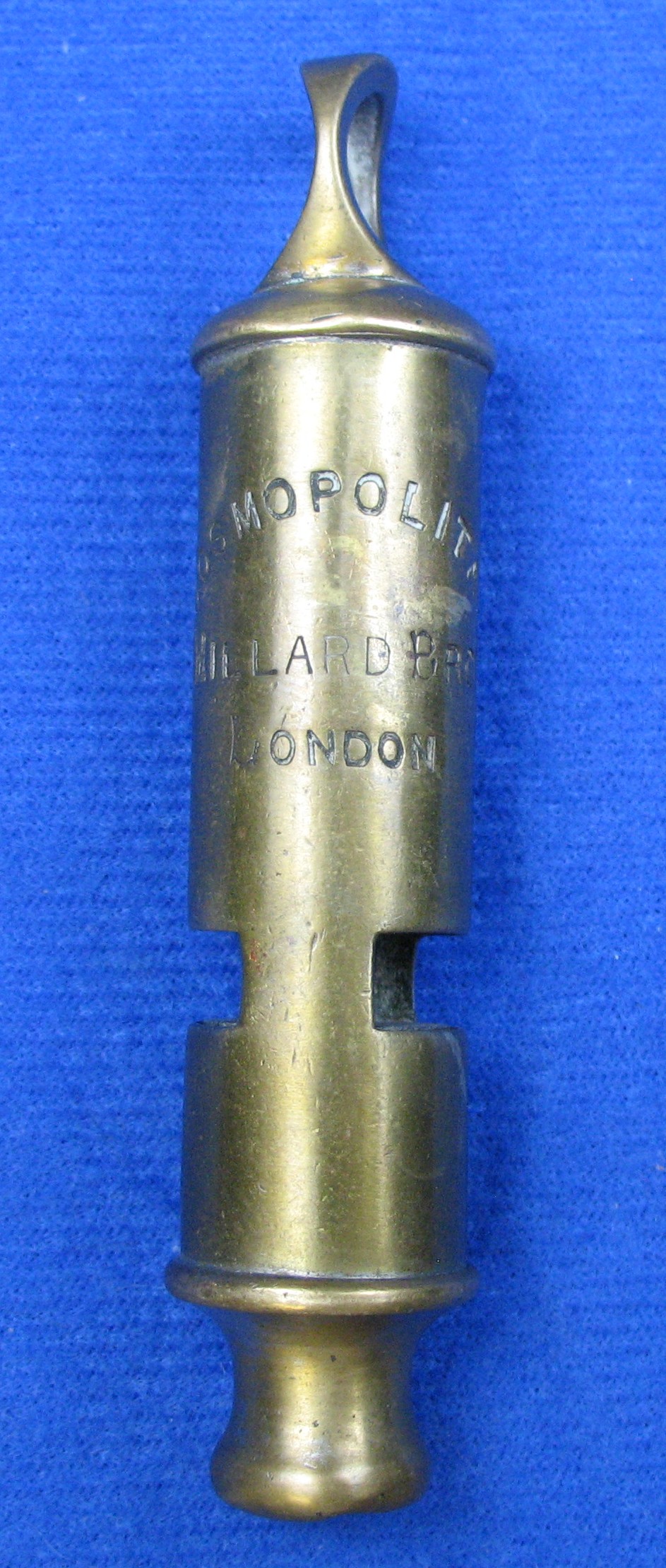
Lastly, we close our discussion by looking closely at escargots prior to the 1904 move. Alfred’s love for variety can be seen in his escargots too. London types were the earliest efforts by all makers (following button whistles) from the 1880s and into the 1890s. Was Alfred making these too? Yes.
As far as heavier manufactured escargots, if you refer to More Whistles page 14 look to the picture second from the bottom and on the right. There you will see an example of a sturdy 5-piece escargot with his name De Courcy stamped on the bottom. The 5-piece construction design had already been in use by others distributed by Black and company stamped whistles, — and he used it too.
This would have been only in his early period, as they ceased to be made shortly thereafter, giving way to the sturdier Hudson 3-piece design of 1891 of Hudson’s patent. De Courcy’ addition of a grooved tongue attachment to the barrel base seems to be the only variation.
Next is another 5-piece whistle, this one from the reference collection, but is it a 5 piece? Look closely at the picture below and you will see this whistle is made of 6 pieces. So, there are two types of 6-piece whistles. One is the heavy Glasgow design and this lighter almost London design. There is that extra sixth piece of under strengthening below the mouthpiece.
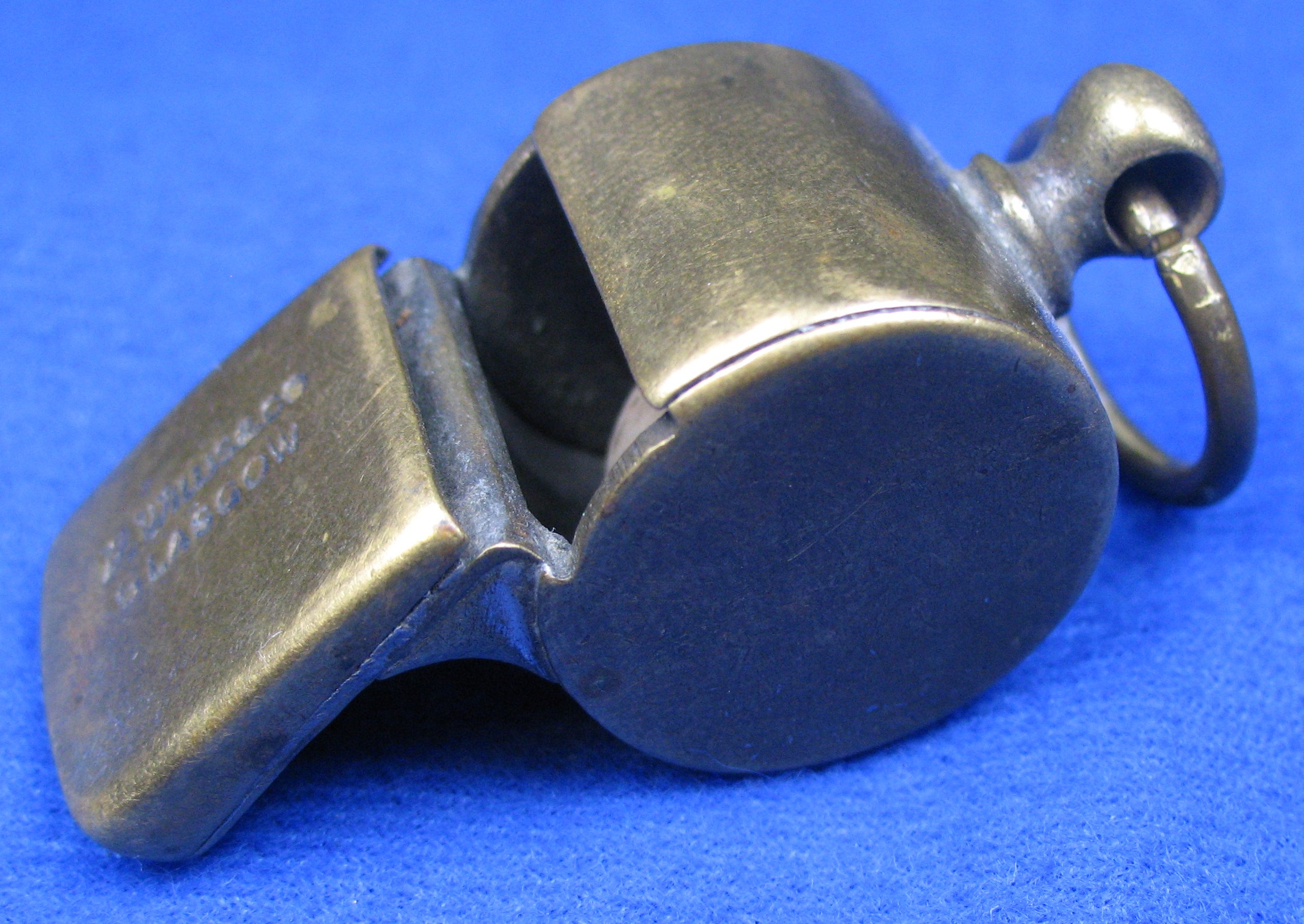
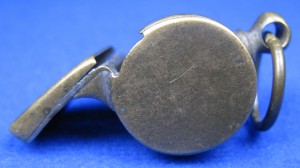
Note the similarity in a circa 1890 Thunderer, possibly by De Courcy. Perhaps at this time De Courcy was supplying Thunderer to Ward and possibly Black and Company.
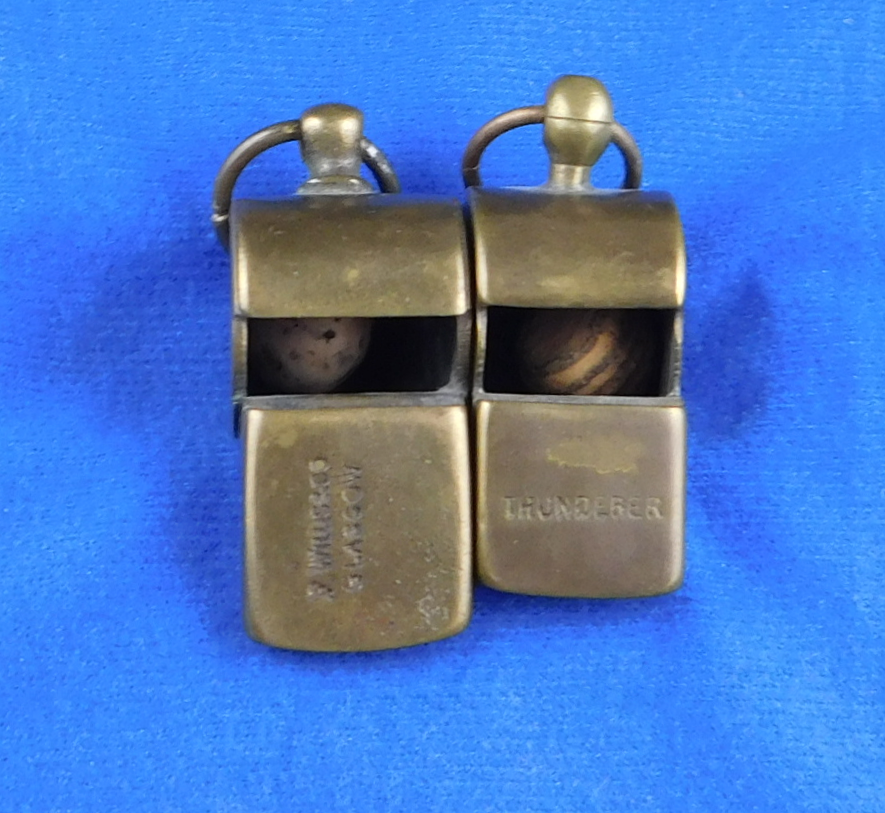
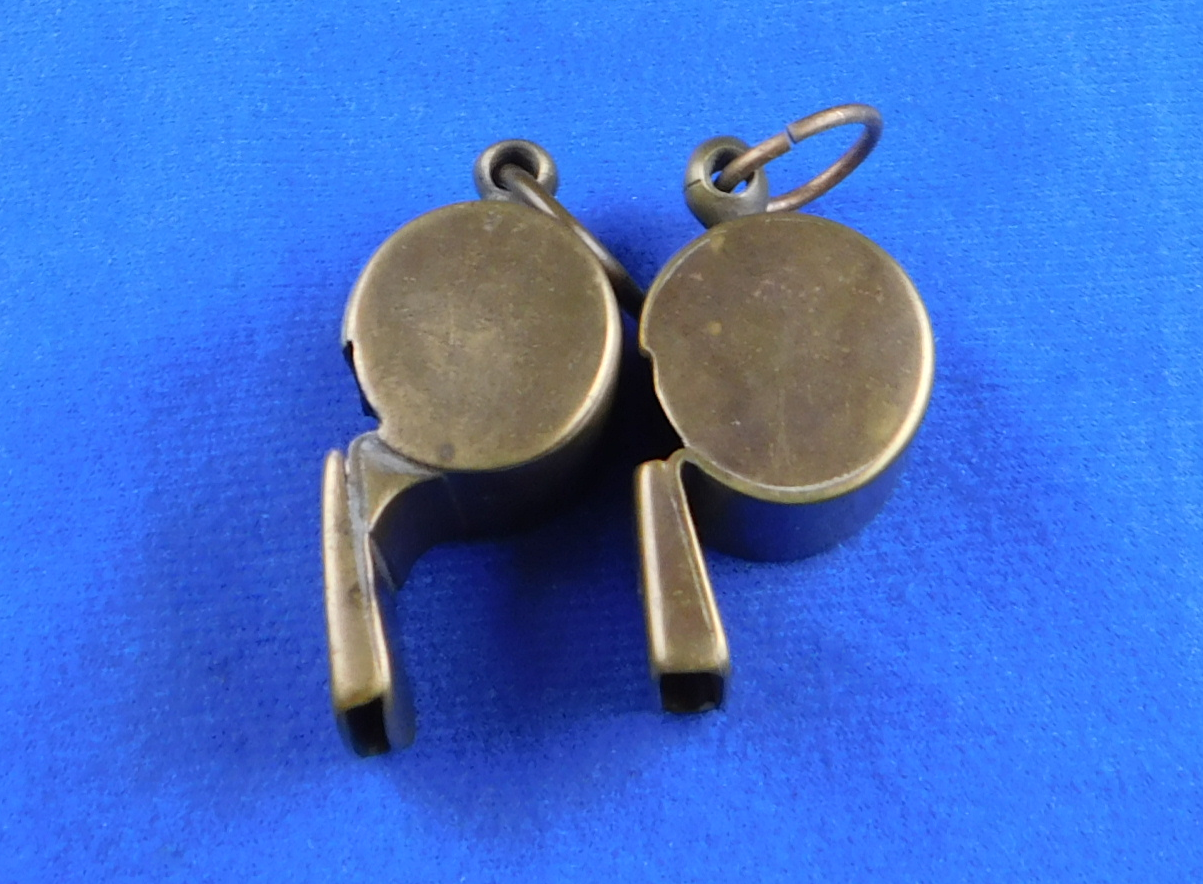
Early escargot whistles prepped De Courcy for his 1905 patent with an innovative ‘fold over top’ to the mouthpiece.
This ‘flower’ type button side wall evolved over the years and was a transition from the heavier 5–6-piece escargots.
The whistle on the left is a lightweight London type with the top of the mouthpiece attached to a separate piece. However, the right whistle is a fold over top piece.
Gilchrist would state on page 13 of More Whistles that “no examples of this call are known”. This appears to be a use of this patent design.
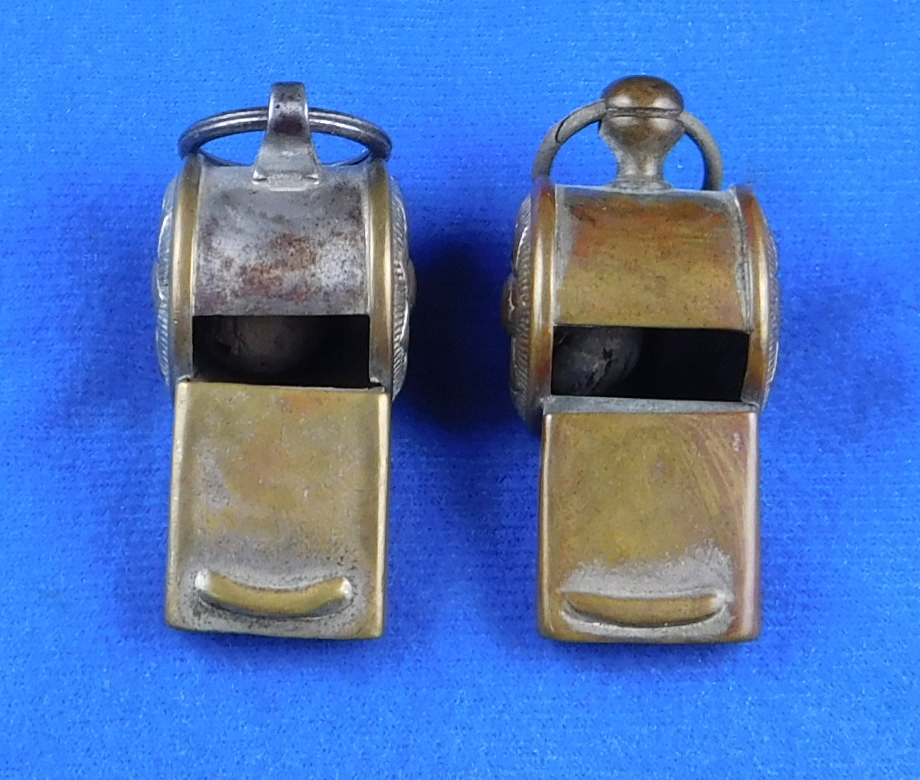
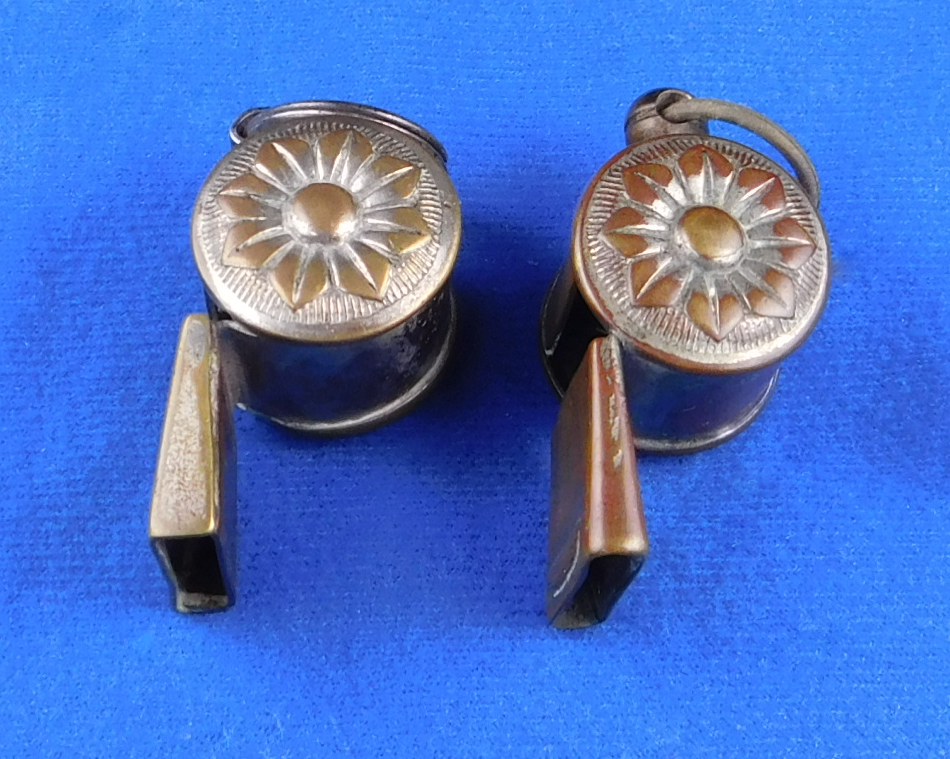
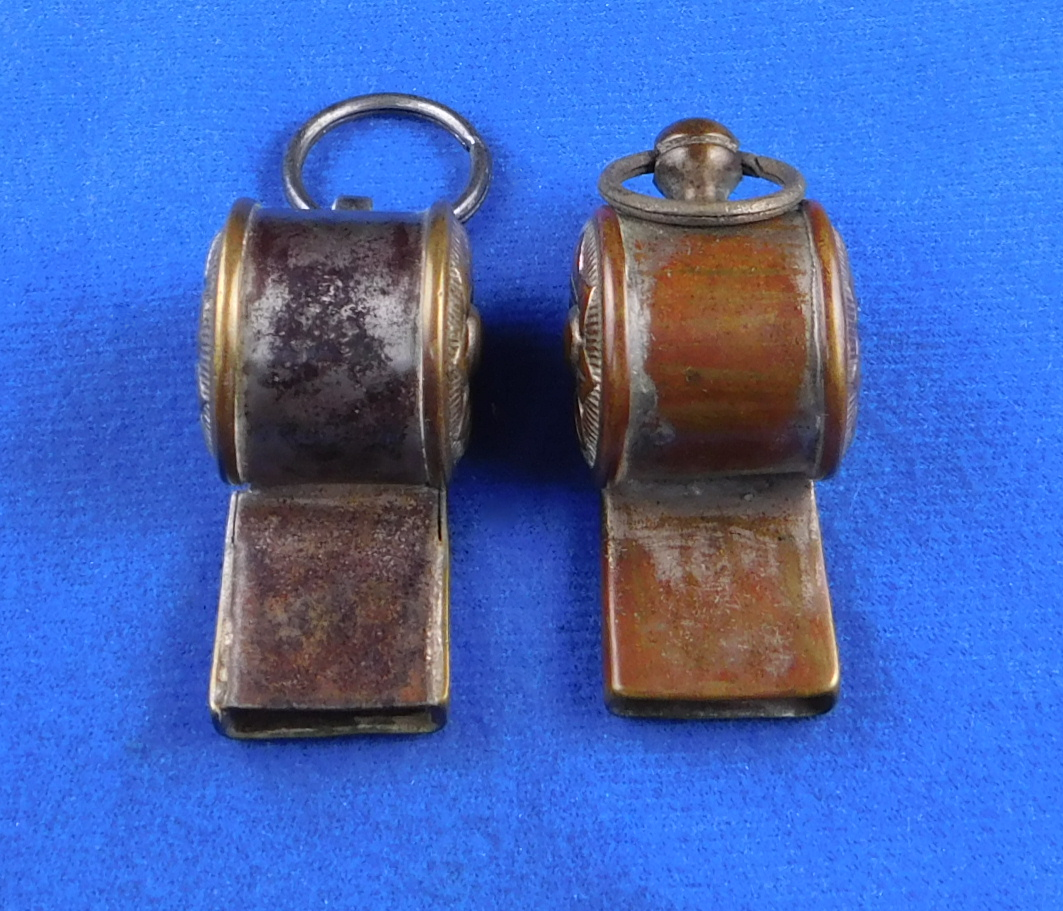
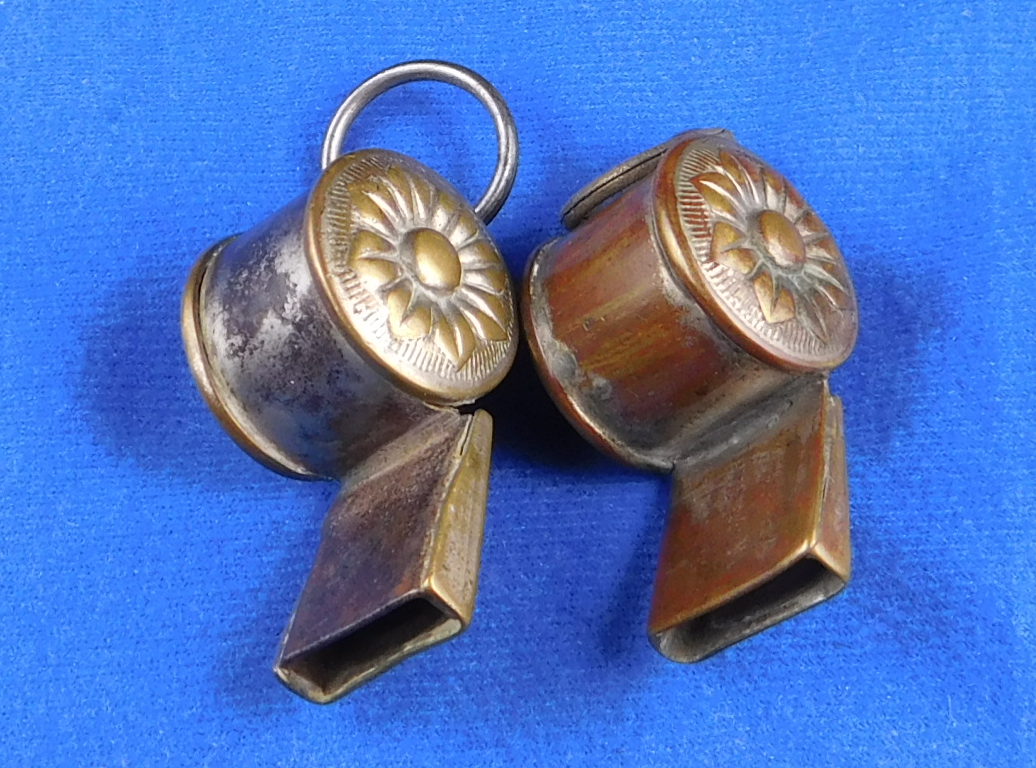
The whistle on the left preceded the fold over patent.
About this time Alfred was making this matching whistle with under strengthening, lighter, almost button type escargots (LYR) in effect a 6 piece also. The LYR railway used the fold over method.
There is nothing new here in Escargot concept, as Hudson was already well into them and perhaps Alfred had made some of these too before leaving that establishment. However, the folding over is quite different as well as the modified under support that slipped over the front edge of the mouthpiece entry.
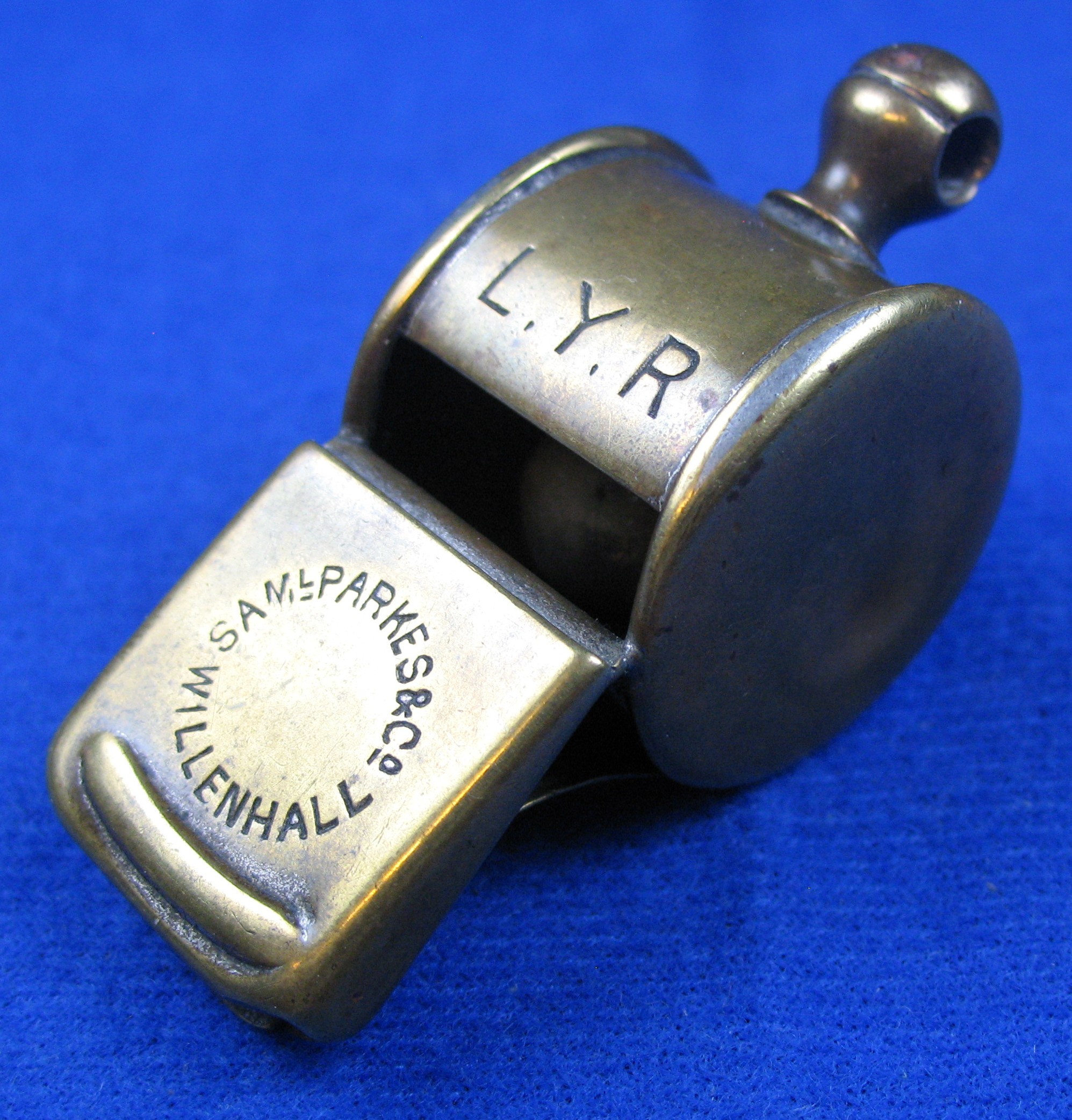
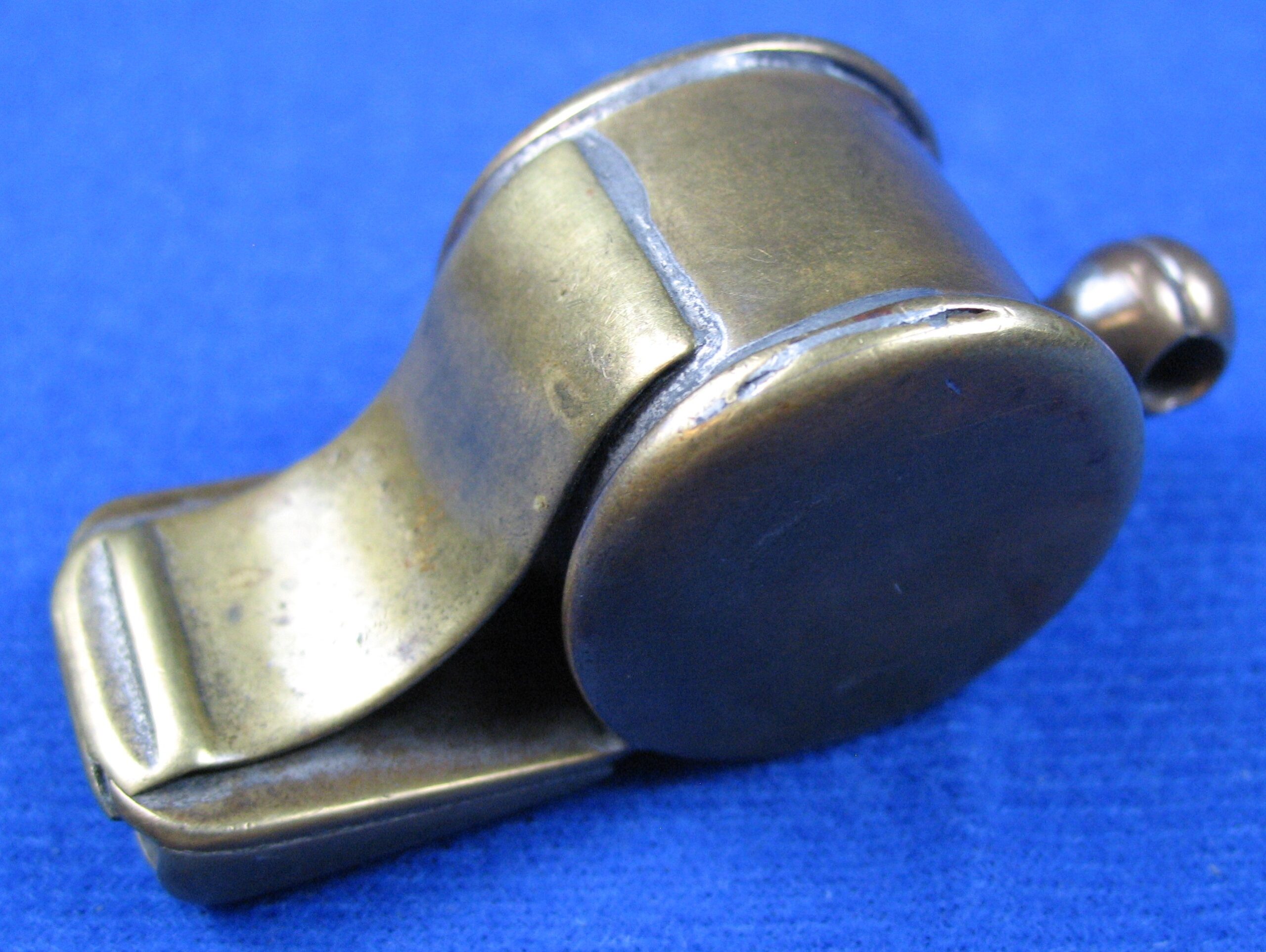
In 1905 a patent described a fold over mouthpiece on an escargot as follows.
Improvements in Railway and other Whistles and in the Manufacture of same.
| Page bookmark | GB190526019 (A) – Improvements in Railway and other Whistles and in the Manufacture of same. |
| Inventor(s): | COURCY ALFRED DE + (ALFRED DE COURCY) |
| Applicant(s): | COURCY ALFRED DE + (ALFRED DE COURCY) |
| Classification: | – international: – cooperative: |
| Application number: | GBD190526019 19051214 |
| Priority number(s): | GBT190526019 19051214 |
Abstract of GB190526019 (A)
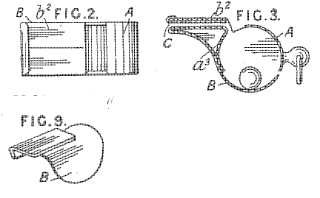
26,019. Courcy, A. de. Dec. 14. Making whistles. -A whistle is formed from four stamped pieces of metal. One piece A is first bent into the shape shown in Fig. 3, with a strengthening-strut a<3>, which may if necessary be absent, two side pieces B, Fig. 9, are then attached, and the pieces b<2> are folded over, forming with the piece C the top of the whistle.
Conclusions
It is not hard to see why he outlasted all the other competitors of his day from being swallowed up by Hudson. We have examined many varieties and innovations:
- cycling
- heavy walled dual chamber
- Combination round/beaufort
- Flat
- knife gadget
- rounds
- beauforts
- tube shaped
- 6 piece London heavy escargots
- 5 piece London light escargots
Although remaining rather enigmatic, as whistles surface, we can connect the dots for these years.
TWG
Posted March 2, 2013
Revised January 2, 2021
Revised February 13, 2021
Revised December 27, 2021
Revised December 29, 2021
Revised January 30, 2022
Revised April 28, 2026
Biblography:
- TWG Reference Collection
- Letters from Martyn Gilchrist – 2008
- Collecting Police Whistles and Similar Types, by Martyn Gilchrist and Simon Topman, 1998.
- More Whistles, Martyn Gilchrist, 2005.
- Family Tree Maker, Notes (Webtool)
- Advertisement: 1908
- Google Patents Search
© – All photos with blue background property of The Whistle Gallery reference collection. Please contact The Whistle Gallery for permission of use of any website content. Spotlight articles are copyrighted. Please contact The Whistle Gallery for permission of use of any website or Spotlight article material written or otherwise. Use of photos without authorization is prohibited.


 Users This Month : 1295
 Total views : 177407