Whistory
A wonderful and just plain fun category of whistle collecting is the research and study of whistle chains. This would be by default, includes the rings and hooks. Beyond that is the outfitting of whistles with personal choices of aftermarket chains that the manufacturers did not make/supply with their own whistles.
After some study, one sees certain chains that were originally issued by each manufacturer. This sometimes helps in identification, but usually just indicates if it is close to original supply.
The materials used were silver, nickel silver, brass, plated brass, copper, high quality steel and various lesser quality metals of steel and alloys.
What About the Lengths of Whistle Chains?
The lengths vary quite a bit and along with the design of the hooks, even the type of rings — adds even further character. The button hooks may or may not be closed. They may be quite large or diminutive. There may be cross bars for fitting inside the buttonholes. Even the rings may be of varying quality and sizes, matching the chain set up or not. Split rings were used back into the mid-19th century and at the same time, solid rings were used that may or may not be brazed closed – usually a sign of higher quality if closed.
Here we are going to look primarily at UK chains, USA chains and a few additional types that have been applied as whistle chains. Often what is seen when straying from actual whistle manufactured chains are watch and fob chains used for whistles.
Who Made the Best Whistle Chains?
By far Dowler led the manufacturers with high quality nickel silver chains, but Hudson was very close if not in quality, surpassing in variety. DeCourcy made excellent chains, but of limited variety. Most other manufacturers gave little attention to this area found in the UK. In the USA, the manufacturers are harder to identify, but the chains are not, yet less in variety.
Additionally, railway chains varied quite a bit in different brass chains. Whether they were after market by the railway or someone else is unknown, but the links seem idiosyncratic with railway whistles.
Whistle Classification
| Type | all |
| Maker | all |
| Category | all |
| Material | brass nickel silver steel silver alloys |
| Features | na |
Whistle Archaeology
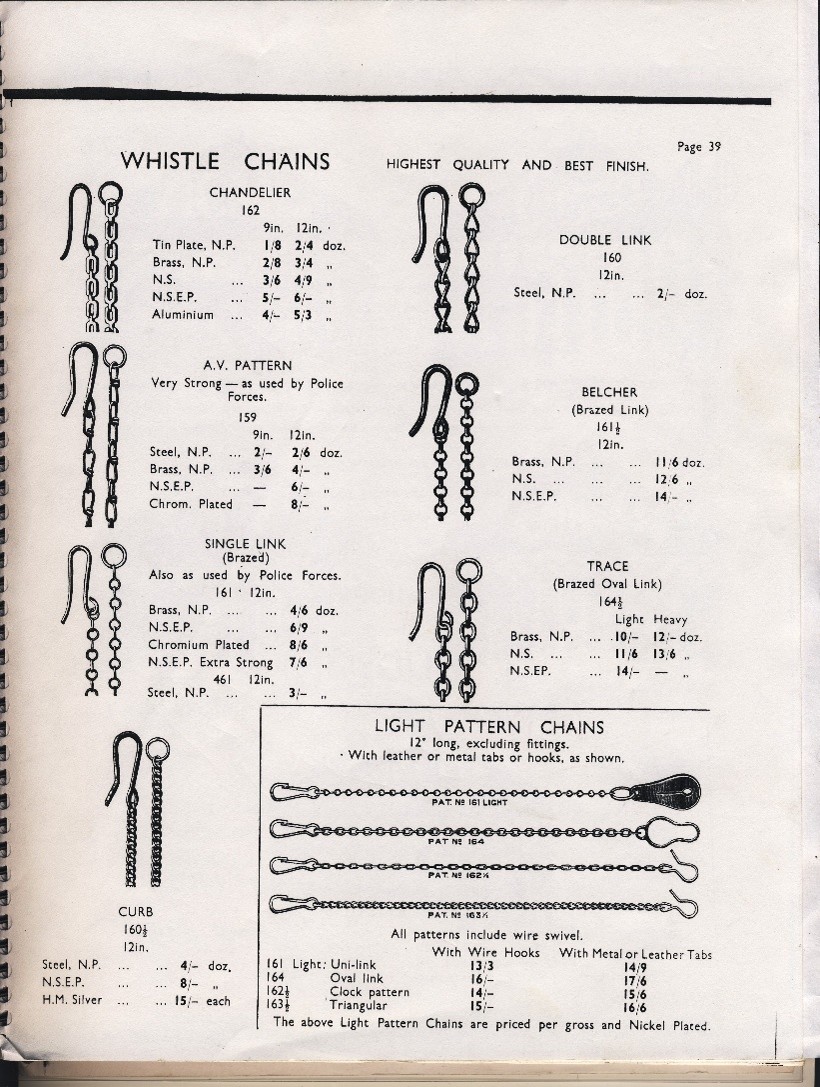
Only Hudson put out a catalog page of chains in 1935.
Comments about nickel silver chains.
| Chandelier 162 | nickel silver can be found on circa 1918 police issues |
| A.V. pattern 159 | nickel silver can be found on many police issues |
| Single link 161 | nickel silver less common, smaller links, light |
| Double link 160 | not found in nickel silver |
| Belcher 161 ½ | nickel silver usually found on military two piece whistles |
| Trace 164 ½ | nickel silver rarely to be found on police, large links, heavy |
| Curb 160 ½ | silver hallmarked, rarely found |
Whistology
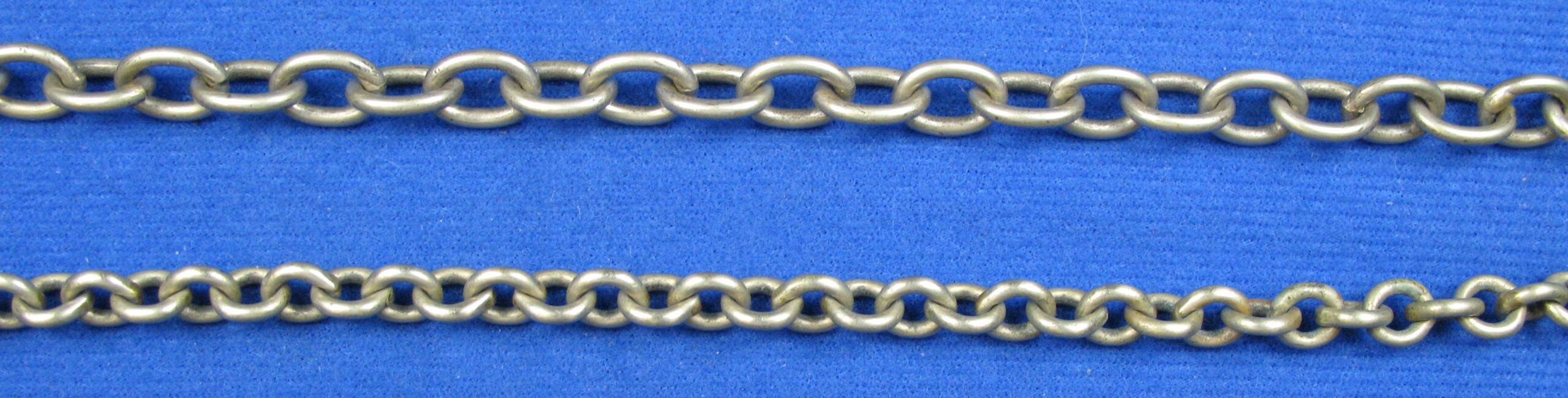
Let’s start off with an early Dowler heavy nickel silver TRACE link (brazed oval link) The links are large and heavy when complete.

In 1935 Hudson printed a nice array of chain types they had for sale in their catalog. Many names they used were already in use for years and make for a great guide for our purposes here. This Dowler is very heavy and rather large links, almost cumbersome to carry a whistle with. However, it also makes a statement about the import of the very fine whistle that was attached. Compare it to the same type, but smaller link.

You see the tighter, smaller links better yet here together or side by side … (circa 1890).
A beautiful link that Dowler specialized in was a large curb link seen in two gauges here…
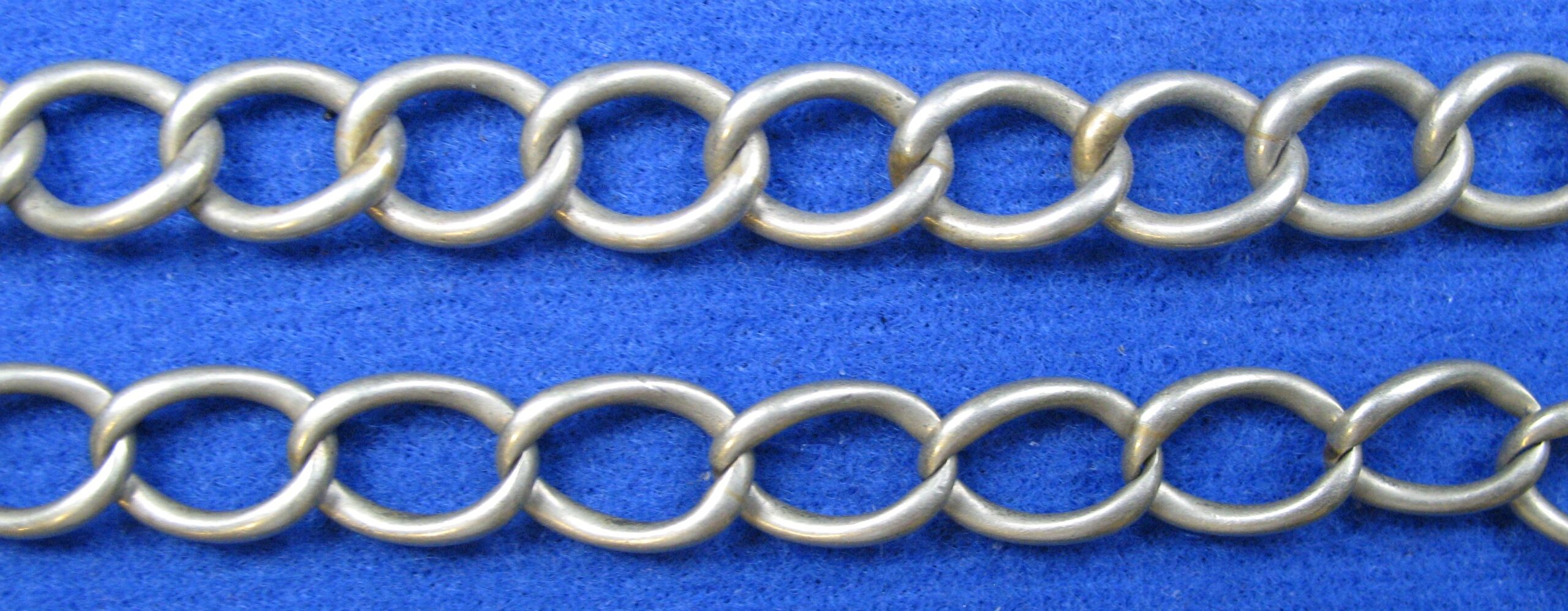
Hudson did not advertise this for sale if they did have their own. However, it is a delightful, airy and lighter feeling chain, although still substantially solid, always brazed shut.
Following this we look at some SINGLE link chain. These date back to Hudson’s earliest police issues. It has two links that are brazed together almost forming a figure eight, but perpendicular to each other. These were quite popular and came in several sizes of links and gauges. Historically they were issued with Metropolitan whistles in the first order of 7000 that Joseph Hudson filled. Some were rejected due to the chain stretching under test. (Gilchrist – Collecting Police Whistles)
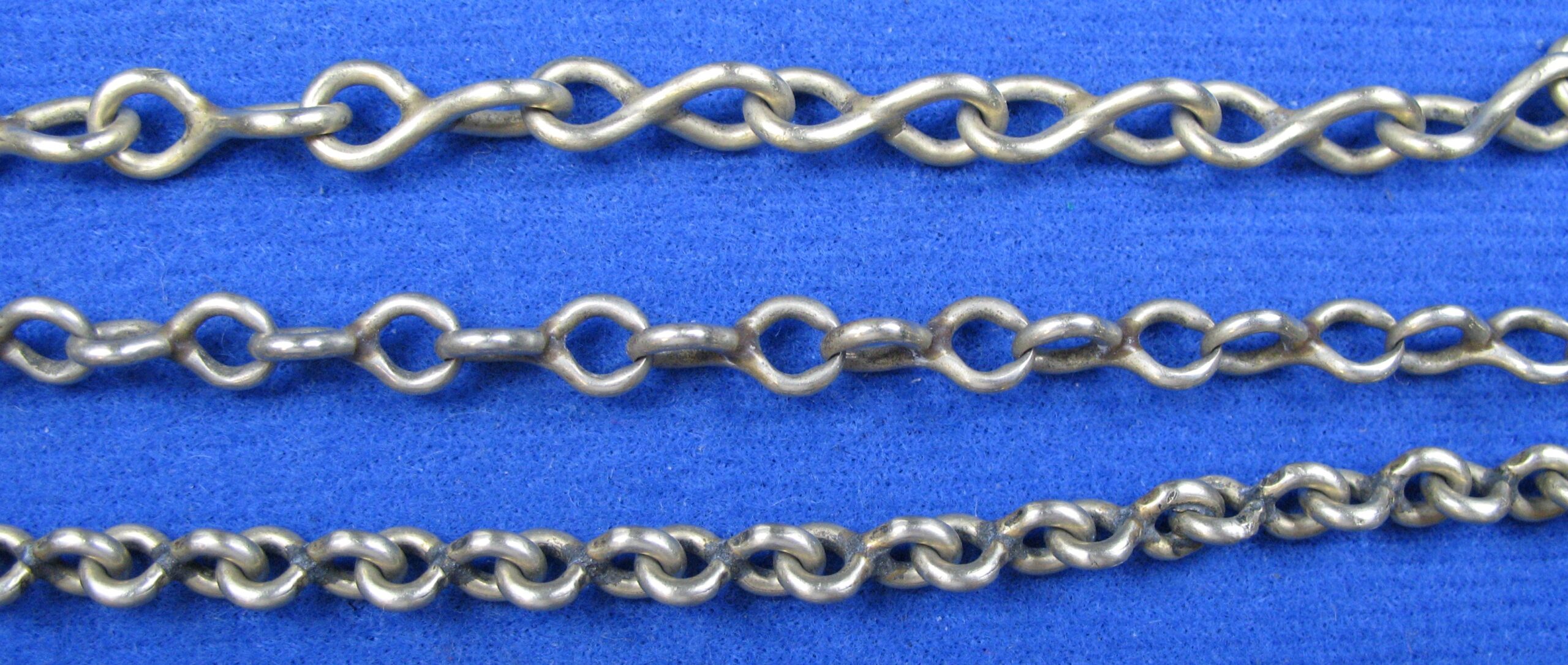
A very difficult one to find (for us here anyway), is the CHANDELIER link in nickel silver as presented here…

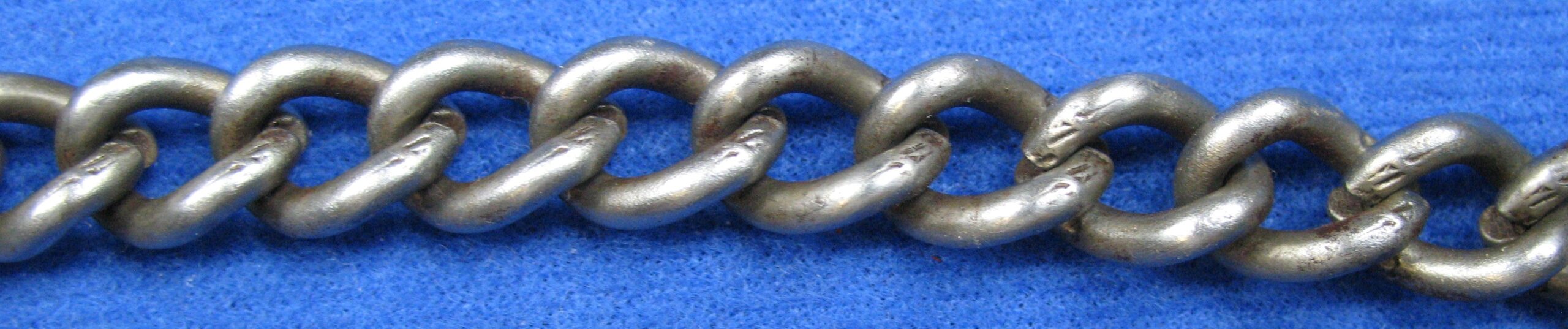
It is very popular in the states, but in brass and cheaper steel or alloys. Heavy nickel silver CURB link…

Belcher chain is one of our favorites and is hard to find in large nickel silver, usually a smaller link…

And the A.V. link has been found in two sizes in nickel silver (so far) which usually was sold on Hudson whistles circa 1920.
Nickel silver is our favorite, but brass and copper are nice too and they get dark with patina, whereas nickel silver mostly turns a hazy yellow/silver tarnish.

All these great chains have been in nickel silver, and some can be found in the following metals on various whistles or were available by order in 1935:
- Silver
- Tin plate
- Nickel plated brass
- Nickel silver
- Nickel silver electro plate
- Aluminum
- Chromium plated
- Nickel plated steel
Also listed in the catalog were:
- TRIANGULR
- UNI LINK
- CLOCK PATTERN
- OVAL LINK
Now let’s look closer at some from the states…
In the states the early whistle makers either produced or used marketed CHANDELIER patterns in a wide variety of forms and gauges as follows… (these are also sometimes seen on UK railway escargots) —– All of these are brass.
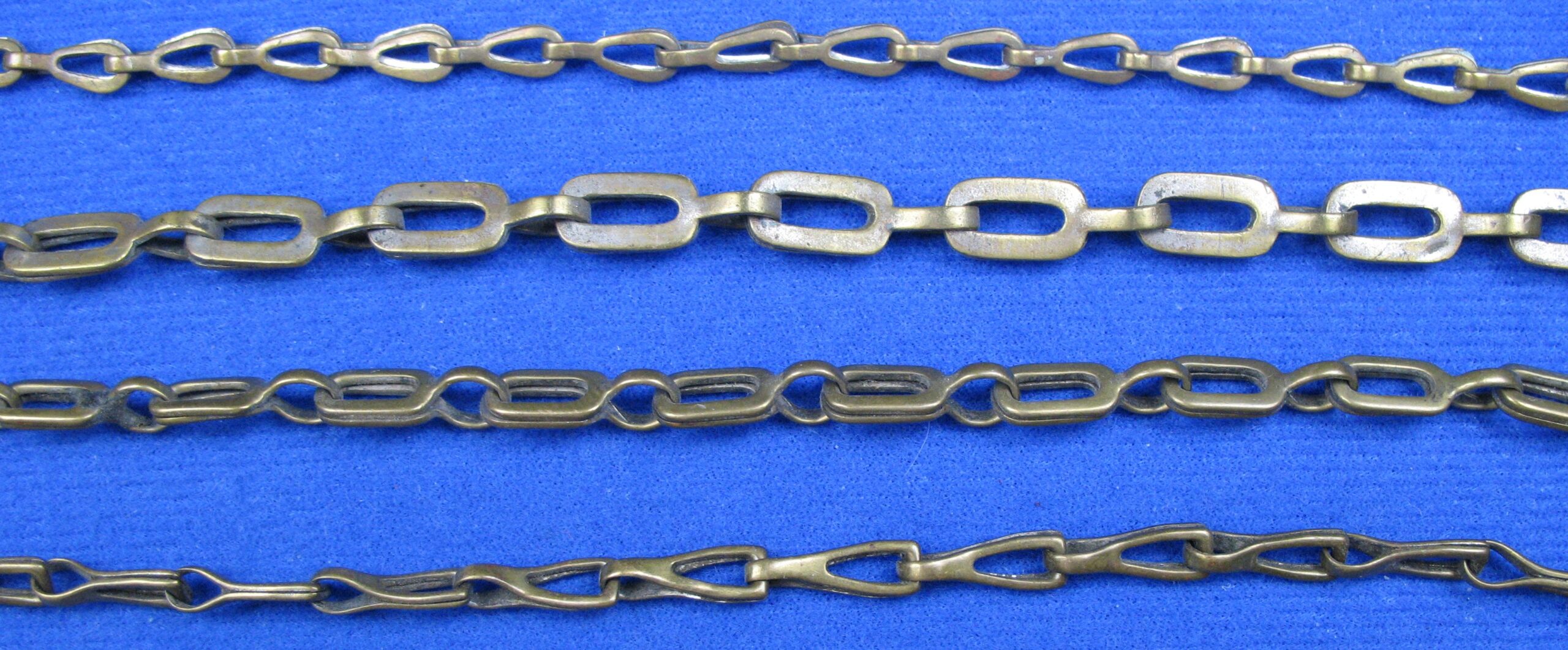
The metal of choice was brass. However, many used steel and some beautiful patinas of early quality steel chains can be found. Later the quality dropped substantially.
Here are some belcher chain sizes in brass — used sparingly, perhaps bought by the owners after or at the time of the whistle purchase.
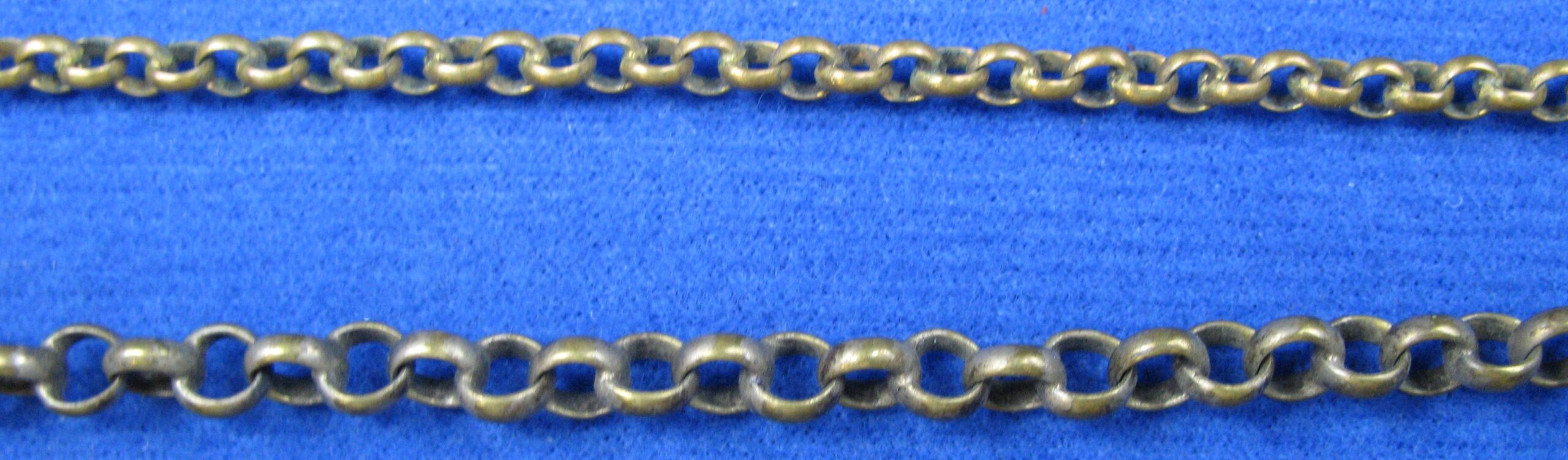

The curb link was extremely popular in the states and still is, finding an old one on an early whistle is a challenge.

This distinctive ‘DOUBLE’ type link next is made of copper, which was only used by a couple of USA manufacturers. Horstmann and one other unknown maker that produced a siren, escargot and tube shaped GSW (trifecta see SPOTLIGHT 105). They like Horstmann, preferred copper, quite unusual in the whistle world, due to corrosion.

Other manufacturers used this pattern often, but in brass of varying quality of craftmanship . It was not offered in the UK.
And of course the very popular brass A.V link used primarily in the 1930s and 40s pre war and WW11 time for the military in varying qualities of workmanship.

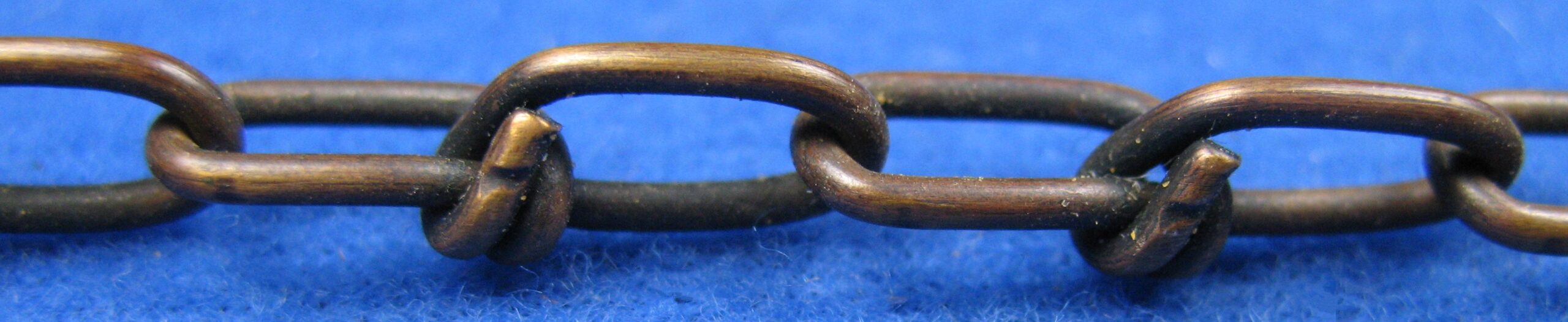
Where the USA excelled was in early steel and they also came in a variety of links as follows. However original installation is a mixed bag of applications from the manufacturer, out sourcing, or just owner preference. You will note the DOUBLE link pattern in steel at the top and in the middle of the group picture below is a unique pattern that invariably came with angled mouthpiece -2 chamber whistles by BGI and others. Here is a closeup and the group picture has two very different sizes. There are many graduated sizes in between.

They were marketed for doormen, hockey,conductors, and hunting. These were always in steel and of many different guages. The hooks were small and rather short chains.
And a group picture helps to see the variety of old steel links and their terrific patina.
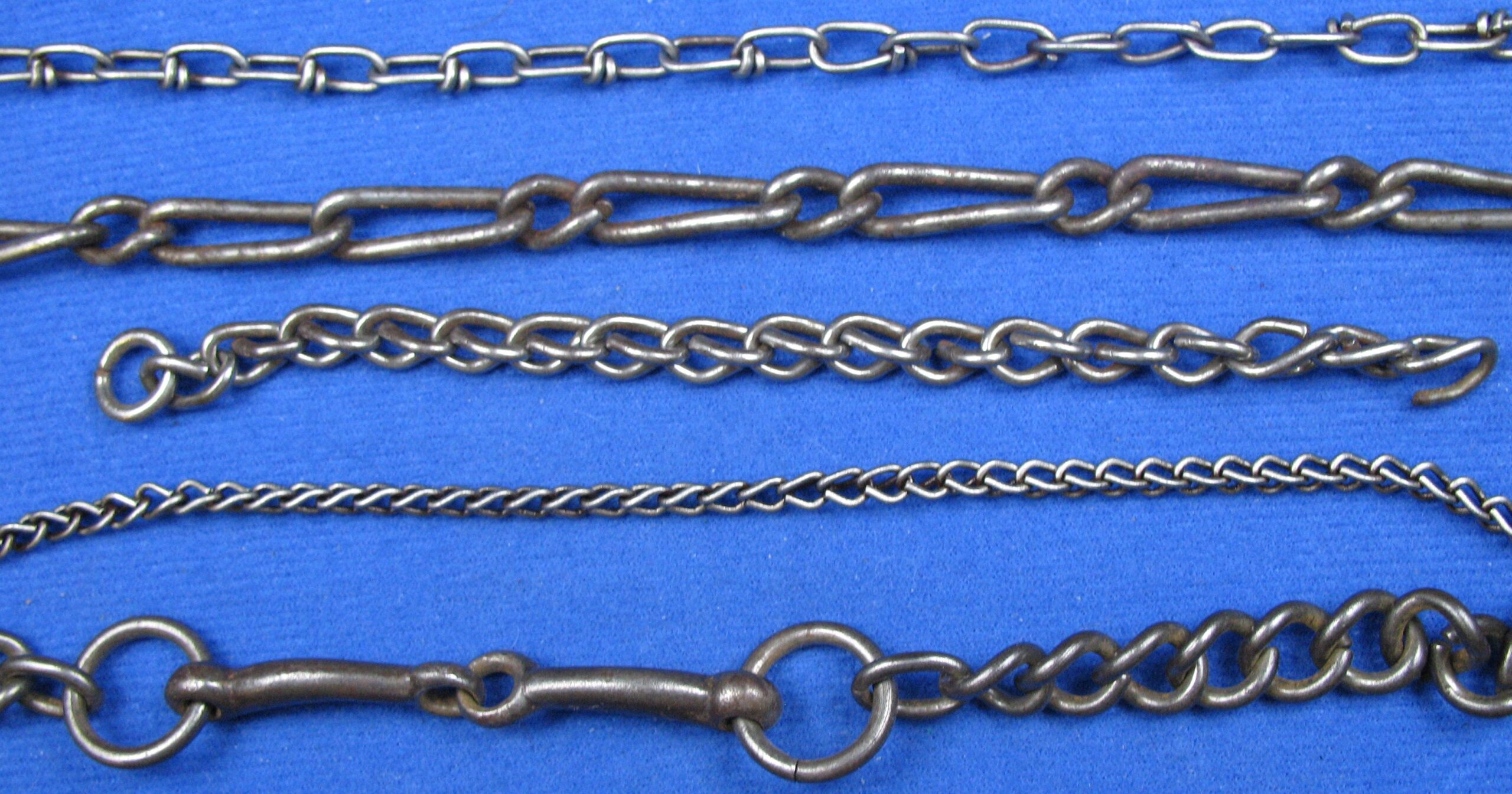
Next up is a wrought iron link. Excellent old character to it.

In closing some various applications:



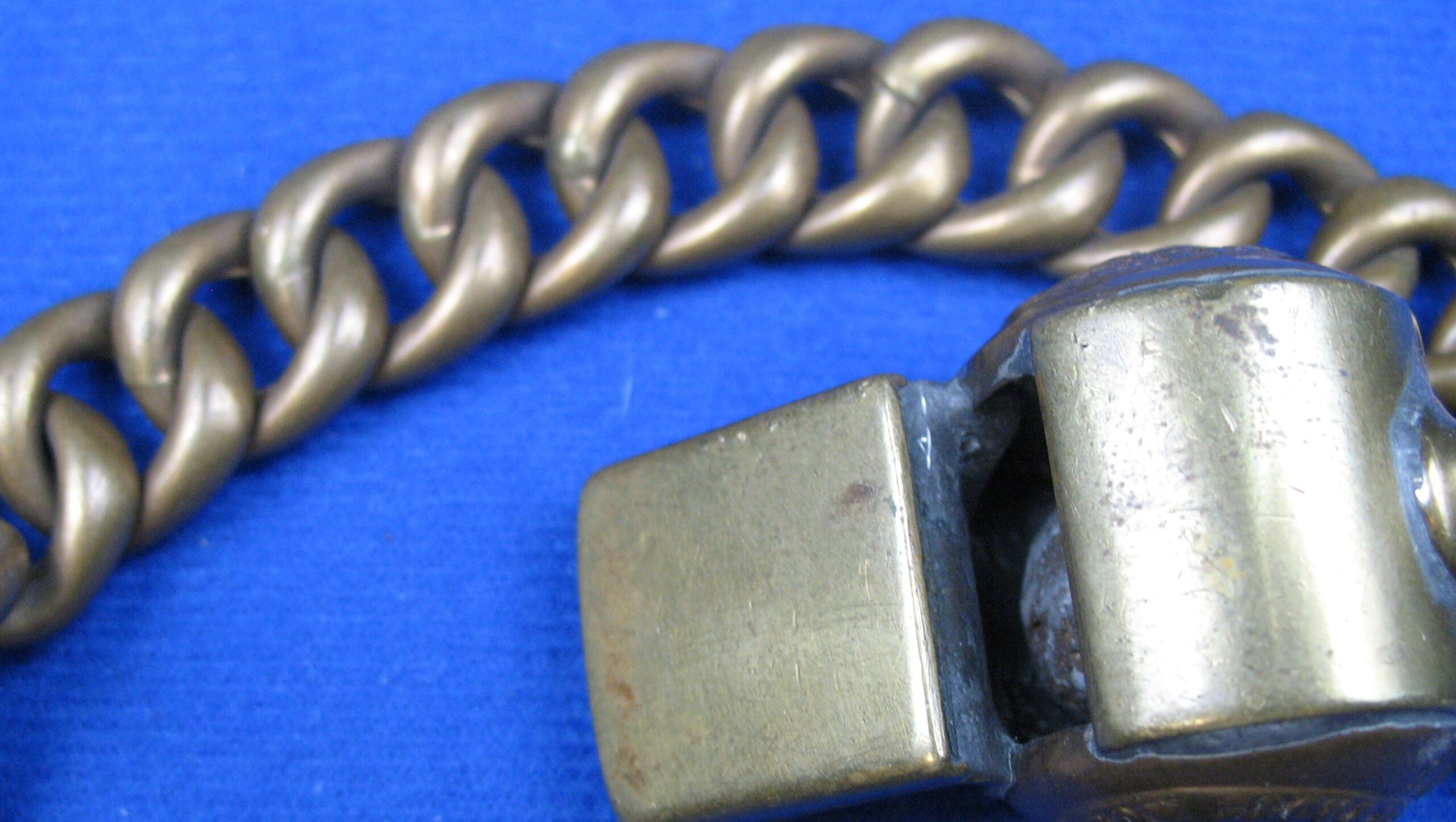
This extra-large brass curb link came with a very early five-piece escargot from Glasgow used by the fire brigade there. One can’t help but note that the whistle was meant to be kept track of. Very bulky.
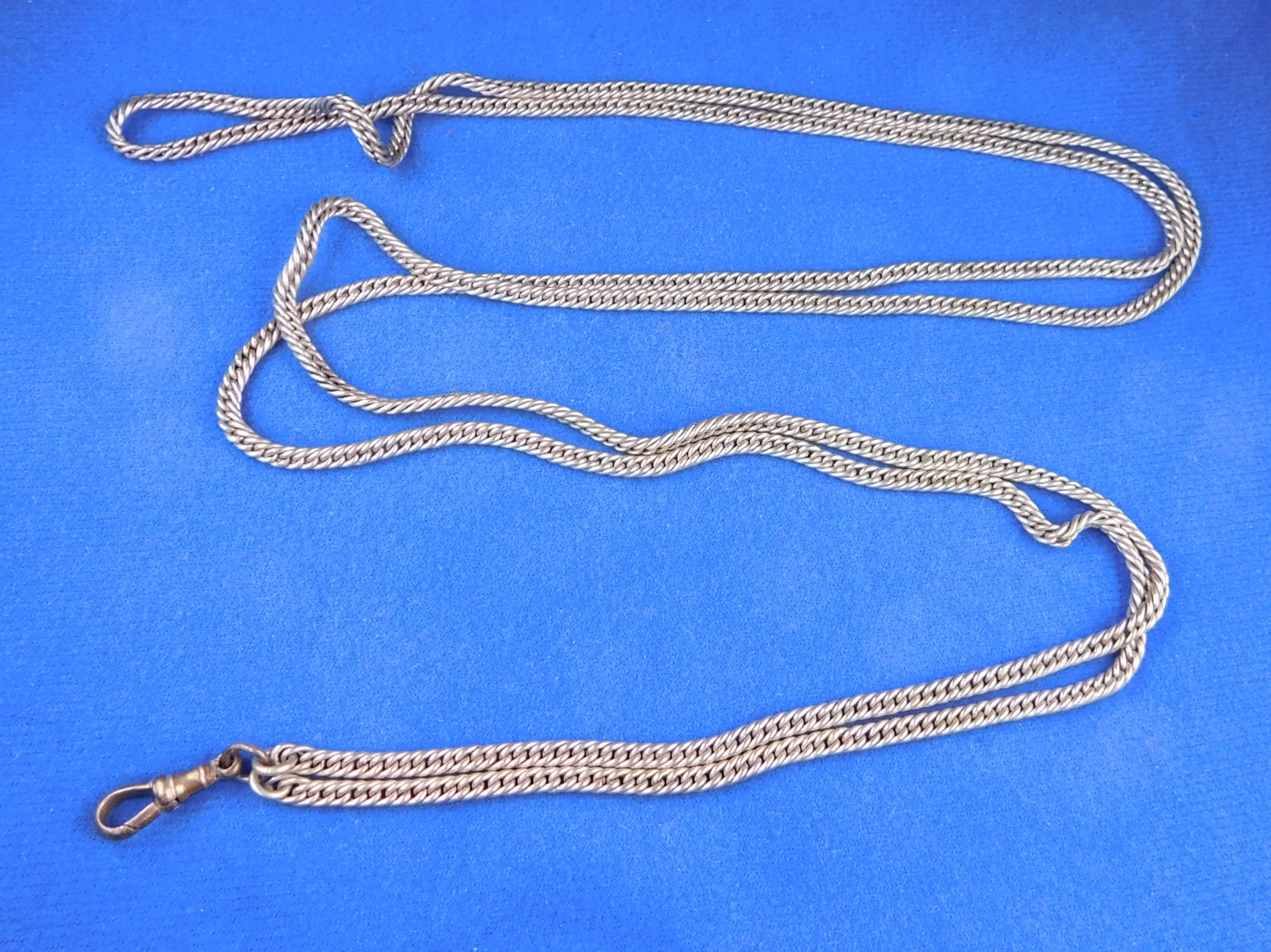
An example of a boatswain whistle chain from the USA.
Conclusions:
This is the first published array of a study in whistle chains by the manufacturers themselves. While so many whistles have after market chains applied by the owners that they can’t be ignored either.
As we search for more variety of original manufacturer chains, we will add them to the group here.
TWG
Posted July 1, 2013
Revised November 22, 2018
Revised September 3, 2020
Revised October 11, 2020
Revised December 30, 2021
Addendum January 2, 2022
Revised February 13, 2022
Revised February 23, 2025
Revised December 2, 2025
Revised June 10, 2026
Bibliography:
- TWG Reference Collection
- Catalog: Hudson, 1910
- Catalog: Hudson, 1935
© – All photos with blue background property of The Whistle Gallery reference collection. Please contact The Whistle Gallery for permission of use of any website content. Spotlight articles are copyrighted. Please contact The Whistle Gallery for permission of use of any website or Spotlight article material written or otherwise. Use of photos without authorization is prohibited.


 Users This Month : 3191
 Total views : 180036