Whistory
In SPOTLIGHT 1 we looked just a little at the Bridgeport Gun Implement Company (i.e. BGI #601) bullet whistle under American made production whistles prior to 1900.
Commonly thought of as what kind of bullet whistle?
If you remember it was a production whistle, not as mistakenly identified as a ‘trench’ whistle or handmade hobby whistle that a soldier or other person put together while sitting back in some hole or trench or even at a home workbench.
It is a high-quality whistle design, and we would like to investigate its designer and the subsequent production of it prior to 1900.
What are the features of this bullet whistle?
The 601 whistle has attributes of a round whistle with one window, but with the design of a diaphragm inside rather than a fipple at the mouthpiece, much like a tubular shaped whistle.
The mouthpiece is round rather than half round with a fipple. The target market was hunting. It came in two sizes, the smallest of which has not been found yet, but is in the patent history.
It was offered in Brass and gilded over brass mouthpieces.
Whistle Classification
| Type | round |
| Maker | Bridgeport Gun Implement Co. |
| Category | hunting civil |
| Material | plated brass brass copper |
| Features | gilded |
Whistle Archaeology
C.D. Leet (apparently the father of C.S. Leet), laid the groundwork for these whistles by way of his business dealings in the Bridgeport Gun Implement Company, which was formed on December 28, 1869.
Along with his other patents and witnessing signatures to various other company patents in Bridgeport, that came over the next 15 years or so, was one he had patented (along with Hotchkiss) — a shell cartridge (patent #98,278 — dated that same year) that was said to be improvements in the ‘boxer’ cartridge.
He had been making ammunition earlier (1862) as a small manufacturer. In 1878 came another improvement in a cartridge that C.S. Leet was a witness for, patent #208,247 dated Sept 24,1878.
C.S. Leet went on to patent the call whistle #250,083 – dated November 29, 1881, taking only 5 days from filing to issuance – just three years later, after the latest patented cartridge already mentioned. Here is the actual patent information.
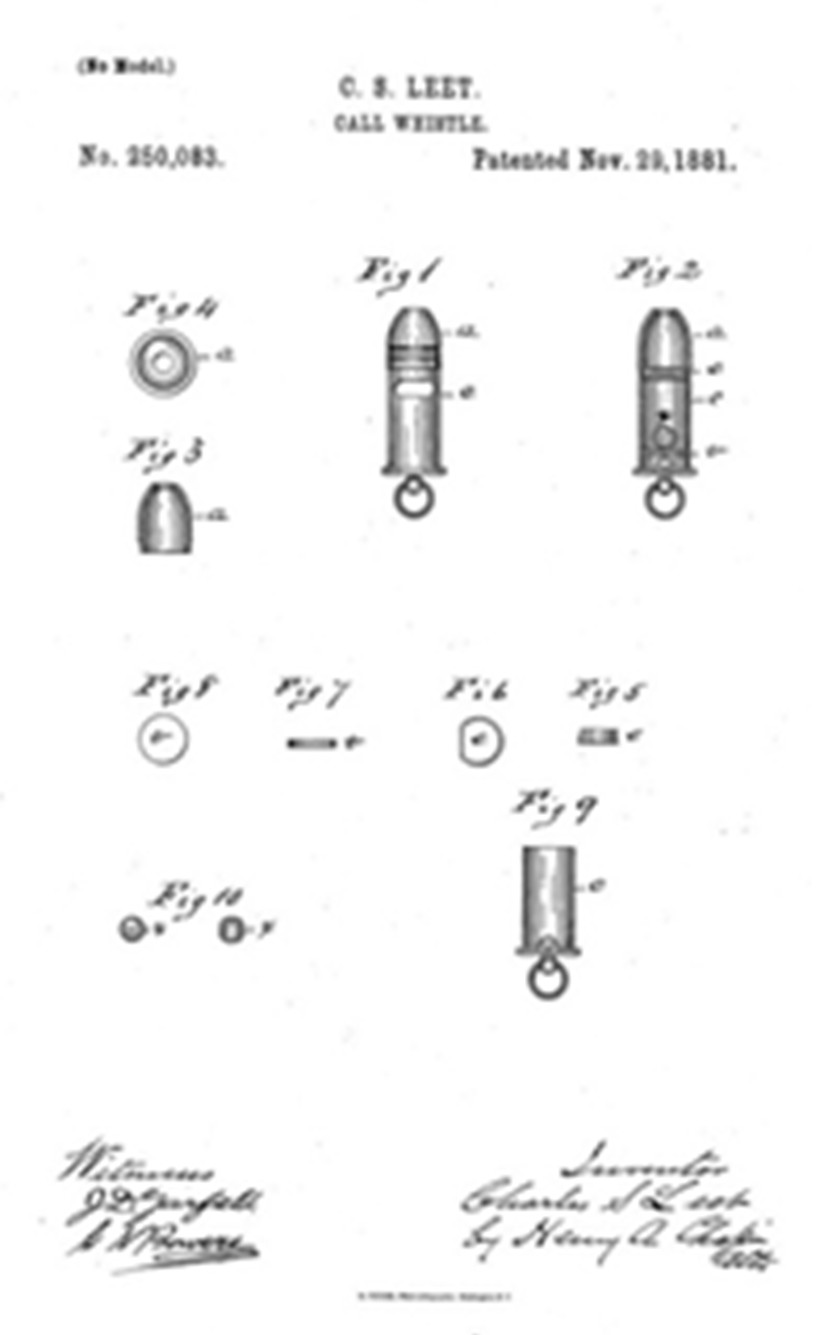
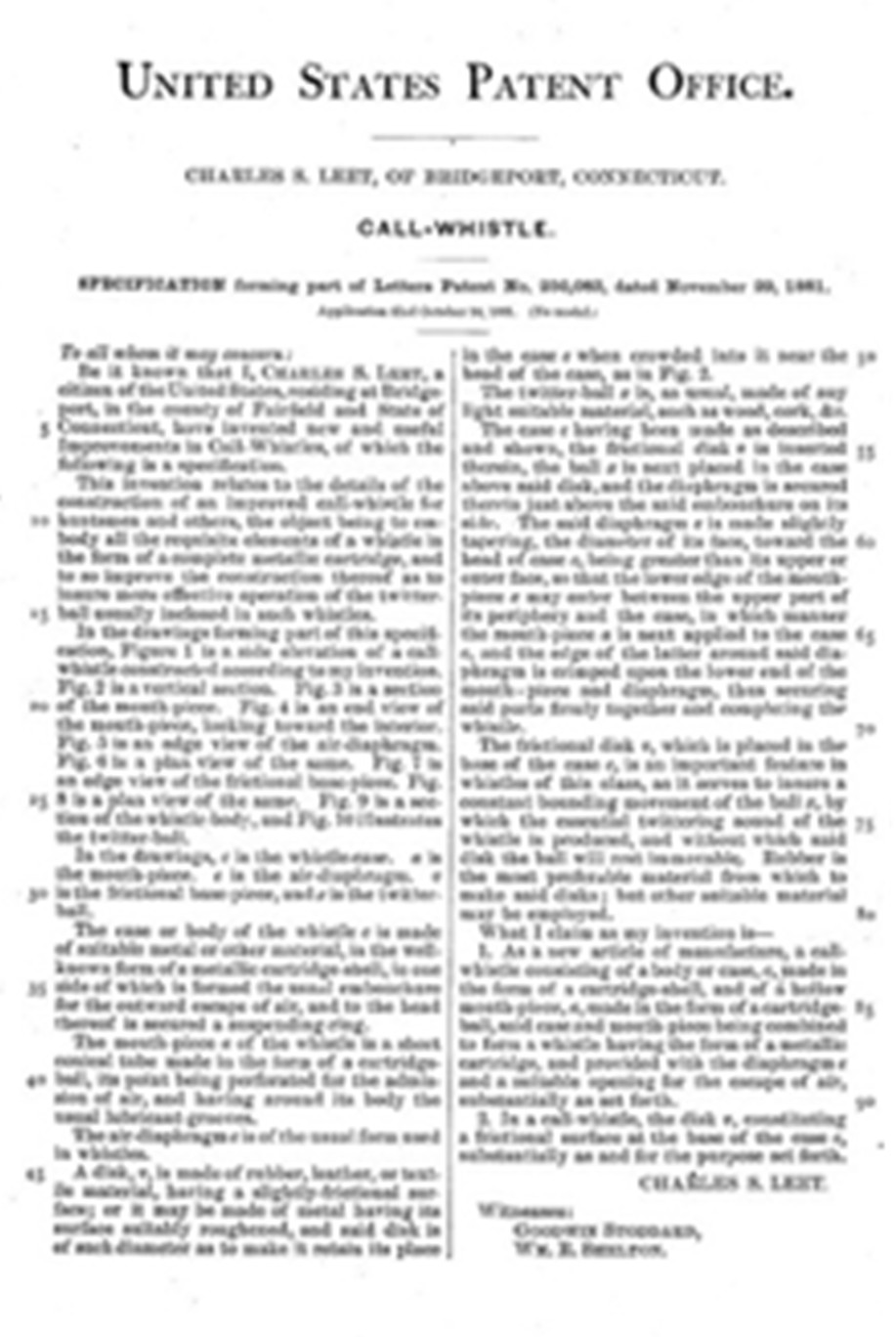
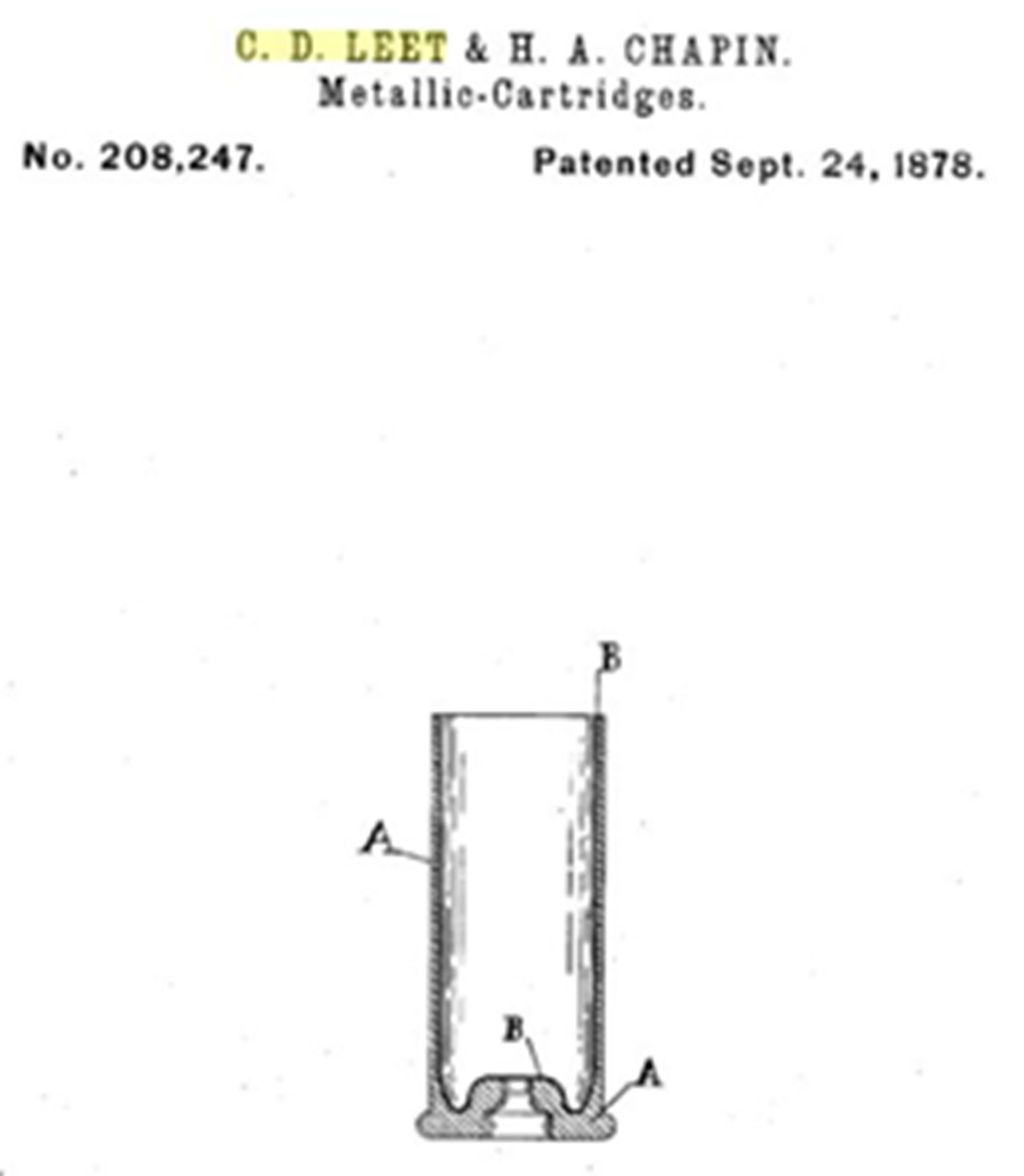
One can easily see the similarities in structure to the earlier casing in production. His design (C.S. Leet) was for huntsmen (not police per se) The casing is in the form of a metallic cartridge – shell and the mouthpiece is in the form of a ‘cartridge-ball’. It would go on to be manufactured in two sizes, a 50-caliber carbine cartridge and a 33-caliber pistol cartridge as seen in an 1883 Tryon catalog. It was offered gilt and nickel finished. An example of the 33-caliber model has not surfaced yet.
How long this whistle was manufactured is not known, but it disappears at about the turn of the century, making it scarce. It does surface from time to time though and is a very high-quality whistle, quite shrill.
As of this writing, (Feb. 10, 2013) there is one listed on eBay for almost 500 dollars. However, one sold this past summer on a BUY IT NOW for under 30 dollars.
Some were made with a ‘twitter’ ball (wooden with a hole through them) some were not. Some had flat stones instead. We have examples in brass and copper materials. There are handheld only models but typically with a ring for a chain.
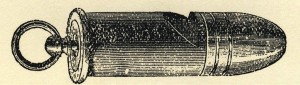
We might take a moment here to look at an early advertisement of the 601. The knop is a little higher up than usual and what really jumps out at you is the different window, half rounded. This whistle also has not surfaced.
Whistology
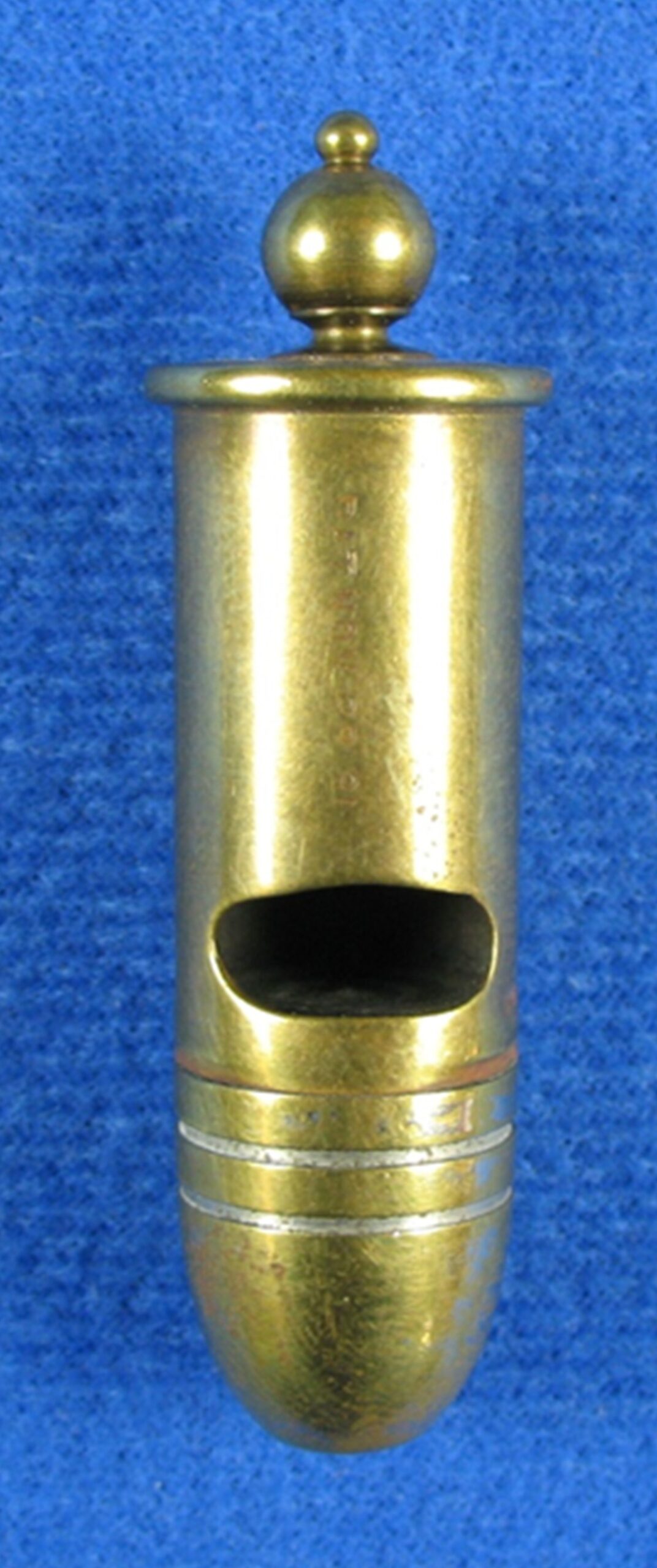
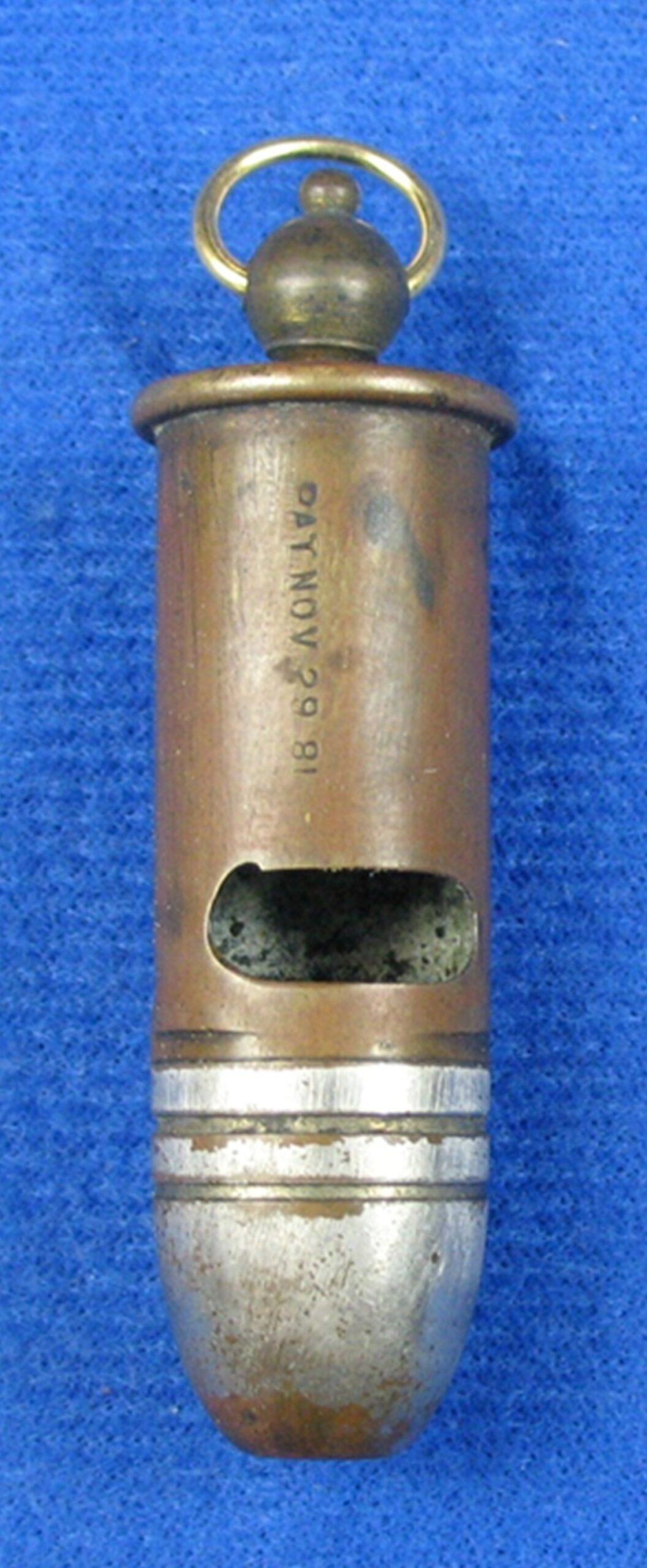
Our first look is at a handheld model 601 entirely in brass. You may note that the top is not just a round ball knop with a hole through it for the chain, but has a bit more design with a tip and works with the ‘extended’ knop. It attaches to where the center pin would be. In the example on the right, we replaced the missing ring.
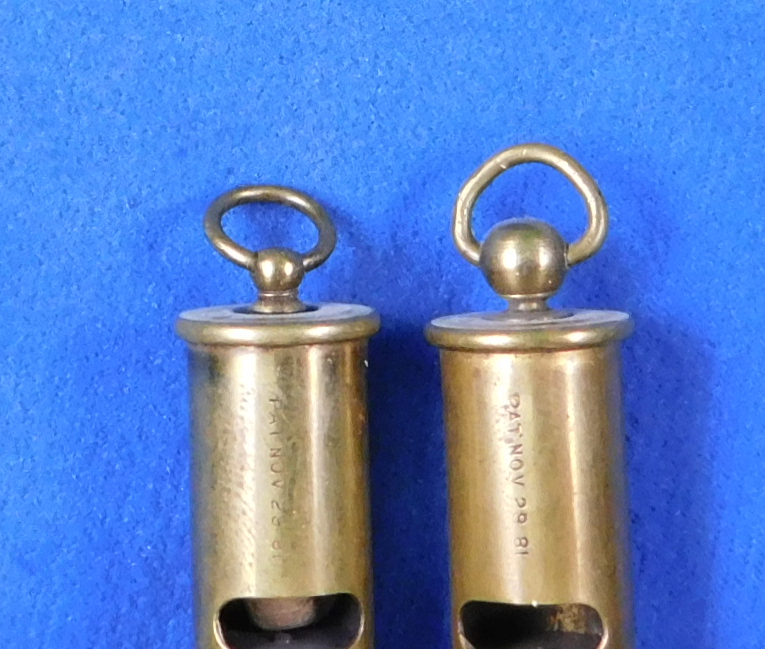
Further, the patent date when stamped is always to the front above the window. You can compare this to the ‘rougher’ made (note the window cut is off center) copper next to it, the bullet end being gilded.
Typical of these knops it has two holes in the knop that do not go all the way through. So, the ring must be an open ring pressured into the holes for retention. This made it easier to lose that ring and so when we found it missing, we had to replace it. The length is 1.8 inches or 46mm for the main body itself and it weighs 14 grams.
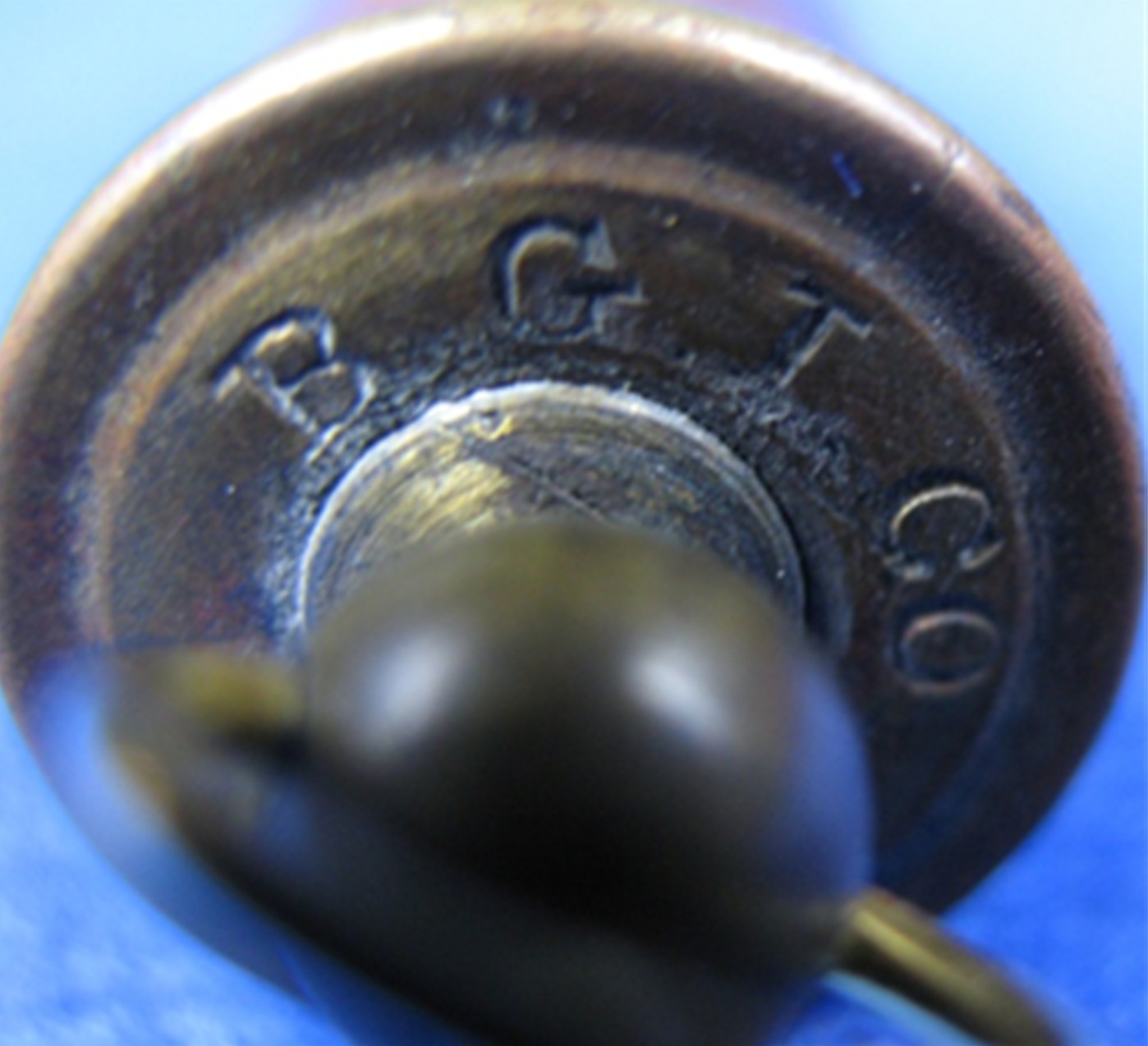
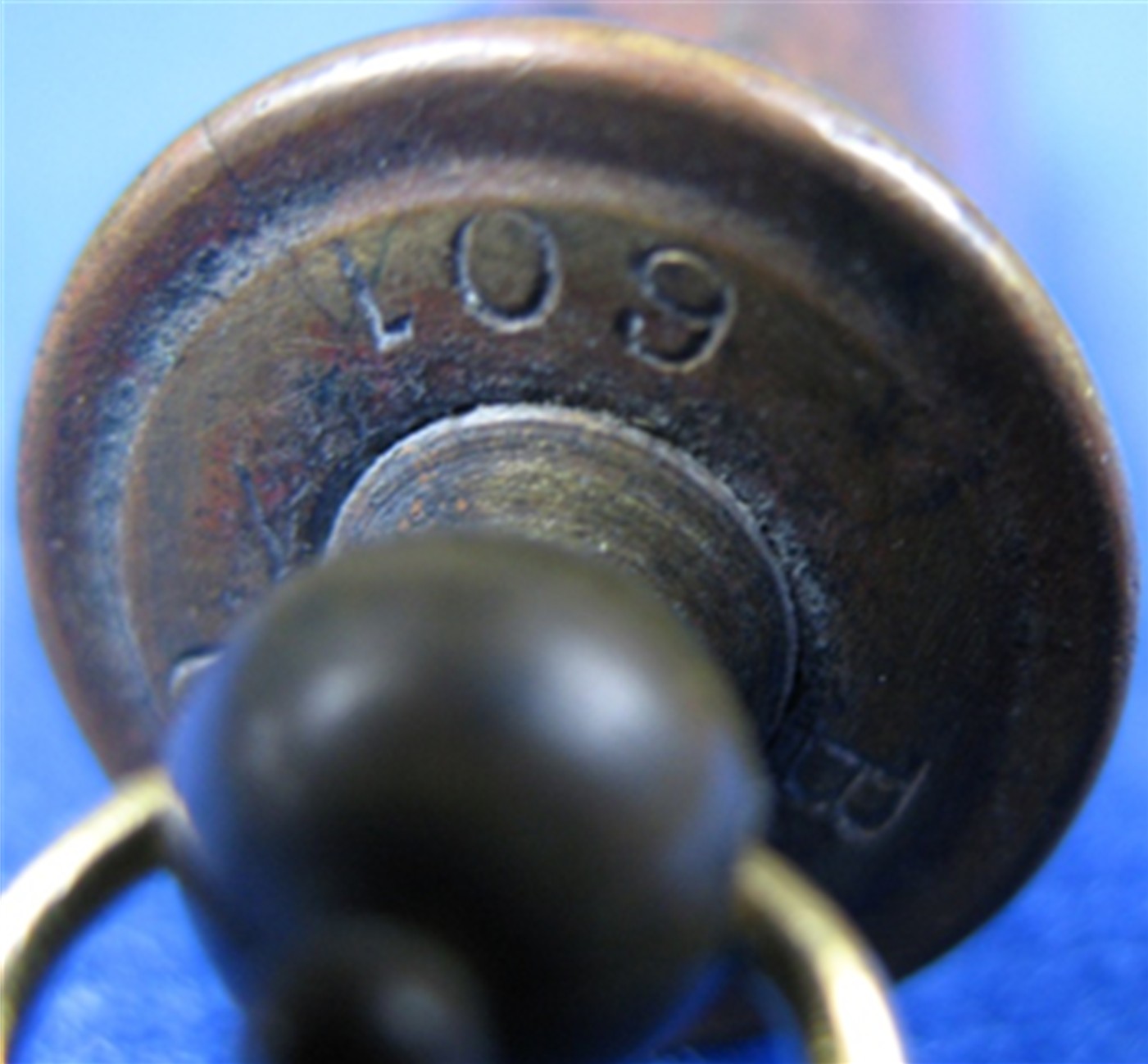
The following two pictures show where the stamp for BGI is displayed and the model number.
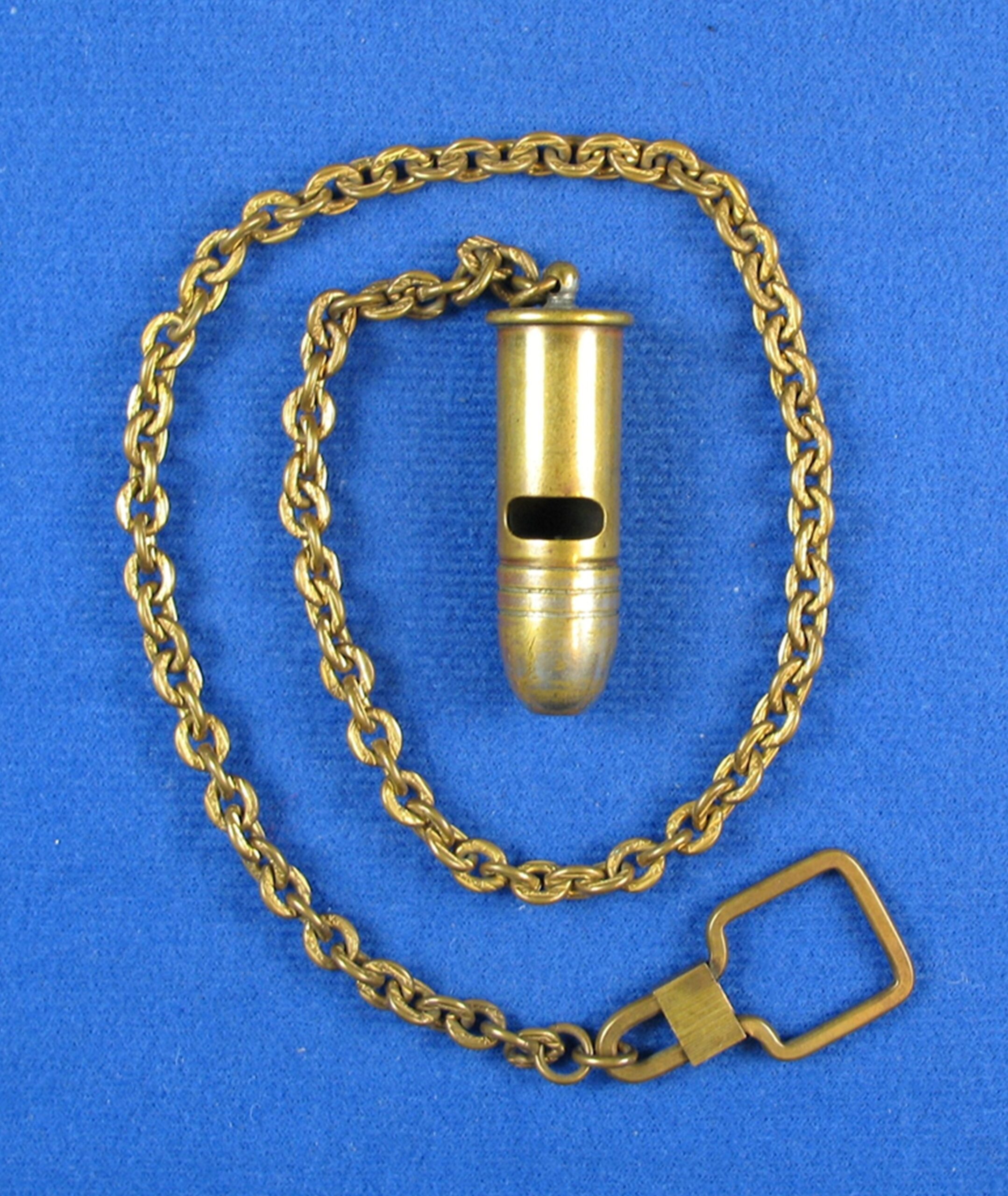
Next is the plain round knop that is seen more often — when found, this one was fitted with an aftermarket chain attached at some point of ownership. The knop is very small, and the ring is original. There is no patent stamp on the front of this one.
In the following picture we see two different simple round knops, one smaller, one larger.
Conclusions
For almost twenty years the Bridgeport Gun Company produced a high-quality bullet-shaped whistle. Two sizes were made, although only one size has been found.
There may be variations not found yet. They are scarce but do come up occasionally.
It was marketed for hunting mainly.
TWG
Posted March 13, 2013
Revised October 11, 2020
Revised February 12, 2021
Revised December 30, 2021
Revised January 30, 2022
Revised March 27, 2025
Revised December 2, 2025
Revised June 10, 2026
Biblography:
- TWG Reference Collection
- The Whistle Gallery Archives
- Google Patents Search
- Catalog: BGI – 1899, 1902
© – All photos with blue background property of The Whistle Gallery reference collection. Please contact The Whistle Gallery for permission of use of any website content. Spotlight articles are copyrighted. Please contact The Whistle Gallery for permission of use of any website or Spotlight article material written or otherwise. Use of photos without authorization is prohibited.


 Users This Month : 3154
 Total views : 179997