Whistory
For this Special Edition SPOTLIGHT, we are focusing on the description of three sizes of the three & four tube 1845 Registered Porteous Wind Instruments. Previously, it was thought there was only one size of each. Perhaps this was due to the picture on page 46 of More Whistles, Martyn Gilchrist, 2005, who was an early pioneer of whistle collecting and publications.
How Rare are Porteous Wind Instruments?
Currently there are more Porteous whistles known and can be compared. Why are these rare whistles? Several factors come into play such as age, quality, production and therefore rarity. Possibly they are kept longer due to their uniqueness and do not come to market, because of this. Whatever the reason, we now can study them more closely.
It may be that others will surface, such as duplex or five tube models. In a future article SPOTLIGHT (SPOTLIGHT 53) Richard Porteous will be described in detail as a designer of many whistles. The only validated earlier dated whistle by him is the Field Pipe which preceded the Wind Instrument by as many as 15 years.
Who Manufactured These Wind Instruments (Whistles)?
Stevens and Son is attributed to manufacturing Porteous’ earliest whistles (excluding the Porteous Field Pipe).
The Porteous Field Pipe of 1845 did come in brass, which has not been seen yet, but also fine nickel silver and even sterling silver. A silver field pipe has not been recorded yet. The Porteous Field Pipe reflected the quality and work of a musical instrument company in its time. The Porteous Windpipes were somewhat crude and reflected another manufacturer.
However, as said, the style and quality of the musical instrument in the Field Pipe point toward a different maker. The roughness in the Wind Instruments reflect less fine workmanship, in threading, finish and structure.
The Porteous Field Pipe of 1845 did come in brass, which has not been seen yet, but also fine nickel silver and even sterling silver. A silver field pipe has not been recorded yet. The Porteous Field Pipe reflected the quality and work of a musical instrument company in its time. The Porteous Windpipes were somewhat crude and reflected another manufacturer.
However, as said, the style and quality of the musical instrument in the Field Pipe point toward a different maker. The roughness in the Wind Instruments reflect less fine workmanship, in threading, finish and structure.
Whistle Classification
| Type | multitube |
| Maker | Porteous (designer) J. Stevens |
| Category | railway |
| Material | brass |
| Features | models |
Whistle Archeology
The Porteous Field Pipe of 1845 did come in brass, which has not been seen yet, but also fine nickel silver and even sterling silver. A silver field pipe has not been recorded yet. The Porteous Field Pipe reflected the quality and work of a musical instrument company in its time. The Porteous Windpipes were somewhat crude and reflected another manufacturer.
However, as said, the style and quality of the musical instrument in the Field Pipe point toward a different maker. The roughness in the Wind Instruments reflect less fine workmanship, in threading, finish and structure.
Possible Makers Involved in the Field Pipe Wind Instruments
It could be for example that because Porteous spent his life as a band leader, that he contracted a musical instrument maker for both designs, possibly makers such as Kohler, Potter, Pask & Koenig (who were advertised distributors of the Field Pipe), to manufacture his whistle designs. On record that Swaine and Adeney were the SOLE distributors in 1845.
(See Richard Porteous SPOTLIGHT 53)
Whistology
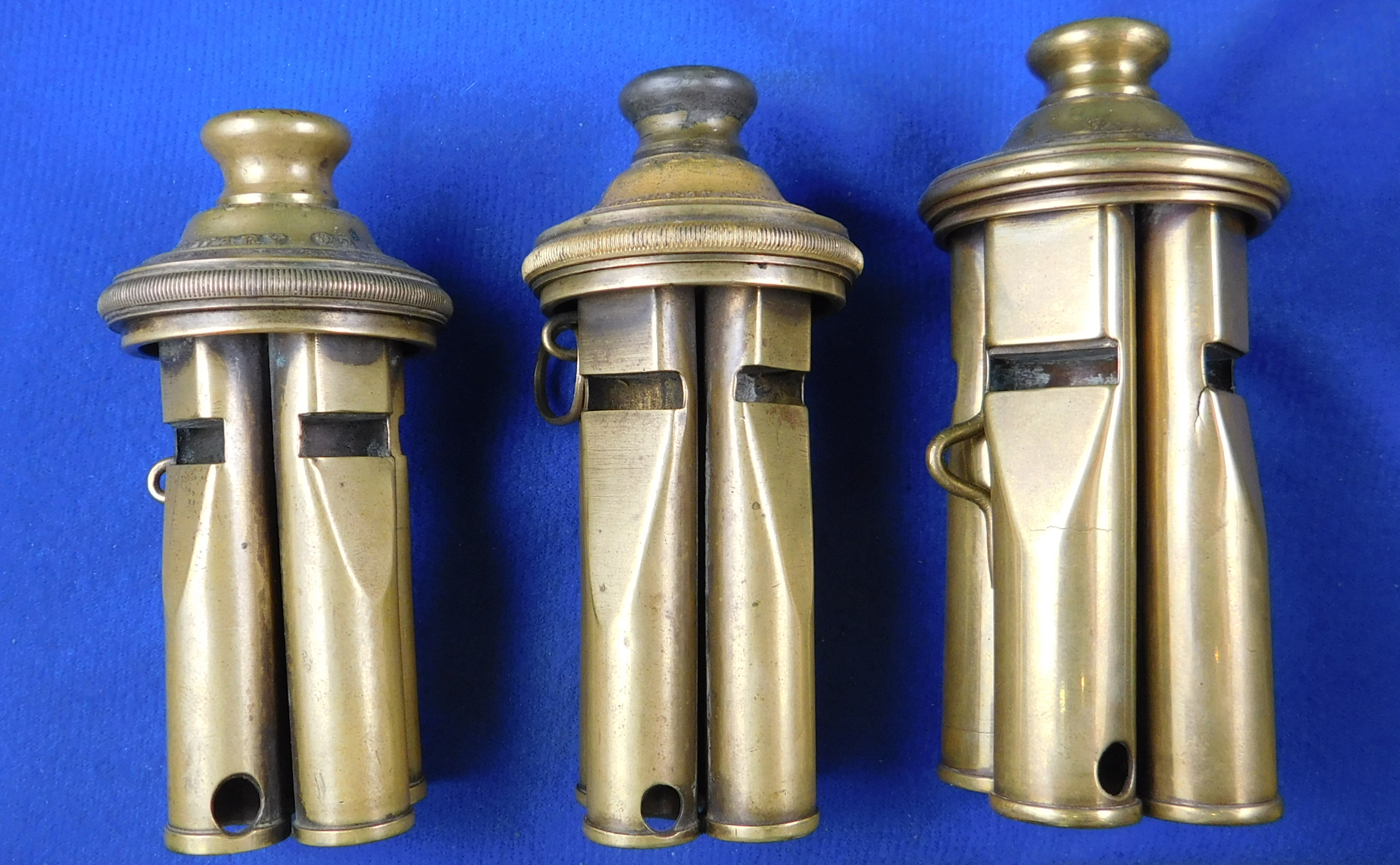
We start off comparing the two sizes of three tube Wind Instruments. The length of the larger is 9cm, while the smaller is 7.8cm. The larger weighs 150 grams, the smaller is 97 grams.
The inside diameter (ID) of the larger tube is 1.6cm, whilst the smaller is 1.2cm. Top cap is 4.3 wide, the smaller is 2.5cm wide.
Here the larger can be seen as a cumbersome whistle, although beautiful in workmanship.
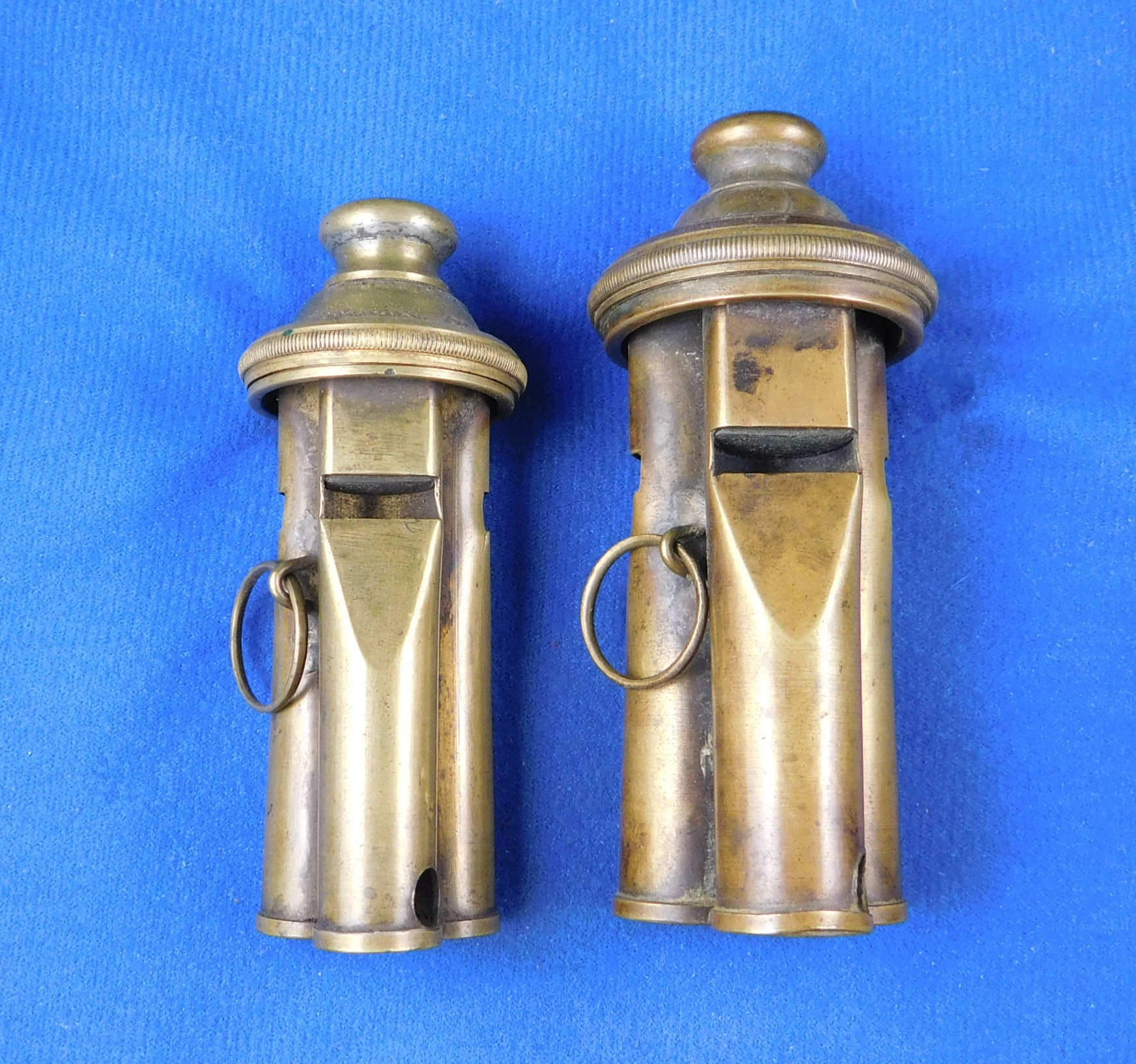
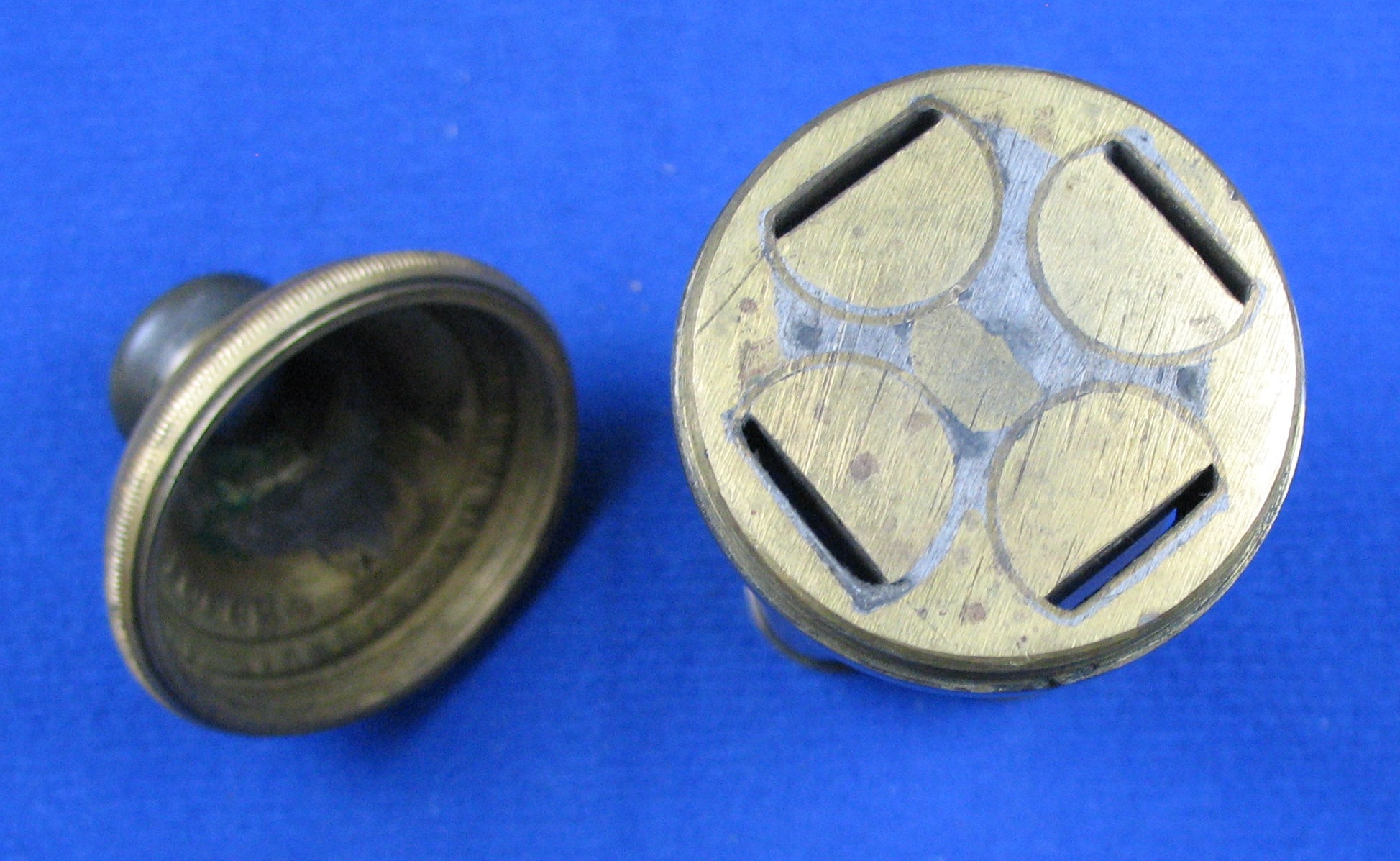
Note the distribution center under the top cap as follows. Threads on such a wide top cap are rough.
Workmanship reveals the thinking of musical instruments. Each whistle is of brass and the cast tops are quite ornamental. The windows slanted and looked somewhat like pipe organs.
The following three sizes are of four tube design, leading us to think there is another third size of three tube whistles.
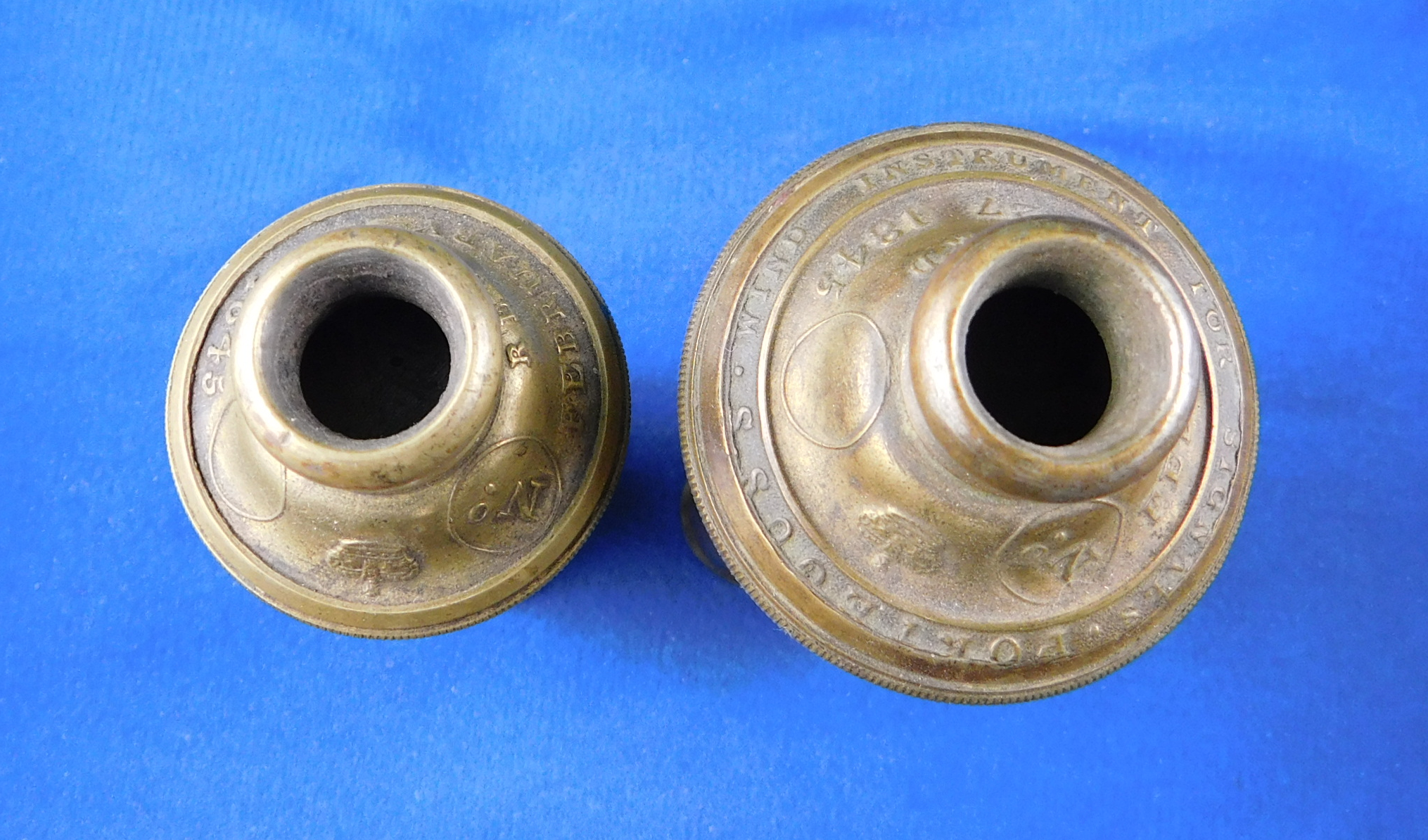
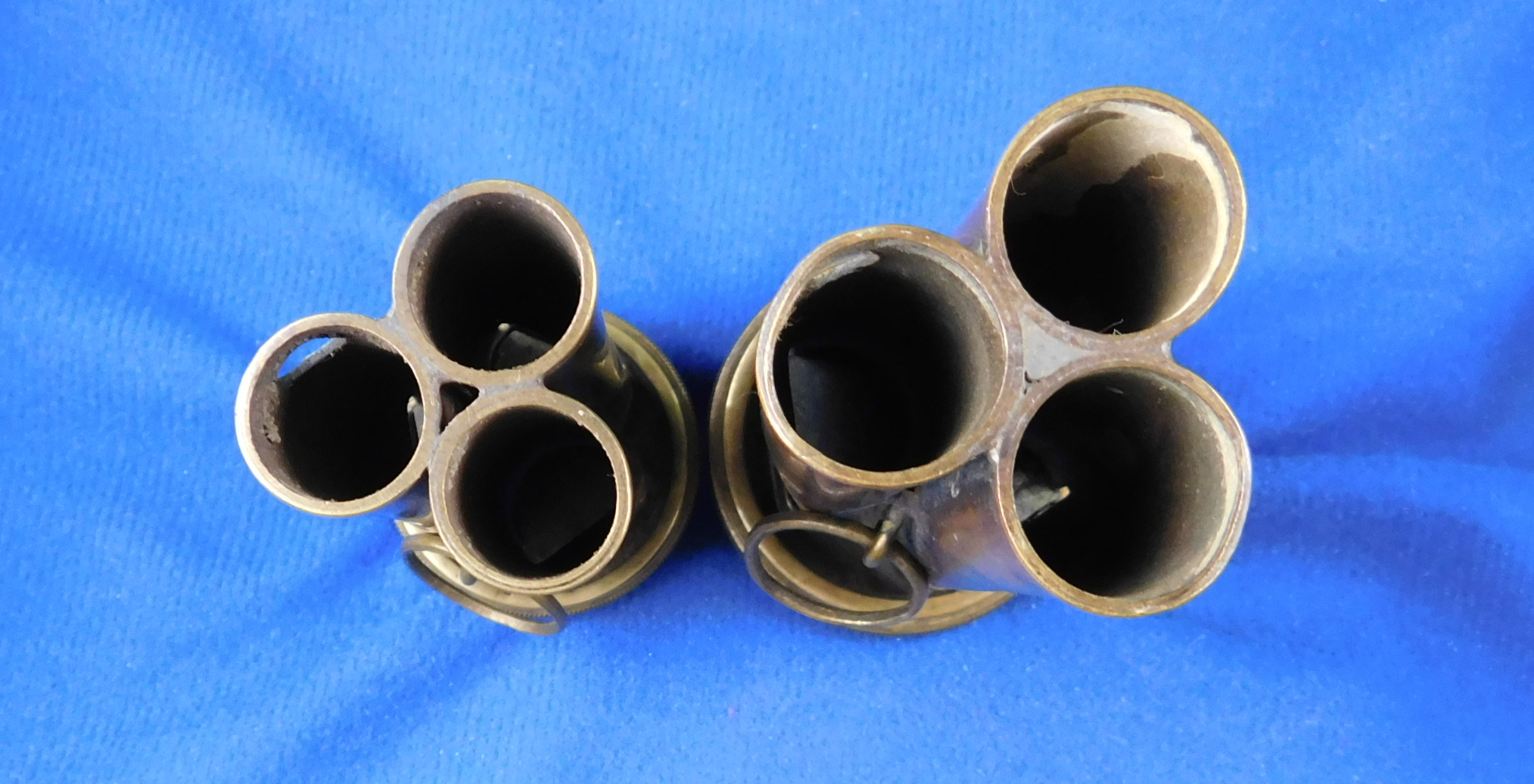
Next, we examine four tube whistles of the same type of design.
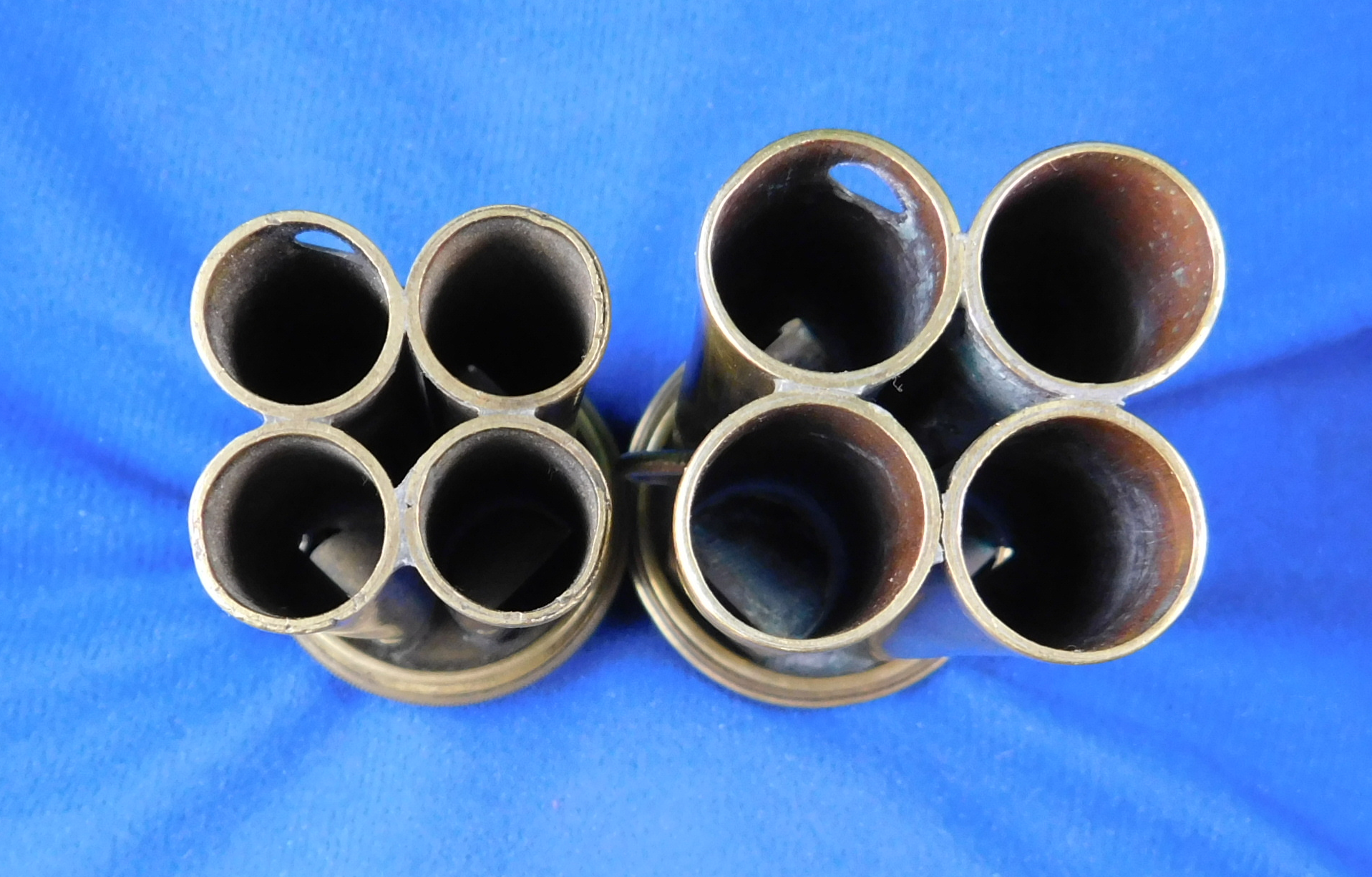
The top cap is 3.5cm and weight is 185 grams.
Lastly, a comparison of all three whistle models. Three, four and six (214 grams) tubes.
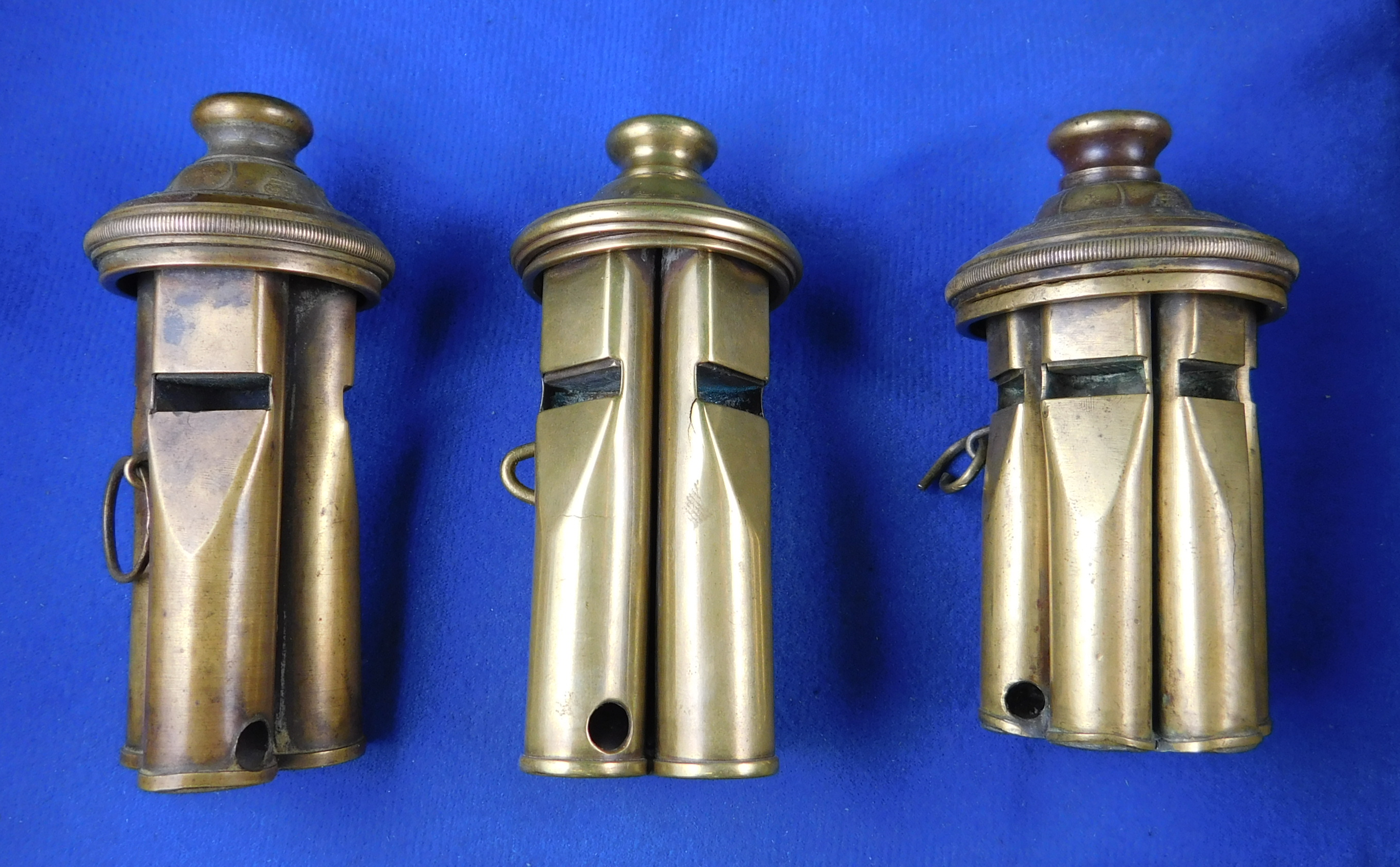
Conclusions:
With the advent of several sizes of Porteous Wind Instruments comes a widening of our vista and adds to the worldwide database. What are we now looking for and why? Well, at this point a duplex or five tube 1845 Registered Porteous Wind Instrument would be possible.
One recorded news clip of the day describes Porteous as making different sizes, so we have reason to think that he made a medium three tube. This whistle is possibly already in someone’s collection and not described.
The workmanship is exactly alike on all the 2 & 3 tube Wind Instrument top caps, reflecting the registration. All are screw on tops, albeit ‘rough’ in application — something that would be improved upon dramatically in time with other makers (the Field Pipe is an exception).
Notably these Wind Instruments ceased to be made at some point in time between 1845 and approximately 1860 when he shifted direction. Whether they were too bulky to use or too expensive to make is not known. None the less, Richard Porteous designed a beautiful series of whistles with the Porteous Registered Wind Instruments.
TWG
Posted June 16, 2013
Revised November 22, 2018
Revised September 2, 2020
Revised January 16, 2021
Revised February 12, 2021
Revised December 30, 2021
Revised February 13, 2022
Revised February 23, 2025
Revised March 27, 2025
Revised December 2, 2025
Revised June 10, 2026
Bibliography:
- TWG Reference Collection
- The Whistle Gallery Archives
- More Whistles, Martyn Gilchrist, 2005.
- Google Search
- Advertisement: Porteous Field pipe – 1845
- Advertisement: Swaine and Adeney – 1845
© – All photos with blue background property of The Whistle Gallery reference collection. Please contact The Whistle Gallery for permission of use of any website content. Spotlight articles are copyrighted. Please contact The Whistle Gallery for permission of use of any website or Spotlight article material written or otherwise. Use of photos without authorization is prohibited.


 Users This Month : 1483
 Total views : 183650