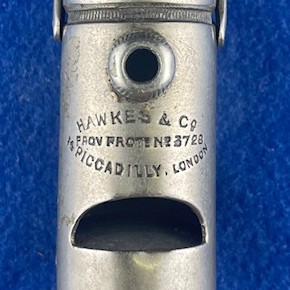
rusty whistles

The next best thing to steel is perhaps sheet metal steel. Heavy steel whistes are very hard to beat and I'm not saying that sheet metal ones come very close in comparison. However, we do love steeeeel don't we ????

How do you deal with rust on them ?? On a heavy one you can use a wire wheel or better yet a brass wire brush. However sheet steel is too thin for that. Well, perhaps a softer brass brush would work. Steel wooooool works OK for me, and I also use WD-40, which is a solvent. I even soak them in it for a few days. Love the way it darkens them and am almost addicted to that smell of whistle cleanliness 🙂

It may be impossible to remove rust that is on the inside of the whistle but the WD-40 might stop its progress somewhat. Just got to be careful not to scratch the whistle in the process is all.

Not too much of a problem for us here as these kind of whistles are usually dated too recently to mess with, but when looking outside the common whistle digs one does come across some keepers. Good to know anyway…..
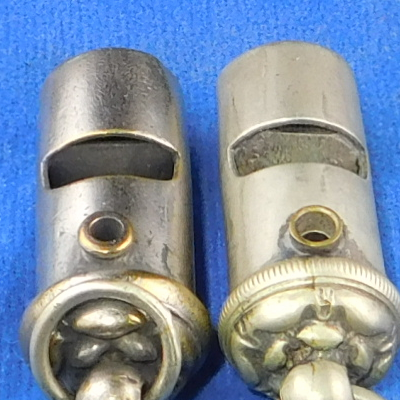
signal whistle

Just can't get off this subject of grey metals used in whistle makes >>>>  when we usually see brass or nickle plated brass whistles.

Here's another…..

Pot metal, also known as monkey metal, white metal or die-cast zinc, is a colloquial term that refers to alloys that consist of inexpensive, low-melting point metals used to make fast, inexpensive castings.

There is no scientific metallurgical standard for pot metal; common metals in pot metal include zinc, lead, copper, tin, magnesium, aluminium, iron, and cadmium. The primary advantage of pot metal is that it is quick and easy to cast.

Qouted from wikipedia…

I see this used a lot on German whistles with the stamp Signal on it. You know I used to think that it was a whistle used for signalling and that was why it was stamped on it that way. And it may well have been true. However that is not what the stamp itself means.

Turns out a whistle manufacturing company in Germany named for Martin Signal made them !!! Beyond that we do see a LOT of cheaply made ones were produced. You can tell them right away from the knop —-  as it has a slightly raised shoulder and squat round knop.

The cheap ones are a dime a dozen. However one might take note that mixed in we also see nickle plated brass ones that are quite well made I might say. So look closely and see if you can spot the difference, otherwise you might pass right over and miss a great whistle — albeit another escargot 🙂

insights into rare whistles

….here is where one really can enjoy other collectors.

Received a whistle today in the mail. It is model #168 in a German whistle catalog — manufactured by Martin Signal circa 1900. It is a long tube shaped whistle that sounds a little like a train, but without the extra tubes. Really an interesting hollow sound. It is almost 5 inches long. Quite long for a whistle really. Nickle plated brass. Just a tube with the end cut off and then reattached with four wire like 'extensions' that make it almost half an inch longer. The mouthpiece is flat and the metal used is quite thin.

Now I look at this whistle and think, hmmmm looks a LOT like an F.L. Johnson patented Jan 29, 1889 cycling whistle from pre 1900 in the USA. Could there have been any influence ?? Why yes one would say !!! Why is that ??

For one thing they are the same diameter.

Then the top ring is actually a wire that has a slight bend in it running across the end to allow the chain or string to loop through —- and they are exactly alike on both whistles.

Those 'extensions' ( 4 ) at the mouthpiece are also the same on both whistles and only one other USA manufacturer ( Hatch ) used the same design and he lived at the same time as Johnson and even in the same town.

There are two rings around the area that is extended and they are also exactly alike.

Why give it so much thought ?? Just observations really. But who was first and who actually designed this whistle  ?? That's worth knowing. So much for patents huh ???

Johnson and Hatch classified theirs as cyling whistles. Was Signal's or was it just to show off ??

Tid bits to share, just tidbits, alas no pix…unless you write in and request to see 🙂


How do you date a whistle

Good question. Can be frustrating, enough to make your eyes water sometimes !!!  Difficult but doable. Where do we start ???

Clues !!! How is that for vague ??? But really how do you date anything old ?? Circumstantial evidence it seems. Even a whistle with the date stamped on it can be difficult at times. Now, if it is a military whistle then the date on it is actually pretty good right ?? AND if it is hallmarked it is very accurate. However for most of the field, it is Sherlock Holmes and powers of deduction….

Where do we start then ??? ….

Patents >>> depending on what the patent is for and for how long it was good for at that time of issue.
Registrations >>> when it was issued and how long good for.
Catalogs >>> unless they used an old picture, otherwise works well.
Advertisements >>> whatever date of ad.
Manufacturer >>> the dates he actually was in business.
Internal parts >>> major telling point !!!
Design >>> takes lots of experience looking at different whistles though.
Comparison >>> Easy to overlook this one !!! ( note the previous discussion on Tudor Rose rounds.)

Now take as an example…. You get your whistle and look at the stamp if any. Do you know the maker right away ?? That would help the production dates a lot. If not stamped by the maker then the perhaps the stamps the maker used for others ?? Listed in Collecting Police Whistles for many UK whistles.

Next, the all important parts inside — which many times were specific to that maker ( however sometimes several manufacturers used those parts or designs ) Now go on to  design characteristics. Do you have similar ones to compare to ??
Is the word PATENT on it anywhere ?? >>> Even on the disc if tube shaped.

For what was the patent issued and to whom ??

We had several whistles in a row that looked alike, then one came with the manufacturers name on it. That told us who made the others and that helped to date them.

Really one is getting to CIRCA for the most part. Sometimes getting right down to the year if all falls into place, but usually not so. More like a period of time is doing really good. And keep in mind, it may take years to unravel. Or should I say to peel back clue by clue…

Like peeling an onion ??


tudor rose whistle

History has it that Henry Tudor united Lancaster and York whose heraldic symbols were white and red roses or was it red and white roses ?? Annnnnny way, the Tudor Rose became the heraldic emblem of England and eventually found its way on top of a Hudson round whistle. When did that first happen ?? Dunno. However in 1909 Hudson did patent a three point connection on the backplate under where your bottom lip goes when you blow it —–  of their round whistle design.

So we have a demarcation point don't we ?? Yup, we can thank patent 553.

The point ?? Well, Tudor Rose round whistles can be found with those interlocks and without. That dates them before and after. If we are looking at after they are stamped patent, then 1909 to 1922 is the window or circa, and later of course.

What if there are no interlocking tabs ( three ) ?? Using our great powers of deduction that would mean that it was made before 1909 !! However when did they start being made ?? Can't say. So to be safe how about circa 1900 ??

Just goes to show you how involved whistle collecting can be, I was examining some of these older ones tonight. Four to be exact.

First one is longer than the others by over an eigth of an inch. That would be miles in whistlespeak !! Interesting 🙂 The next three are the same length ( in case you are shooting ahead of me )…. Looking closer we note that the edge around the top is very smoooooth. Why is this important ?? Because all three others have milling. oooooooh variations !!! ( just a collectors thing is all ) Not only that, but the milling on the second and third is straight up milling and the fourth is reverse angled milling. Weird huh ?? Oh yeah !!! Now we're rolling !!! And we all thought that all Tudor rose rounds were alike !!!!!

I got to really looking now ( panting ) and you know, the inside fipples were three out of four different types !!! Wow !!! Then I turned the whistles sideways ( shaking with excitement by this time ) and the stopholes were different too !!!! ACH !!! Is this toooo much or what ???

Let's review and see….

1) different lengths
2) differnt millings
3) different fipples
4) differnent stopholes

Now I am looking for more variations and I haven't even looked on the other side of 1909 !!!

police whistle

Yeah I know, we have talked about ( or me jabbering away anyway ) Police Whistles before, but why are police whistles seemingly at the top of the food chain when it comes to whistles ?? Why do they get the limelight ?? I mean even a book is dedicated to them and oh yes, similar whistles.

Some would argue that some Ivory whistles or Silver whistles or the latest rage — Asylum whistles ( or ?? ) are higher up. Perhaps they are more expensive and certainly more artistically designed, I would venture to say —  no conflict there. However for the average Joe ( that's you and me ) the collectability is far down below in the trenches — where we can afford them more and still have fun.

So again I ask—why are they at the top ?? Well, here are a few reasons,

Constabulary Named )
County ( named )
City ( named )
City Police
Metropolitan Police
Police or Fire
Police
Police Special
Shire ( Named )
Borough ( named )
Traffic
Municipal
Officers Call
Cyclone Police
Signal Police
Police Alarm
Other countries forces
more ?????

Probably pretty obvious by now that there are a LOT of stamp variations, along with the different designs of the whistles themselves like beauforts in all their forms, escargots, tube shaped. Then there are the different makers….

Seems to just keep going doesn't it ?? Well, that's collectoing for you…. 


hungery for whistles ??

Had an aquatance send me an item, we'll call #@*. He started collecting them because of a contest between him and another friend.

The goal was simple. Each pick an item to collect ( ergo #@* on his part ) and then see who could reach 50 first. Harmless fun really. And cheap as no one else really was after those #@* anyway  ðŸ™‚

Interesting what people collect isn't it. Now LOTS of #@* later, there is a what some would call a significant 'collection' However you and I might look at it and ask why collect those ????? Kinda weeeeird you think ???? The same could be said about whistles……

What makes a collection so important ?? Lots of things I would imagine like history, caftmanship, rarity and so on. However it is always good to pause and ask…is there something else going on here — behind the scenes?? As we look for more, is something else driving us ?? The desire to aquire that is relentless. A hunger, a need ?? What one could add up to >>> as a craving….

For example:

After looking long hours for a rarity, when one is finally found, how long does that victory last ?? Do we go back and get the same pleasure we had when we first found it ?? In other words how lasting is each find ?? Or is it fleeting and the move is on for another 'fix' ?? Good questions to ponder !!! Does it not seem over the top to get emotionally worked up over objects ???

A collector once showed me a whistle and said that if 'so and so' saw it he would go GA GA over it !!!! Do we go GA GA ??

Try this on, compare whistles to bird calls. Similar right ?? But do we turn up our noses at a bird call and then salivate over a whistle ?? It would seem that whether we collect MAPS, CORKSCREWS, POKEMAN CARDS, BARBED WIRE SECTIONS ( and the list goes on forever !!! ) our individual passion is rooted way down below >>>>>>  where no one likes to go.

Well, at least not today…..


escargots

the lowly escargot…who will speak up for it ( them )

I WILL !!!

So many trip over them getting to the OTHER whistles and miss sooooo much !!! There are many nuances to find . And NOOOOOO they don't all look alike, there ARE differences.  Like what you say ?? Good question, let's look at just one thing ( well think about it anyway ) >>>>>>>>> The toothgrip.

Not much to look at, but looking closely one sees an important amount of variation and isn't that a big deal when differentiating them ?? You betcha !!!! Some are WIDE, while others are SHORT !!!  Then there are those that are only on the top and vice versa — well haven't seen it on just the bottom yet, but am looking and expectant   ðŸ™‚

I have even seen some that are applied after the whistle is done !!! Little flat curved pieces attached. All of it helps tell the makers apart. The curvatures vary too,  some really curved and some less.

Now add to that height and we have even more clues !!! Granted this is a little stretched….

The "piece de resistance" though has to be those escargots from India made during the 1940s. Wow, what work they took. Exmaining them closely shows that although it was common before this time to have the toothgrips pressed out by a machine, these industrious makers ( and there were plenty of them ) actually filed them into place !!! How ?? The metal was thicker on the top of the mouthpiece and someone had to sit there and file down the metal until only a rough toothgrip was left !!! Same on the bottom many times. How many hours did THAT take ?? Dunno, but a LOT of labor.

Doesn't take much to make me pant over whistles, but boy that's a sprint to get there !!!!!. Won't ever look at escargots the same again will ya ?? ….. Unless of course you are tripping over them.

metals used for whistles

wish I knew more about metals. I surfed the net today to find out where nickle plated brass goes to ??  Well, the nickle I mean. You've seen them right ?? A hundred year old whistle and all the brass showing through ?? It can't be all rubbed off, as extensive as I see it — and barely any left at the joints….

Many times one sees the whole whistle of brass and at the extreme edges some nickle plating remaining. Search as I might, not much written about oxidation and deteriorating of nickel. However 100 year old whistles nonetheless show quite a bit of it  !!!

Don't take me wrong, I love it myself. I much prefer the richer patina of old brass rather than the pristine look of nickle. In fact let's rank my most favorites from the tops to the least … I'm sure that's what you want to hear right now… yeah right….well anyway….

Tops for me issssss yep, you guessed it — nickle silver !!! The yellowish kind is the best, but ANY is great. ðŸ™‚ I even prefer it polished. Hmmm kind of makes me an oximoron ( boy, there's puns in there front and back ) since I don't really like nickle plating that much. Some prefer that very powdery yellowish patina, gotta give it to them,  it can look nice too I guess.

 2nd place goes to brass that has a very dark patina. Very rich looking. Can't touch it to repair it without ruining the patina though !!

Thirdly ( is that even a word? ) comes old steel that has that rich almost blackened look to it. Wow, even the chains look terrific that way. I'm salivating thinking about it !!!

( I'm inserting bronze in here, cause I missed it and so as not offend all the Romans of old )

Fourth(ly) would be copper – if I saw it much. Does show up on Horstman escargots and GSWs. Sometimes elsewhere. Really turns brown doesn't it ??

Slipping in here is pewter. That was a close battle and I am not so sure that pewter doesn't actually edge out copper, but whatever….It can really look rich and dark — are we sensing a theme here at all ?? >>>>> and adds to the feel for some reason.

Not last at all, is of course our friend tonight–nickle plated brass. If it is a good plating job it really does look quite impressive. Real quality to the feel, but this look is more like chrome, just not as silvery.

Running closer to the bottom is of course chrome, yech. I even had a few whistles stripped to get it off. Looks more like a bumper finish than a whistle. And to think some had theirs plated years ago on purpose !!!

At the lower level is brittania which accepts plating, so can look even worse believe it or not !!! The whistles always look cheap made of brittania don't you think ?? Well I do and can cite many examples if you get your dander up at all. Even with all the plating worn off they don't ever measure up to Pewter whistles.

Whats at the bottom ?? I would have to say pot metal sort of like SPAM of the whistle world — what's in that stuff anyway ?? One wonders if other stuff than metal is actually used in there. Sure feels like wood products or something Or even spam or something….anyway…. I dunno….CHEAP that's for sure

Noticed I left out silver and gold completely ??? Yeah, another day……Of course we have restricted our 'discussion" to metal only , no tin ( for obvious reasons )

What say you ?? Did I miss anything ??? Hello ???


porteous

what makes a Porteous ??

Well, it IS a name now isn't it ?? ( Whistles are named AFTER that name doncha know?? ) But why ?? The inference would be that he ( she ) did some design work —–  that applied to those whistles !!

The earliest seen is 1845 on the 4 chambered whistles manufactured by Stevens. Did the three chambered have a different design date ?? — Anyone know ?? Did this person work there ?? Did that person design the whistles that were registered designs ?? ( not patents by the way ) Did Stevens make the whistles or did Porteous ?? All good questions that need answering.

Next came those police and GSWs with the round tops that apparently were also attributed to Porteous because they first show up on labels that Stevens manufactured too >>>> on the over labels that weren't OVER labeling anything. They were just attached to the sides if the whistles. Both tube shaped and also round whistles.

Quite a conundrum really……. WHO WAS THIS GUY ???????

Makes you wonder if he had anything to do with all those fantastic BELL whistles that Stevens manufactured….

And what about when the name changed to Stevens and Sons ….. was he still around ?? Why wasn't it Stevens and Porteous for crying out loud ???????????? Makes one wonder now doesn't it ???

—————————————————————–

juat goes to show you that we all need to dig for these answers — most now have been answered in the May SPOTLIGHT 2013 of the Whistle Gallery !!!!