whistle research

so what is a student of whistles ??

More than someone who learns something new like a whistle that one didn't know about but turns out is known about by many other collectors,  don't you think ??

There has to be a serious study done at some point. Nothing major, just well below the surface.

For example:

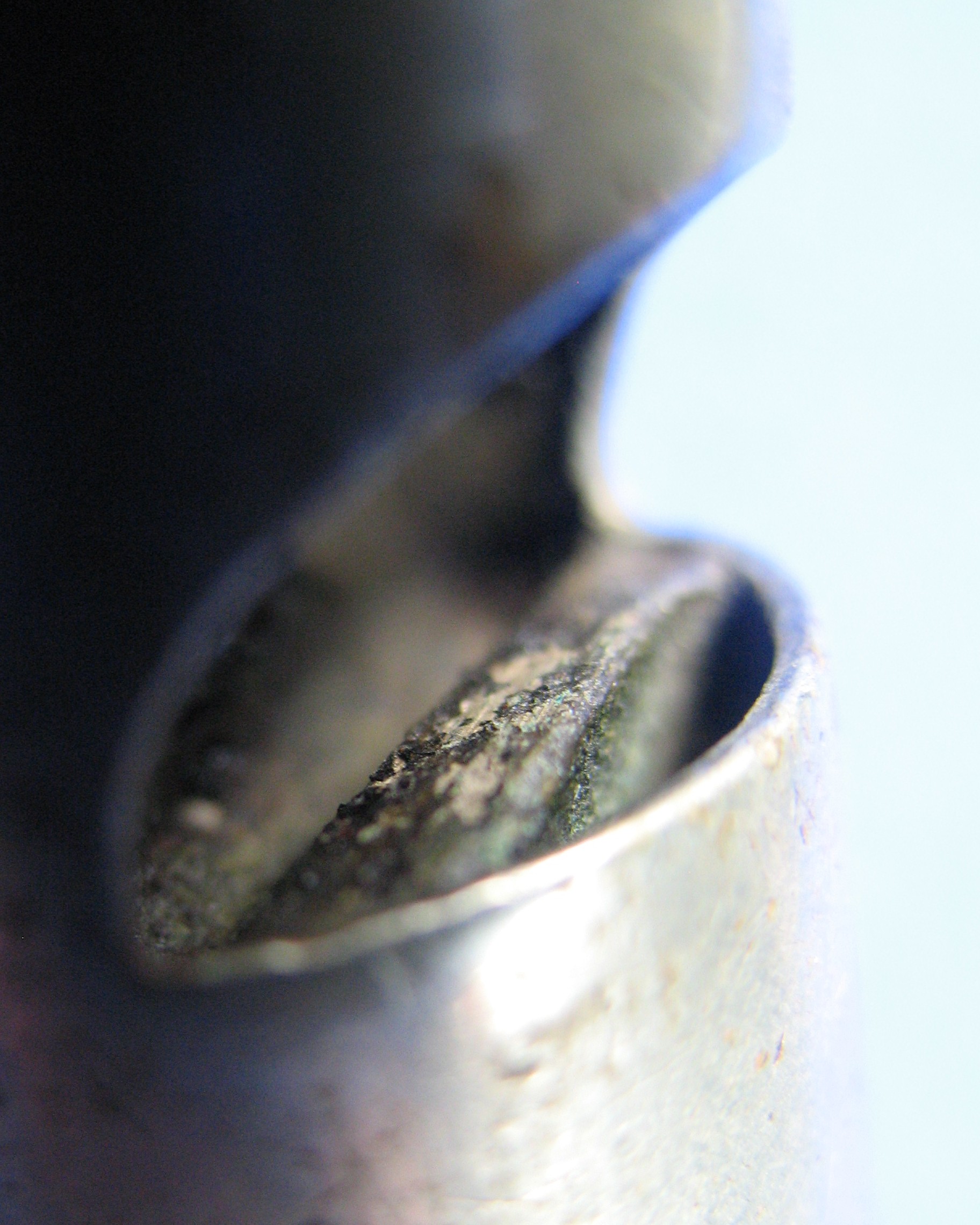
The innards… yeah the inside of a whistle. No not how it works….well maybe, bot more importantly the desire to look inside, take the time to do so and then record what you find. Like peeling an onion only not as caustic.

The payoff ?? You become an expert at identifying your whistles. Even better ??  ……..  You get to learn all about nuance

Now what is that ????

tomorrow….

researching old antique whistles

one of the most rewarding things about research is that when you dig into it, you find out things that you just couldn't see before. Happens all the time for us when doing the SPOTLIGHT research.

How might this happen to you though ??

Well, it is all about discovery and that only follows knowledge. Ironic iisn't it ?? To be after knowledge,  but new knowledge needs to have a foundation to build on to add up to anything.

In other words, it doesn't matter to talk about a roof if you don't know what it means to clear the land, to lay a foundation, to frame a house —– for the roof to go on !!!

What do you think the earliest knowledge might be ??

First is what is a whistle –DER !!! Next ?? What is it made of ?? Next, What kind do you like ?? Hold on now something just changed !!!!!

You are now making choices from what you learned – first time 🙂 So now you can direct what you are going to learn.

Next you have to take in more by spreading out in your basic knowledge and again back to simple input…what kinds are there, who made them, what years , what uses….Plateau after plateau….

But here is where it drops off  —- unless you go deeper. Probably at this point you will start to become a student… ………………..scared ????   ………. a student ………

rare whistle oval windows

when researching rare antique whistles one comes across the most insignificant details. And yet are they worthless points ??

Take for example oval windows typically seen in Auld round whistles. Now who else made those windows ?? Could it be said that Auld was the only one ??

Noooooo !!!! As a matter of fact 🙂

Auld was indeed the first, but not long after that ( and we are talking UK only after all ) came Ward, then later came DeCourcy and then likely Hudson ( but only for the auld type rounds, they re manufactured after Auld shut down.

Ward made several and DeCourcy made even more. It would seem that Hudson made very few.

So what is the point ?? Nothing, Just sayin…

researching antique whistles

What’s a typical day in researching rare, old, antique whistles you ask ??

Well, today was only a half day, but here goes…

1) Close reexamination of steel knop escargots
cross examination of steel knop sirens

2) match up chain for complete nickel silver attachment and cross check
3) Close examination of large knop maker of copper escargots circa 1910
cross check against matching sirens
4) Deep study and note page of Israeli military/police handmade whistles circa 1930-50
5) Quick check of on line auctions for whistles around the world
Post blog, write blog for tomorrow. Check on line collections from other collectors…..

Good thing it was merely a half day….

whistle research

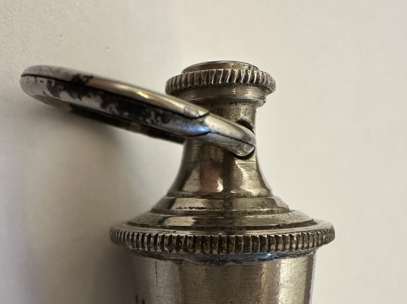
—–who would think that there could be so much to split rings — you know, those OLD steel, slim, very tensile  — split rings ??

Yah, been studying them further and further and further due to making sure that every whistle in the reference collection has a proper ring. That means of course matching up nickel silver when appropriate, brass when so and most ofte is matching up steel to the right kinds of whistles.

Interestingly , pewter usually has an old split ring ( but sometimes it is solid, yet still steel –and rusted )

MANY other whistles used simple steel split rings. I LOVE it when an old ring is worn smooth and is a dark charcoal grey, almost brown !! Then there are ornamental split rings –Did you know that ?? Me either !!! Do now though 🙂

Some are wavy like all around the split ring, some are filigree.

SO, I hunt for those too, so I can outfit my best old whistles with the best old split rings. Kinda rare to find though.

Such subtleties…who knew ??

whistle chains

Really, really into whistle chains as of late ( well, this morning anyway ) — SEE SPOTLIGHT whistle chains

Trying a new ( to me ) technique of soaking the rusty steel chains in molasses – weird huh ?? Seems to work though. I think I need to oil them or at least shoot some WD40 on them afterward.

Then it is mix and match !! Yah, tried to stay with the original chain for each whistle, but that was waaaaay too hard to maintain. Frankly speaking it was sometimes ugly. Beyond that it may have been an owner that attached a chain rather than a manufacturer.

SO… what to do ?? Rob chains from whistles that come in and reuse them. Some are just thrown out. Most find a home somewhere.

In the process one learns a lot about hooks that seem to have been ONLY for the whistle trade 🙂 Split rings come in all sizes, and many uses, so that is great. However those hooks are very ‘specialized’ in materials are specific too. Gotta match up nickel silver or plated over brass or even oxidized paint that LOOKS like brass over steel, It goes on and on.

Then there is the shape of the hook, which dates it pre WW two or later — yes there is a large difference !! I am beginning to recognize manufacturers hooks !!!

But the real challenge is in the chains. UK whistle chains were manufactured in much more variety, However there are some very distinct USA chains — we are talking about the shape of the individual links right ?? Sorry, may have left that out.

LOVE nickel silver
LOVE old steel
LOVE brass
LOVE copper

well now what else is there I have been missing ??? I’ll have to go look….

whistle history

To find out the connection of the whistle you have — to the manufacturer, their location, their length of time manufacturing is a real pay-off. If there is a patent to match up even better. If it is previously unknown model even betterer. If, well you have the picture.

HOWEVER, the wait can be painful. Not the hunt mind you, that is almost as fun as finding the actual whistle !!!

BUT, it takes time to dig and dig and…

First you have to see what you are looking for, then get the whistles, then study them, then research them, whew, I am tired just thinking about it all…

….been on the trail of Frankfort…Colsoff….American whistle….They are all connected. Gotta admit to not being altruistic about this. None of the whistles are great in anyway…

Well, except those interlocking teeth around the barrel sides and the fact that circa 1920 there was a series of escargots with interlocking teeth–much more professionally done though. And THOSE I really want to unearth who made THEM.

Not like these smallish escargots with blunt over sized teeth….yet they are teeth and they do interlock …..ARGH !!!!! Is there a connection ??????

On the other hand there have been a couple other whistles made with the same manufacturing technique that were from other countries — made out of the USA ??

still….

whistle spelunking in concaves

concave fipples 012

Digging for information long past on whistles is slow and difficult. Might seem that it’s simple huh ??

Take for example an area we have been pecking away at…

CONCAVE fipples in round whistles….. Yah, pretty obscure huh ?? We agree !!!!

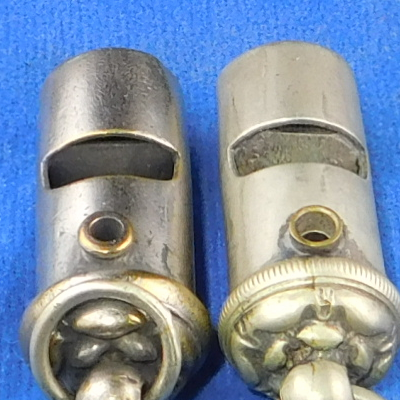
However in several round whistles in the reference collection, the fipples are indeed concave and that might point to a different manufacturer than normally would appear on the surface. Or an identifying mark for one we did not know of.

What to do ?? Well one thing is to look for a whistle with a concave fipple and a makers stamp of course 🙂 —-  No brainer there right ?? No such thing yet either 🙁

What else ?? Perhaps a distinct manufacturing feature or even patented feature of the whistle in another part of the manufacturing of the whistle ??

In any event another feature has been unearthed ( not yet presented in a SPOTLIGHT  though ) Here we touch on it for the first time.


There were over 300 page loads on the website yesterday !! It is possible that enough enthusiasts can connect in such a way that we all can benefit. Posting here on the blog then becomes another way to share and learn as a group.

Now we ARE getting somewhere……….

Any ideas ?? concave fipples ???

plural whistles

one of the most innovative whistles EVER has got to be the so called Hatch plural whistle— filed for patent  Sept. 16, 1901. WOW !!!! Not just a plural, but a three way plural whistle. !!! Check it out >>> http://www.google.com/patents/US696814

Instead of the windows being on the sides like we are used to seeing in the classic police style whistle that is tube shaped, it is perpendicular to the mouthpiece !!!!! Is that cooooool or what !!!!!! You don’t see THAT kind of new approach every day do ya ???

( Check out the article on plural whistles in SPOTLIGHTS to see what I mean )

Interestingly enough, this patent came 7 years after Bent and Parker came up with the idea in the UK.

Hmmmmmm……. interesting to say the least…… Not so new and innovative after all ?? Well it certainly was ‘over there’ 🙂

Check it out >>>> http://worldwide.espacenet.com/publicationDetails/originalDocument?CC=GB&NR=189410828A&KC=A&FT=D&ND=3&date=18950330&DB=EPODOC&locale=en_EP

Gilchrist points out in his book that it was an 1894 patent, but it wasn’t till Stephen Van Dulken dug it up for us all that we could confirm the chronology. MANY THANKS Steve.

Check out his blog >>>> http://stephenvandulken.blogspot.co.uk/

So much to learn about whistles 🙂

TWG


whistle patents

here is a subject(s) for explanation, study and exploration.

Patents. Wow the whistles that can be revealed there. Types, models, designs. dates. makers

Then there are different countries Patents

Then there are hallmarks

Then there are Registration designs

Then there are Lozenges

Whoah…