researching collectible whistles

well, only one more day till the latest SPOTLIGHT !!! What could it be on ???

How about a hint     ðŸ™‚ 

Better yet a riddle !!!!!

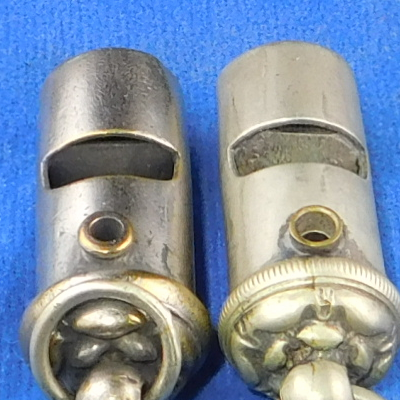
You can't talk with them, but they are not good kissers either. In fact they are toothless and without gums. Turns out they are triplets too, at least for the present.

What can the new SPOTLIGHT be on ???

Just a few hours…..
 

antique whistle research

SPOTLIGHT ARTICLES

let's see now…

1.5 hours taking pictures and photoshopping the lint and wrinkles out of the back ground and then cropping them for loading up to the articles.

2 to 4 hours researching

2 tp 4 hours writing and placing pictures

1 hour loading article to website….

on average a full days work for each article….

just sayin….

beaufort whistle

The beaufort whistle gets little accolades.

Why is that ?? Just too conical ?? Or plain Jane ?? Can be I suppose.

Or maybe we just haven't seen enough of them.

It has been said that when the Metropolitan was being promoted that beauforts were accepted as trade ins. Not all fell for it, like the Liverpool forces for example. But apparently many did. So then they are a bit scarce.

Well, except Liverpool understandably so.

However, not every beaufort is generic now are they ??

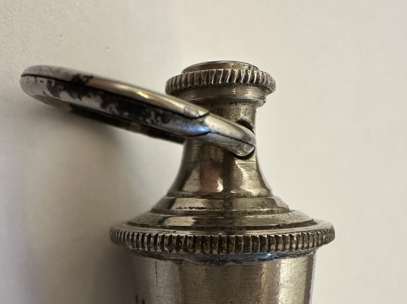
Just add a decorative knop and a whole new image develops — around who used those knops??

Add to that a creative cast mouthpiece or even one that unscrewed for cleaning and WOW !!! Now you have a vintage amazing whistle !!!

Perhaps made of pure nickle silver too ??? And those LARGE beauforts really are outstanding don't you think ?? Haven't seen many ????.

Could this have anything to do with the belated SPOTLIGHT ?? Hmmmm…..


rare, antique whistles

Time to take a break from all the deep motivations and weaknesses that can lead to buyer's remorse !!!

Yup, only a couple days till another new and fresh SPOTLIGHT post. Isn't it great to see every month an article for free on our favorite subject ?? ( i.e. antique, rare, vintage and collectible whistles ) Our target is whistles prior to 1900, but sometimes we just have to go post 1900 🙂

So, what will the next SPOTLIGHT be on ?? A hint is ….  the largest category of whistles….. Now don't jump to any conclusions !!! I said it is a 'hint'

What is fun is this — where else can you go for regular reliable information on vintage whistles ?? And the more you spread the word about the site the more motivating it is for us. After all what do we get out of it all other than the satisfaction that our efforts are doing some good somewhere ?? When we started collecting it was just the three books. Then a few friends were met and connected with and we learned as much with them as we did from the books !!! So in return we try to post everything we learn. And writing the articles actually forces out new information for everyone.

For example, right now we are researching and writing and article that before long 'morphed' into FOUR articles !!! So for now, article one is being finished. That will take at least another month as it turns out. And the other three ?? well, they too will take time throughout the year.

Of course there are other articles. We could post them sooner, but, well, truthfully it becomes a burden and no fun. This way we can keep going or even take breaks for a few weeks…wow, a break….hmmmm…..


whistle research

It would seem that after 5 years of really, really collecting and researching antique hand whistles that things would be winding down by now.

In fact the opposite is happenings. More to learn than ever before !! HOW CAN THAT BE ??

It’s endless. The scary thing ?? Very few countries have been tapped into. Each country has it’s own idiosyncrasies that manifest themselves in the different whistle designs

Back to my discussion or I will keep slathering on some new vector….

Just in the last few weeks are some study examples ….

A whistle from Australia found  to tie into a SPOTLIGHT on Ward ( from the UK )
A whistle from France with a compass on top.
A whistle from Israel related to the Hagana.
A whistle from the USA unknown maker, (been waiting for this one for 5 years or more and it surfaced )
A whistle from the UK that uses buttons, but with a much more solid construction than normally seen on these type whistles.

Add to this a closer look at Japanese escargots, mostly overlooked, as they seem cheaply made.
a closer look at a group of USA escargots ( maker unknown ) —  with very clear identifying characteristics.
a closer look at ….. ad infinitum…..

gotta run…

whistle SPOTLIGHTS – micro studies

thought it would be fun to add yet another SPOTLIGHT category !!

How about this — studies in just a small area of collecting ?? — SPOTLIGHT – micro studies

What might this be ?? Well, not a single whistle, that is new to the collecting world — that would be waaaaay toooo small a subject, almost nano size. Just the nature of it you know.

Aaaaaaaand it couldn’t be a REGULAR size SPOTLIGHT now could it ?? Already got those huh ?? Der…. Soooooo it must lie somewhere in between.

What would be its purpose ??
How might a study like this work ??
What benefit would it be to the collector ??
How would it be classified and searchable ??

These and other questions will be ‘revealed in their own good time’ ….. shhhhhhhhh — that’s right another surprise !!!

Workin on some as we speak….well as you read anyhow….

Gotta keep you sharp….

vintage whistles – steel and brass

well, now this SPOTLIGHT really took a lot !!! Not just the writing though. BUT yeeeeeears of collecting.

I mean who else but a whistle geek would search everywhere for combinations of steel and brass whistles from the early 20th century ??

Then taking all the pictures, photo shopping out all the lint from the background, cleaning the whistles from dirt and rust–but not toooo much to ruin the patina.

Then there is the thought that goes into them. What qualifies and what doesn’t ? Which to picture and which to leave out.

Oh, I know — just whistles right ?? Yeah, guess so.

Then again all the activity on the web page says that there are other whistle geeks out there.

Now the challenge is where to find them there steel and brass whistles ….

bell whistle new discovery

sorry to double dip, but can’t help but talk about the SPOTLIGHT  special edition in today’s posting !!!

WOW !!!! Do you realize what an important whistle this is ?? And the best part ?? It was an accident finding it. Just goes to show you how important it is to take chances and pick through whistle lots.

In fact there was a group sale on eBay today that would have been terrific to get, but too much going on and missed it. There was a cool one right in the middle — oh well can’t get them all !! AND there are so many surfacing everyday that there is plenty to write about.

Anyway back to the bell whistle — fantastic. Now there is an article to study well and you get it for free !!!!! What kind of follow up article will there be ?? And what might it contain ??

Will just have to wait and see…

research whistles

the Agony and the Ecstasy written about Michelangelo might be a far stretch about whistle research. After all it isn’t art we are creating is it ??

However the title fits !!

Yeah, searching is great when it pays off, but miserable when it fails to produce.

For example, been trying to find for years anything on the plural whistle PATENT 10828 by Bent and Parker dated 1894 ( Gilchrist )

We have the whistle with the actual stamp on it and still can’t find it !!! Argh !!!

Perhaps it was just stamped on it and they called it ‘protected’. More likely a patent was taken out and then it wasn’t followed through on and dropped. Otherwise how would Gilchrist have been able to date it to 1894 ??

In the USA all patents are relatively easy because of Google patents — great to look through !!!

However, for us dummies ( like myself ) searching UK patents presents a challenge….

I know….’just keep swimming’, ‘just keep swimming’…..


wiki research


wiki has become the fast food of research. Anyone can contribute and even though original info is taboo, it happens. Here are a few notes under whistle on Wikipedia :

Joseph Hudson set up his business in Birmingham in 1870, with his younger brother James. Around 1875, he designed the ‘Acme City’ brass whistle. This became the first referee whistle to be used at football matches during the 1878-78 Football Association Cup match between Nottingham Forest and Sheffield.’

Hmmmm…. since nothing is known about Hudson’s whistles prior to his breakout whistle contract of 1883, this would be a BIT inaccurate !!! In fact it isn’t even literate. Besides that ACME CITY was registered in 1907 – what would that be about THIRTY years later ??? THREE DECADES !!!!!!!! ——Just poke a sharp stick in my eye !!!!!

Worse yet it goes on …

‘In 1883 he began experimenting with pea-whistle designs that could produce an ear-splitting noise that could grab attention from over a mile away. His invention was discovered by accident, when he accidentally dropped his violin and it shattered on the floor. Observing how the discordant sound of the breaking strings travelled (trill effect), Hudson had the idea to put a pea in the whistle.’

OMG !!!! Really ?? A pea in a tube shaped police whistle ??? ARGH !!!!!! Help !!!!!  Have you ever seen a pea in a tube shaped whistle ?? EVER ???? …………..It only gets worse. Sorry I can’t read on anymore…

What’s the point ?? Research takes time and we can’t take wiki short cuts. Sometimes we just have to put things on hold.

So spread out and get several projects going at once. Have as many whistles to study as you can. Keep extensive notes and don’t rely on your memory !!!