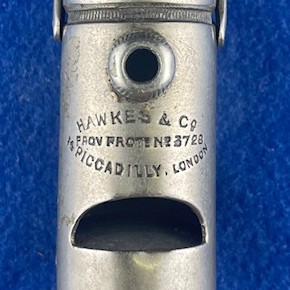
tin litho whistle

colorful and varied, tin litho whistles are really fun looking. They are pretty cheap for the most part too. That really helps if you are a whistle geek and yet on a budget. They aren't too big or cumbersome, but displaying might be a bugaboo.

I imagine one could collect hundreds without doubling up. Many are Japanese, but identifying makers would be a nightmare !!! Probably just stick with designs and colors. They are of course steel and not tin.

Here's a link for that enigmatic shortened name 'litho'

http://www.virtualbargains.com/home.cfm/page/Articles/Article/3.html

Do you think clickers would fall into here ??? Oh, yeah….
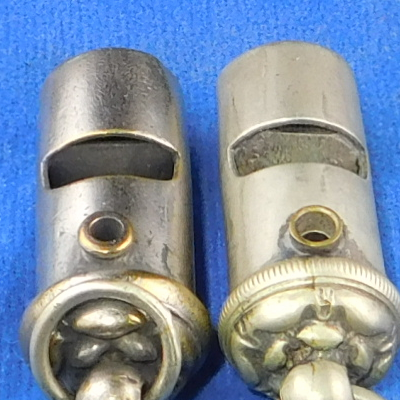
whistle auctions too

Another pertinent question that follows yesterday is…

"does one use a gut feeling, respond to the rush or just pick a figure and hope:

The gut feeling you will use for all the decisions we discuss today. Responding to the rush is another decision right ?? Do you want the whistle so much that you would be willing to pay more than what you feel it is worth and indeed above the current 'market price' – can you live with that feeling ( often called buyer’s remorse ) afterwards ?? Indeed auctions have a special chemistry that can go south on you in a hurry !!! ( Or do you say down under that things can go north ?? )

Picking a figure is the most important thing if you decide to fish in these fishing holes. You have total control that way and are not persuaded to overspend. Does your wife agree with your budget, is it free cash or needed for other things ?? If the hobby becomes more important can you shift directions and sell off other 'interests' and re use that money ??

I know you probably know all of this, but there is a tremendous amount of psychology involved in why people collect. One really needs to get to the root of THAT and then determine where to go with one’s life….or not….

whistle auctions

recently we received a few questions that perhaps you have been thinking about ??

"is there such a thing as a "retail" price for 'antique' whistles" ??

Great question Bob. However retail is quite subjective.…you asked several  questions though, and they are ones that never go away and even haunt you after your purchase. It is the battle of all collectors. Let’s deal with retail today.  In the end it is almost always price first to deal with.

Price  –  if one can afford it
Price  — if one feels that it is so important whistle that they reach for it anyway
Price  —  if one forgoes others to meet an overall personal budget
Price  — if it is an investment

I repeat,  retail is subjective. If it goes to an auction house like Christie’s or such it can go quite high, but does that set the retail price?? Hardly. If it sells off my website it will have a higher price on average because of my costs and expertise identifying the whistle, maker, etc. Also I have my costs involved maintaining the site. At an antique booth or boot sale in the UK one finds better prices.

Perhaps a seller on eBay or other on line auctions knows the rarity and won’t budge. For example a TANK acquired recently, established what I would call retail – for now anyway.

As always, SUPPLY  and  DEMAND  is always a huge factor !!!! Most people have little interest in whistles. But now move into an arena with a small cirle of collectors and the playing field has changed !!!!

I think that perhaps you are wondering if there is a relative value and the answer would be yes, ( with provisos ) I will try to give you a relative scale I find has developed over the years I have been trading within.

Common – up to 50 dollars
Scarce  —– up to 150 dollars
Rare ——– up to 300 dollars
V.Rare –—  up to 700 dollars
?? ———-  higher

So one needs to decide where the whistle falls and then the other factors set in that we will address next visit.

Still uneasy ?? Welcome to my world….


rusty whistles

The next best thing to steel is perhaps sheet metal steel. Heavy steel whistes are very hard to beat and I'm not saying that sheet metal ones come very close in comparison. However, we do love steeeeel don't we ????

How do you deal with rust on them ?? On a heavy one you can use a wire wheel or better yet a brass wire brush. However sheet steel is too thin for that. Well, perhaps a softer brass brush would work. Steel wooooool works OK for me, and I also use WD-40, which is a solvent. I even soak them in it for a few days. Love the way it darkens them and am almost addicted to that smell of whistle cleanliness πŸ™‚

It may be impossible to remove rust that is on the inside of the whistle but the WD-40 might stop its progress somewhat. Just got to be careful not to scratch the whistle in the process is all.

Not too much of a problem for us here as these kind of whistles are usually dated too recently to mess with, but when looking outside the common whistle digs one does come across some keepers. Good to know anyway…..

signal whistle

Just can't get off this subject of grey metals used in whistle makes >>>>  when we usually see brass or nickle plated brass whistles.

Here's another…..

Pot metal, also known as monkey metal, white metal or die-cast zinc, is a colloquial term that refers to alloys that consist of inexpensive, low-melting point metals used to make fast, inexpensive castings.

There is no scientific metallurgical standard for pot metal; common metals in pot metal include zinc, lead, copper, tin, magnesium, aluminium, iron, and cadmium. The primary advantage of pot metal is that it is quick and easy to cast.

Qouted from wikipedia…

I see this used a lot on German whistles with the stamp Signal on it. You know I used to think that it was a whistle used for signalling and that was why it was stamped on it that way. And it may well have been true. However that is not what the stamp itself means.

Turns out a whistle manufacturing company in Germany named for Martin Signal made them !!! Beyond that we do see a LOT of cheaply made ones were produced. You can tell them right away from the knop —-  as it has a slightly raised shoulder and squat round knop.

The cheap ones are a dime a dozen. However one might take note that mixed in we also see nickle plated brass ones that are quite well made I might say. So look closely and see if you can spot the difference, otherwise you might pass right over and miss a great whistle — albeit another escargot πŸ™‚

D.R.G.M. whistle mark

Curious about the initials D.R.G.M. ??? Ya see 'em on German whistles sometimes.

Registrations are different than patents. Some interesting reading about it at the following link…

http://www.porcelainmarksandmore.com/resources/vocabulary/drgm.php

I like the part about poor mans patent !!!! Just received a cheaply constructed whistle from Germany with that stamp and thought you might want to take note of it ( saved here anyway ) —- you know, for your records…. helps in dating them too.

Hmph…cheap whistle construction….at least it has a stophole πŸ™‚


grey whistles

we're staying rather focused right now on this subject of alloys and other grey whistles, well admittadly obsessing. What's in 'em anyway ????

spelter — zinc with something else like copper — so it is an alloy
pewter — tin ( mostly ) with something else, like copper, antimony, silver and others, —  so it is an alloy
brittania — less tin and more copper or something else, — so it is an alloy
zinc — an element. Brass is made from it and copper. Sometimes called spelter.
antimony/lead — two metals mixed as an alloy
lead — and lastly ….

Lead is easy — lead !!!

just a few more notes to unconfuse us a little. Remember don't put those lead ones in your mouth πŸ™‚

ZINC METAL WHISTLES

got caught up thinking about zinc now. Obsessing really….

confusing kinda ?? Can be a little…all because of zinc —- and those other metals that are all grey too, so got to thinking about it and well,

spelter
pewter
brittania
zinc
antimony/lead
lead

ALL were used to make whistles !!! However our special area of interest  tonight issssss….yes ZINC !!!! Here are a few bits of trivia to chew on…..

Cast zinc is brittle when cold. Heated to 200°, it is ductile as well as malleable, and may be rolled into sheets retaining these properties at that temperature; while, if the temperature be allowed to exceed 400°, the zinc returns to its original condition of brittleness.

Zinc does oxidize more easily, that's why steel is plated with it. The zinc nearest to the environment, the exposed surface, oxides, and this oxide forms a protective layer for the rest of the zinc and the steel. The same principle would work with steel as well, but for the fact that iron oxide, rust, flakes off all to easily, exposing fresh metal

— exposed to the atmosphere, pure zinc reacts with oxygen to form zinc oxide, which further reacts with carbon dioxide to form zinc carbonate, a dull grey, fairly strong material that stops further corrosion.

The easiest alloy to cast, it offers high ductility, high impact strength and is easily plated. Zinc is economical for small parts, has a low melting point and promotes long die life.

When molten zinc solidifies it expands somewhat, thus giving perfectly sharp castings

………..pennies are made of zinc with a copper coating.

So for now let's say circa 1920-40 on zinc escargots  ?? Certainly would like to pin it down closer but for now at least here is a starting point πŸ™‚ Ironically as cheap as they were made, they could become more valuable with a little extra attention….


zinc escargot whistle

Got an interesting enquiry about a zinc escargot whistle yesterday. It is stamped Thunderer and has a V top. The insert to the mouthpiece is brass as well as the V, but the main body is zinc.. One of those whistles that is rare but not worth much ?? It has Tryon stamped to one side. — A sporting company from the states.

It's in More Whistles on page 25, but stamped differently as Officer's Call.

So anyway, it reminded me of one in Whistle Notes ( I know, haven't posted it yet ) out of Jim Fitch's collection. Same whistle again, but with Thomas E. Wilson stamped on it. — A sporting company from the states also.

These whistles are not common and rather cheaply made. Apparently not helping their survival rate at all !!! However that is not what is so interesting. In this case it is the stamps.

Gilchrist states that they are circa 1930s, yet Tryon was merged about 1931 ?? Beyond that Thomas E. Wilson stamps were much earlier ( circa 1920 ?? ) They quickly changed to just Wilson.  

So a conundrum exists now !!!

It's great questions and subjects like this that lead to uncovering delectable morsels of whistle trivia.

teether and rattles

As you may well remember from my whining, I am no great fan of teethers and rattles and of course with whistles incorporated into them. However there have been some great designs in their history and they are quite international. And they date quite a ways back in time tooooo.

But just so you know I keep an open mind…… check out these listings on eBay !!!

290840019650
290840011670
290840026156
290840036110

Now granted were looking at over 12,000 dollars, but hey, it's just money right ?? Of course thats merely asking prices and probably u could get 'em for half πŸ™‚

Now on the other hand those escargot whistles aren't looking too bad after all now are they ???????