Whistory
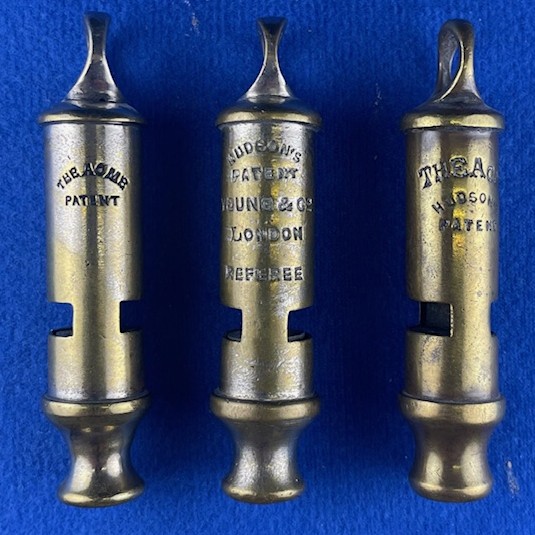
Some Hudson ‘whistles never put into general production’ is written on page 41 of Collecting Police Whistles and Similar Types, along with a picture of four whistles. How early were they made and at what address one wonders? Were there others? Why were they never released? These are unanswered questions.
Hudson Experimental Whistles: What Makes Them ‘Never Put Into General Production’?
From Martyn Gilchrist’s records retrieved, along with Simon Topman, we understand that Joseph Hudson started working at 12 years of age (unknown where).
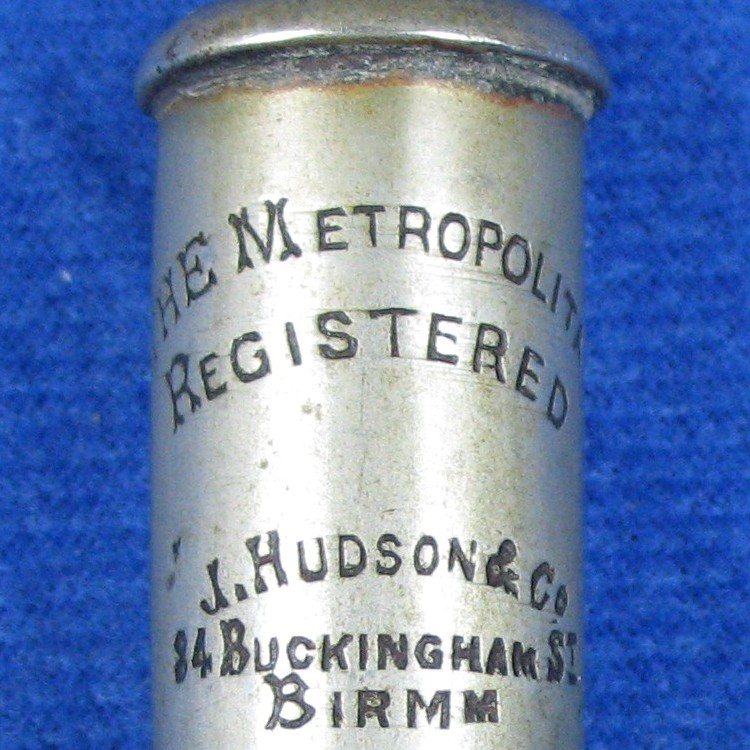
He then worked in the 1860s at Bent and Parker where he learned how to make whistles. Striking out, he apparently started out on his own by 1870, thereafter moving to a house at 7 House, Court 3, Bell Barn Road circa 1871. He progressively moved to 17 Mark’s Street in the St Mark’s Cottages, staying there until 1882, when he moved to 84 Buckingham Street close to the Jewelry District.
What History is Missing from Hudson’s Early Years?
The question begs to be asked, —- what whistles did he make in those 12 years prior? Collecting Police Whistles and Similar Types also notes that he made hand crafted whistles and corkscrews there prior to 84 Buckingham Street. Only one whistle has surfaced with St. Marks St stamped on the whistle.
The challenge comes to identifying whistles made by Hudson in those early years. This amounts to a 12-year period. Over a decade of whistles only a few identified to that period. As of this revision research into the Hudson archives confirms whistle made by Hudson gong back to 1870 and even at Bent and Parker. (Topman)
Pictured in Collecting Police Whistles and Similar Types are ‘whistles never put into general production’, especially the ones at the top of that page are our interest. Gilchrest and Topman date these whistles circa 1900. Interestingly though, these he states in his side notes had cast diaphragms. This would seem late for using this method, possibly pointing out earlier production.
Hudson Dating Clues: Cast Parts, Windows, and Top Caps
The whistle on the left shown in the picture, page 41 in Collecting Police Whistles and Similar Types‘s came up on auction, but unfortunately, we could not get it at the time, along with the others. Additionally, another remarkable whistle came up that had the windows at the top of the whistle tube towards the knop under the top cap, however no ring. It appears to be another early Hudson. We will include the original auction pictures and ask for picture credit (although poor resolution) to examine these more closely.
We re-created the picture from Collecting Police Whistles and Similar Types and added an additional similar whistle.
Whistle Classification
| Type | tubular |
| Maker | Hudson |
| Category | civil railway |
| Material | nickel plated brass |
| Features | circular window high placed window |
Whistle Archeology
No record of model numbers is recorded in a Hudson catalog. Page 41 of Collecting Police Whistles and Similar Types. Describes four whistles as ‘never put into general production’ (top picture). How many other whistles like these are not described, but at least one has been added below.
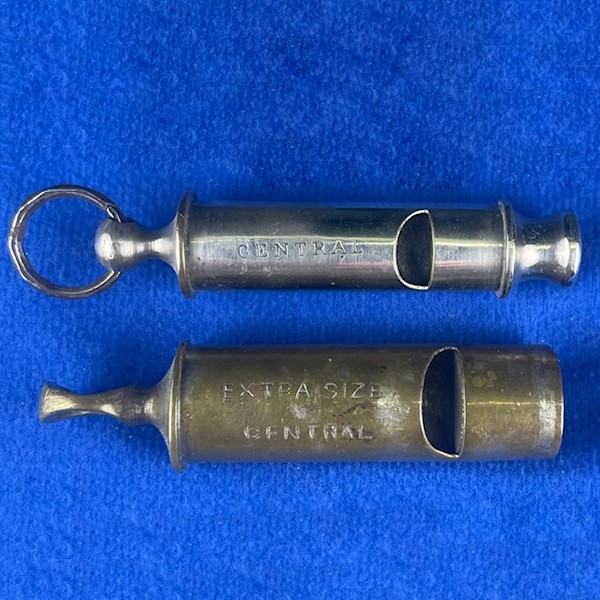
More whistles are pictured (lower picture). The left Kinglet resides here at the reference collection, but no others have been recorded. The center whistle model 51 ½ at 106mm was released as well as the Hudson made ‘Coney’ model to the right.
Whistology
First, we will look at an overall picture posed just like the book, including the addition.
Then, we will look at each whistle individually for close examinations and derive some conclusions in our research.
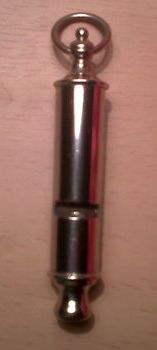
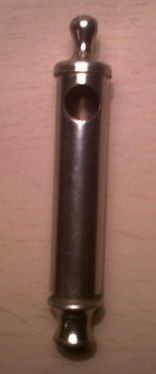
Left: “figure one”; Right: “figure two”
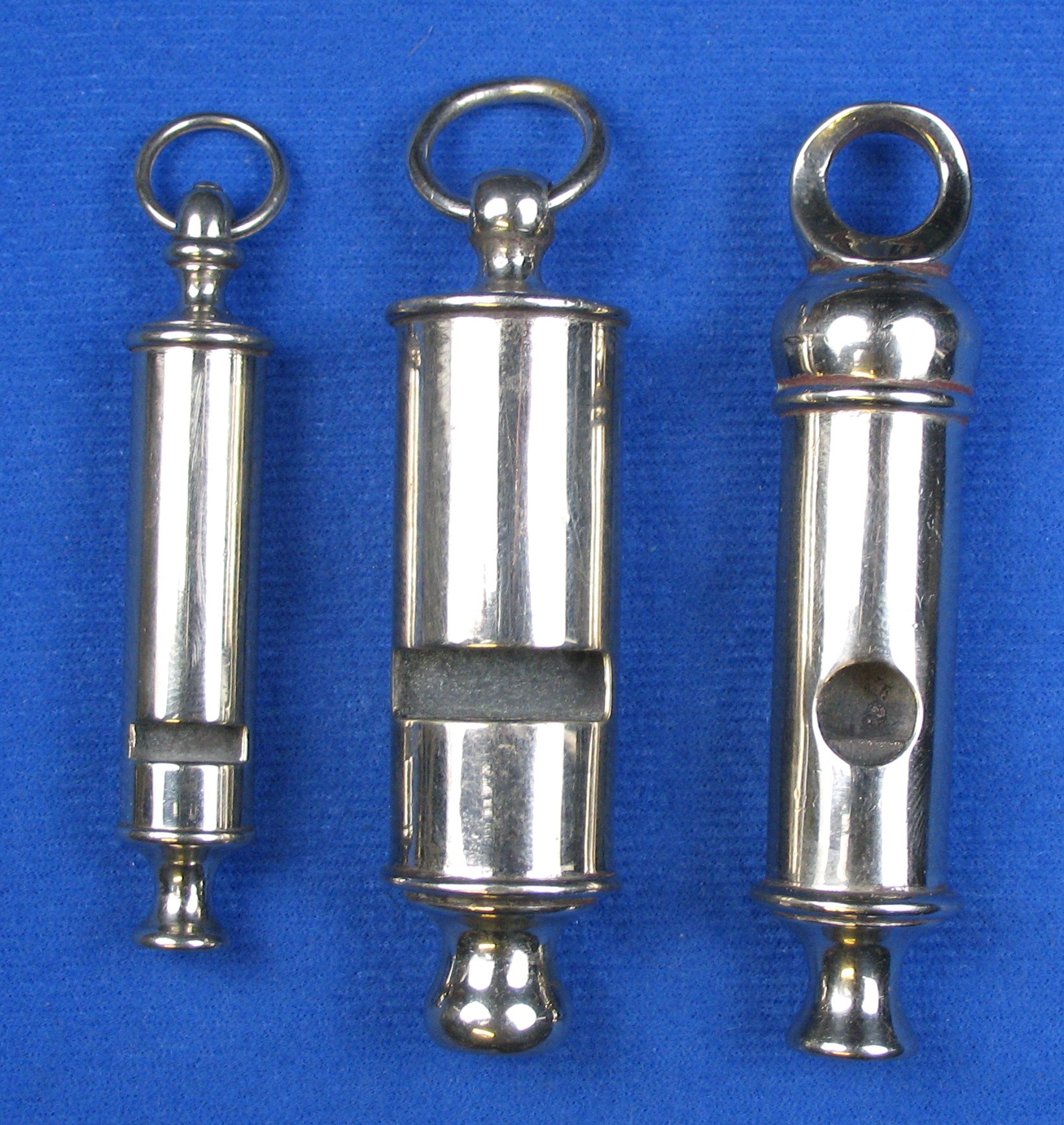
Immediately you can see that there is a similarity in a period of workmanship, to these whistles. The other two mentioned above also match this period and style. Comparatively you can take in the size differences in the middle, (blue background).
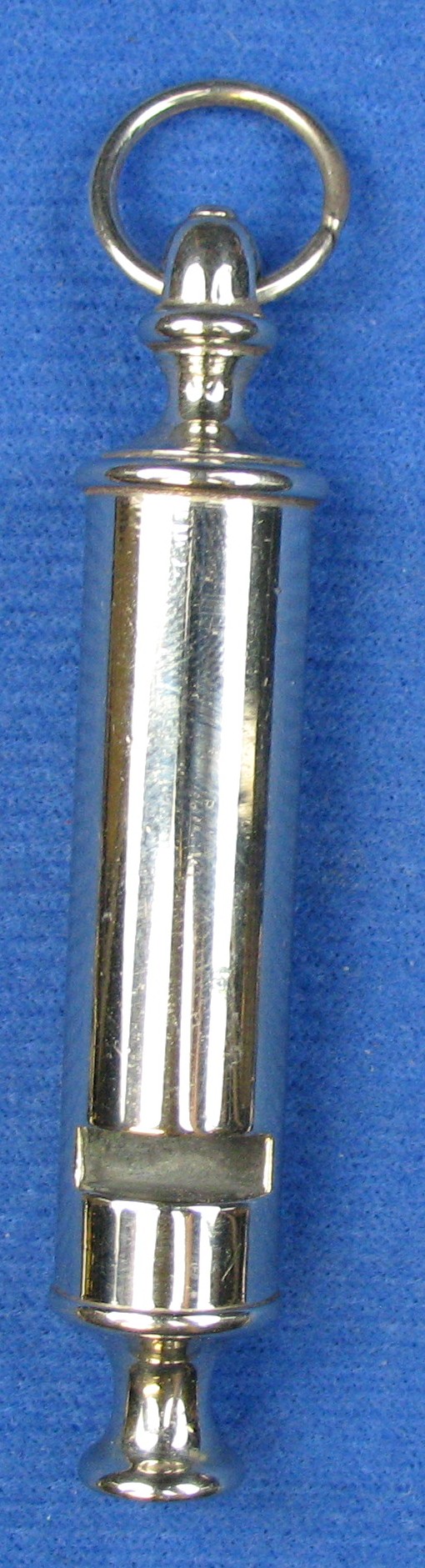
What to look for in the first ones are that they are very narrow — unusual for Hudson whistles until much later in production. They are very high-quality whistles. The first top knop is very close to Barrall whistle tops, used on heavy duals, tubulars, conicals and rounds. Nevertheless, neither seen again on Hudson whistles.
On whistle number two, the cap attachment is set back with a slight reveal and inset edge, also exceptional. Beyond that it has a tall knop. Gilchrist/Topman reports all these as circa 1900. We can only assume that this must be from the records at Hudson’s. Otherwise, the influences and styles speak of an earlier period, not to mention the materials being cast top, inside parts and mouthpieces.
Without the first whistle on site, we must focus on the second whistle interior. Consider the mouthpiece being cast. It is also long for such a small whistle. The inside is well crafted and smooth, and the disc is cast, which would point to an earlier period. This would not match 1900, but brings us back to circa 1885, or post, as cast parts like these were, for the most part, left behind by 1885.
The windows are very low cut and just not seen on later models, nor any others for that fact, but effectively give the whistle a sleek longer look, even though more on the petite side.
Now let’s move on to the remarkably wide tubular whistle. It is a bulky whistle. It is not as heavy as it looks, but rather light. The ring is soldered closed, usually a sign of a better-quality manufacturer and this one does not fall short.
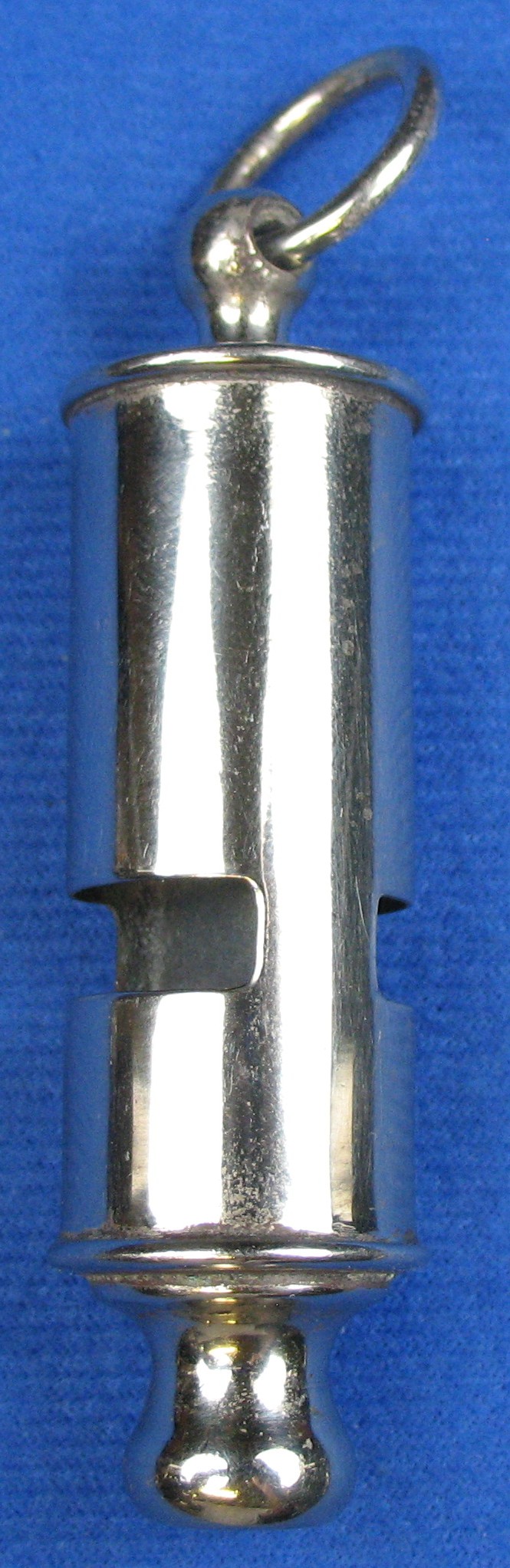
We see a rather simple round knop. Round knops were seen in the late 1800s by Yates and Hudson and others. However, they for the most part went out of production by 1900, Hudson and DeCourcy being the exceptions.
Again, we have here a cast disc set against a partition. The mouthpiece is cast. However, the application to the body is set back with a most definite reveal to it, making it look like a ‘step’ to the design. Here we see some influence from Yates who was very active in the 1870s and 80’s. With the cast parts once again pointing towards circa 1890.
Next in line is the oval window tubular whistle.
The Porteous top is unlike Hudson Porteous type top, being closer to Stevens or later DeCourcy. However, it was post 1900 that Hudson had moved to two-piece tops.
The windows would date the whistle earlier than 1900, as the only influence we see here is from conicals which date from the mid-1800s or even earlier. (Since revising, Stevens has been verified as having used round windows.)
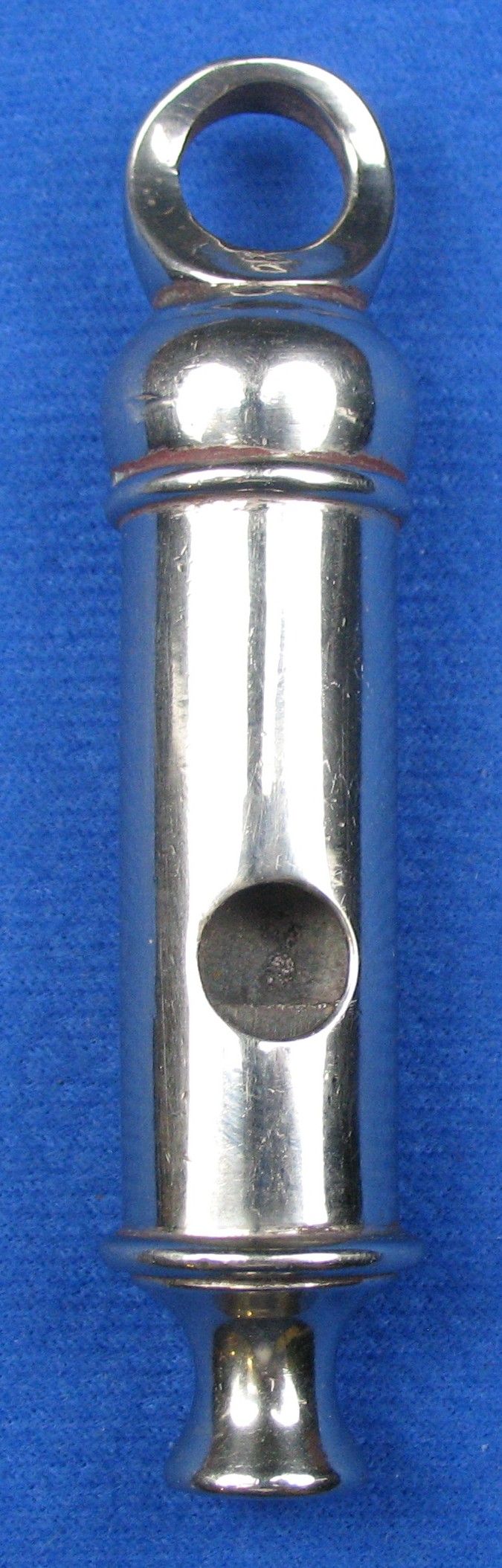
Now add to this the diaphragm being a cast wedge-like design. The application is done as a wedge, but it is flattened off when looking into the mouthpiece. Gilchrist matches it up to patent 435 in the KING whistles with the same design. That would date the whistle to 1885 or later.
Interestingly, Coney, Stevens and Bent and Parker all produced whistles with the word PATENT stamped on them and no patent filed can be found. The KING whistle designed by Hudson can be found with PATENT stamped on it, —- but having the common wedge inside.
Were there so many KINGS made at that time that old parts were being put into whistle bodies stamped PATENT?? Not likely. Few KINGS can be found as it is, made almost to order. And they do date clear back to 84 Buckingham Street times.
Add to this that the disc is cast, quite thick and no tines are attached to the partition for soldering and stability to the sidewalls, the main reason for the improvement to replace the ‘shaky’ Metropolitan designed partitions and discs that came loose. Apparently, Hudson flattened the wedge only and did not add tines for the Kings and this whistle.
Lastly the upper window GSW appears to be experimental and did not go further in production. For whatever reason it did not pan out. The top cap overlaps the top tube, the mouthpiece may or may not be machined rolled dating it to circa 1900 still.
Conclusions
- Influence by early manufacturers like Yates, and Dowler circa 1870-80
- Cast mouthpieces, — which went by the wayside by 1885
- Unique designs later abandoned (i.e. windows, step backs, tops)
- Very high-quality handmade whistles.
- Internal parts that were cast and abandoned by 1885
For these reasons, all these whistles appear to be closer to circa 1885-90. Perhaps more will surface and add to this section, hopefully there will be an even better window into this period.
Joseph Hudson’s ability as a superb whistle manufacturer is seen even better by whistles never brought to the public. Why they weren’t, is unknown. Made during the golden age of whistle making, they fall into the whistle ‘hall of fame’. Perhaps more will be unearthed.
TWG
Posted September 1, 2013
Revised September 12, 2020
Revised February 12, 2021
Revised December 30, 2021
Revised June 12, 2022
Revised December 2, 2025
Revised July 13, 2026
Bibliography
- TWG Reference Collection
- Collecting Police Whistles and Similar Types, by Martyn Gilchrist and Simon Topman, 1998.
- Birmingham Industrial Heritage R M Shill 2002
© – All photos with blue background property of The Whistle Gallery reference collection. Please contact The Whistle Gallery for permission of use of any website content. Spotlight articles are copyrighted. Please contact The Whistle Gallery for permission of use of any website or Spotlight article material written or otherwise. Use of photos without authorization is prohibited.


 Users This Month : 2336
 Total views : 184641